
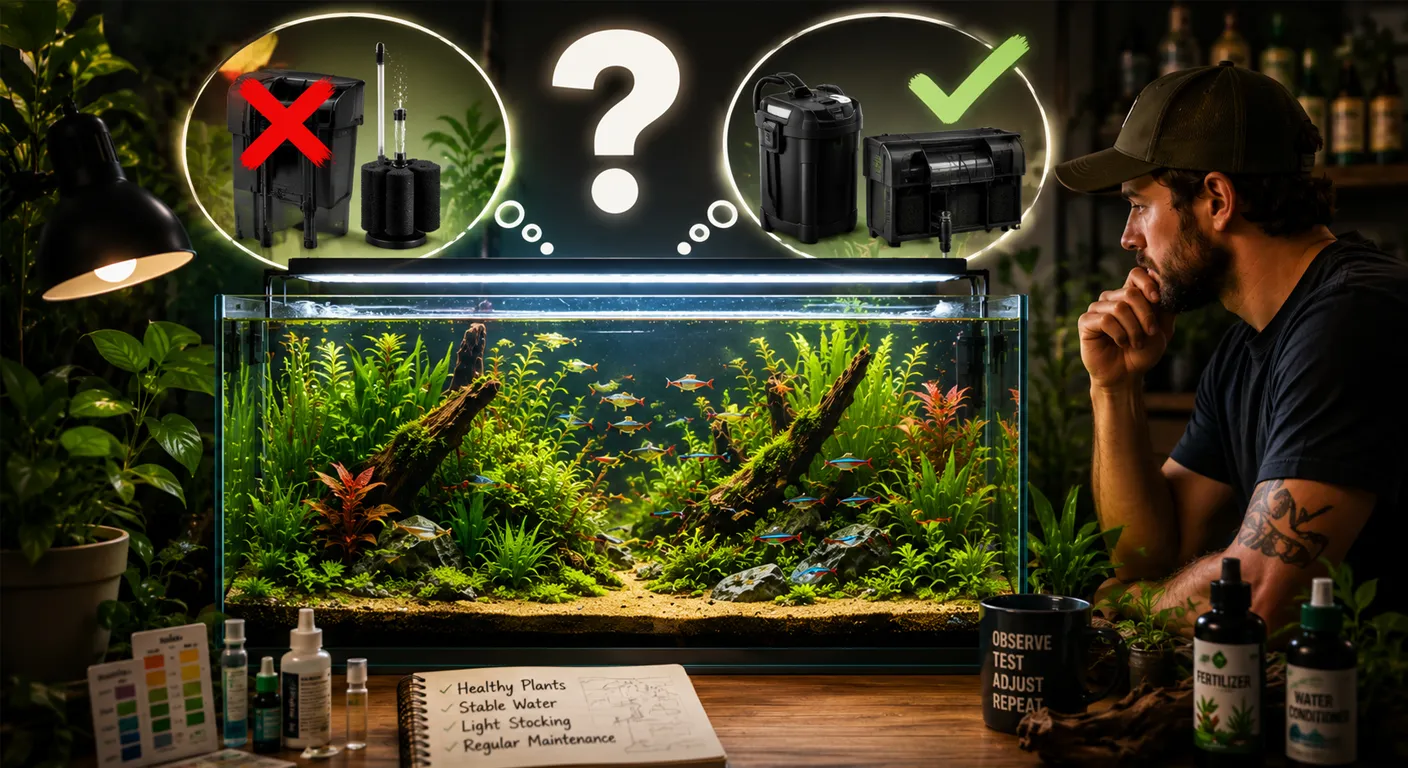
A hobbyist once spent several weeks setting up a densely planted aquarium. The water stayed clear, the plants grew fast, and the fish looked healthy. Naturally, it raised the question: if the plants are handling most of the work, why bother with a filter at all?
The short answer is that most planted tanks still benefit from one. Live plants do absorb ammonia and nitrate, but that does not replace the debris removal, biological stability, and water circulation that a good filter provides. Understanding exactly where plants help and where they fall short makes it much easier to decide what your specific setup actually needs.
What Does a Filter Actually Do in a Planted Tank
Filters perform three distinct jobs, and it helps to look at each one separately rather than treating “filtration” as a single function.
Mechanical filtration is the most visible one. Sponges and filter pads trap uneaten food, plant debris, fish waste, and dead leaves before they break down and cloud the water. Even in a heavily planted tank, organic matter accumulates, and leaving it to decompose raises ammonia levels faster than most plants can keep up.
Biological filtration is where beneficial bacteria colonize the filter media and break down ammonia into nitrite and then into the far less toxic nitrate. This nitrogen cycle is the backbone of any stable aquarium. Plants do absorb ammonia directly, which reduces the bacterial workload, but they do not eliminate it. The bacteria living in your filter media act as a constant backup, especially when plant growth slows at night or during transitions.
Chemical filtration through activated carbon or zeolite is largely optional in planted tanks. Most planted tank hobbyists skip it unless they are treating a specific problem like medication removal or tannin discoloration.
What often gets overlooked is the fourth function: water circulation. A running filter moves water continuously, distributing heat, CO2, dissolved oxygen, and nutrients across the entire tank. Without that movement, stagnant pockets form near the substrate, CO2 concentrations become uneven, and some plants receive far less nutrition than others.
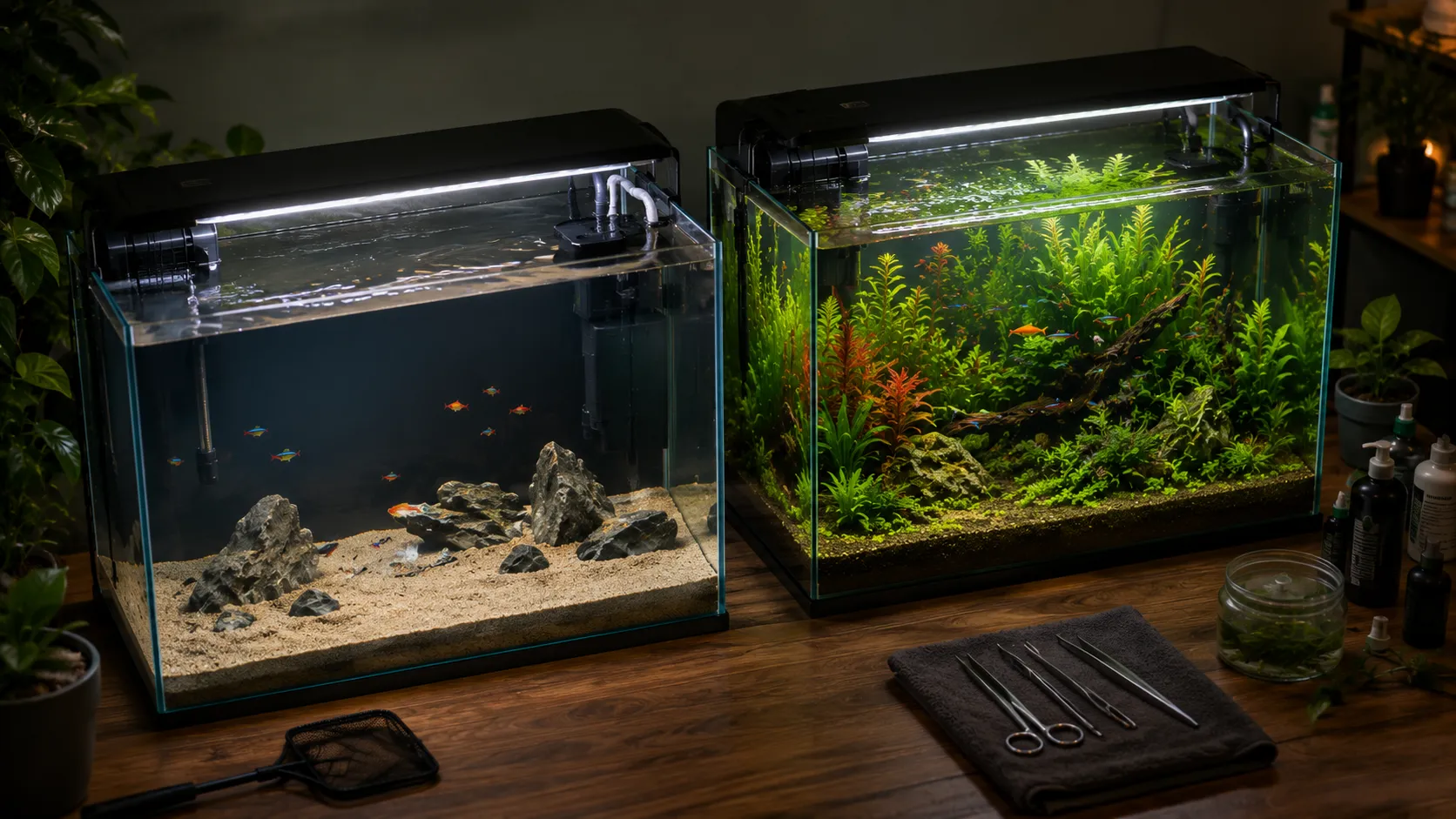
Planted Tanks vs. Non-Planted Tanks: How the Workload Shifts
In a bare or fake-plant tank, the filter carries the full biological load. It is the only structure converting ammonia, and without it the water quality deteriorates within days.
In a planted tank, live plants share that responsibility. Fast-growing stem plants like hornwort or water wisteria can absorb ammonia and nitrate at a rate significant enough to measurably reduce filter strain. A well-stocked planted tank with fast-growing species can process nitrate so efficiently that weekly water changes become less frequent.
That said, sharing the workload is not the same as replacing the filter entirely. Plants only absorb nutrients actively during daylight hours, and their uptake rate depends on how healthy and established they are. A new tank with young or melting plants provides almost no biological support for the first few weeks.
Do Planted Tanks Still Need a Filter
A planted tank does not require a filter in every situation. Here are diferent situations:
When a Filter Is Strongly Recommended
Most setups fall into this category, and for good reason.
Beginners who are still learning feeding amounts, water change schedules, and how to read their tank are much better off with a filter running. A single overfeeding event in a filterless tank can spike ammonia within hours.
Moderate to heavy fish stocking produces more waste than even a healthy plant bed can handle consistently. A community tank with tetras, corydoras, and a centerpiece fish almost always needs mechanical and biological filtration.
CO2-injected, high-tech tanks require reliable water movement to distribute CO2 evenly across plant surfaces. A filter with adjustable flow solves both filtration and circulation at once.
When a Filter Can Be Minimal or Skipped
There is a specific type of setup where experienced hobbyists successfully run filterless tanks. All of the following conditions generally need to be in place:
Very light stocking, such as a shrimp-only tank or one or two small nano fish
A dense, fast-growing plant mass that is visibly thriving, not transitioning or melting
A tank that has already fully cycled and established a stable nitrogen cycle
A consistent routine of weekly water tests and partial water changes of at least 20 to 30 percent
Skipping or minimizing filtration without these conditions in place is where most failures happen.
Filterless Planted Tank: A Practical Checklist
Before removing or skipping your filter, work through this honestly.
Is your tank at least six months old with stable ammonia, nitrite, and nitrate readings?
Do you have fewer than five small fish, or is it shrimp-only?
Are your plants rooted, actively growing, and taking up most of the water column or substrate?
Do you test water weekly and change at least 25 percent of the volume on a set schedule?
Have you avoided sudden changes like adding new fish or changing your fertilizer routine recently?
If you cannot confirm most of these, keep the filter running. The two most common failure points in filterless tanks are plant melt during a transition period and sudden fish additions that spike the bioload overnight.
For those who want to experiment, a small sponge filter running at low flow is a practical safety net. It adds a colony of beneficial bacteria, provides gentle surface agitation, and costs almost nothing to maintain. Turning it off is always an option later.
Choosing the Right Filter for a Planted Tank
The filter type matters more in a planted tank than in a standard fish-only setup, primarily because planted tanks prioritize gentle, adjustable flow over raw turnover rate. Knowing what type of filter is right before buying is important, also find the right size of filter is good for you.
Sponge filters are inexpensive, gentle on livestock, and easy to clean without disrupting your biological colony. They are the default recommendation for shrimp tanks and lightly stocked nano setups. The main drawback is visibility since the sponge itself sits inside the tank and takes up space.
Hang-on-back (HOB) filters sit on the back rim and keep the interior of the tank cleaner looking. Most HOBs allow flow adjustment, which matters in planted tanks where high turbulence can off-gas CO2 before plants absorb it. Adding a pre-filter sponge to the intake prevents livestock and plant debris from getting sucked in.
Canister filters are the top choice for tanks above 40 gallons or high-tech setups. They sit externally, produce no visual clutter inside the tank, hold large volumes of biological media, and typically offer the most precise flow control. They cost more to buy and take longer to clean, but the tradeoff is worth it for serious planted setups.
| Filter Type | Flow Control | Tank Visibility | Best Use Case |
| Sponge Filter | Low, gentle | Visible inside the ank | Shrimp tanks, nano setups, low-tech |
| HOB Filter | Moderate, adjustable | Hangs outside | Mid-size community planted tanks |
| Canister Filter | High, precise | Fully external | High-tech, CO2-injected, larger tanks |
Nano Planted Tank Filtration: Special Rules Apply
Nano tanks, anything under ten gallons, behave differently from larger setups. Parameters shift faster, ammonia spikes hit harder, and a flow rate that feels gentle in a 30-gallon tank can uproot carpeting plants and blow livestock around in a 5-gallon.
The best options for nano-planted tanks are small sponge filters with an airline and adjustable airflow, or nano HOBs with a pre-filter sponge over the intake to protect small shrimp and fry.
The filterless question comes up a lot in nano tanks, particularly for heavily planted shrimp setups. It can work, but the smaller the volume, the less room for error. A 5-gallon tank has almost no buffer against a sudden ammonia spike. Even a tiny sponge filter running on a small air pump provides enough biological colonization to buy time when something goes wrong.
Filter Maintenance in a Planted Tank
Planted tank filters generally need less frequent cleaning than filters in fish-only tanks, because the plants themselves process much of the dissolved waste before it reaches the filter.
A few practical habits that make a real difference:
Rinse mechanical media, the sponges and pads, when you notice the low rate dropping, not on a fixed weekly schedule
Always rinse filter media in old tank water, never tap water, to preserve the bacterial colony
Keep a pre-filter sponge on the intake tube to catch large debris before it clogs the internal media
Leave biological media like ceramic rings or bio-balls alone unless they are visibly blocked
Overcleaning is one of the more common mistakes in planted tanks. Stripping the filter media too aggressively removes the beneficial bacteria and forces the tank through a partial re-cycle, which stresses fish and can cause temporary ammonia spikes even in an otherwise mature tank.
Conclusion
Most planted tanks benefit from running a filter, even when the plants are healthy, and the water looks clear. Live plants absorb ammonia and nitrate, which reduces the filter’s workload, but they do not replace the debris removal, biological backup, or water circulation that a filter provides.
A filter in a planted tank should be thought of as a circulation system and a line of defense, not just a debris collector. The right choice depends on your stocking level, your experience, and whether your plants are established enough to contribute meaningfully to water quality. Choose the approach that fits your setup, and the tank will stay balanced and far easier to manage over time.
Frequently Asked Questions
1. Is a sponge filter enough for a planted tank?
For lightly stocked planted tanks, especially shrimp setups or tanks with one or two small fish, a sponge filter is sufficient. It provides adequate biological filtration and gentle circulation without creating the strong surface agitation that off-gasses CO2 in injection setups. For tanks with moderate or heavy stocking, a HOB or canister filter will handle the load more reliably.
2. Do shrimp tanks need a filter if heavily planted?
A heavily planted shrimp-only tank can sometimes run without a filter if the plant mass is dense and established, the shrimp population is small, and water changes are done consistently. That said, a small sponge filter adds biological stability with almost no risk to the shrimp and costs very little to run. Most experienced shrimp keepers keep one running as a precaution.
3. Does CO2 injection change filtration needs?
Yes. CO2 injection increases plant growth rates, which means faster nutrient uptake and a slightly reduced biological load over time. However, CO2-injected tanks still need reliable water movement to distribute the gas evenly across all plant surfaces. Running the filter near the surface at too high a flow rate will off-gas CO2 before plants can use it, so adjustable flow and spray bar positioning matter in high-tech setups.
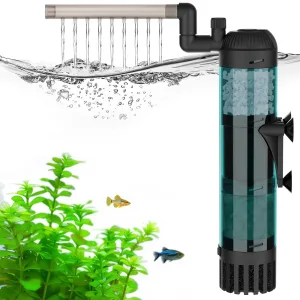
AQQA Aquarium Filter, Dual Sponge, Multi-Stage Filter, 360°...
Original price was: $14.39.$13.49Current price is: $13.49.
Aquariums Power Filter, 74GPH, for 5-10 Gal Tanks
Original price was: $25.99.$20.79Current price is: $20.79.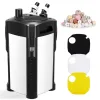
25W 475GPH Canister Filter, Ultra-Quiet External Aquarium Canister...
Original price was: $98.99.$69.99Current price is: $69.99.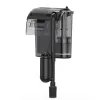


Add comment
You must be logged in to post a comment.