
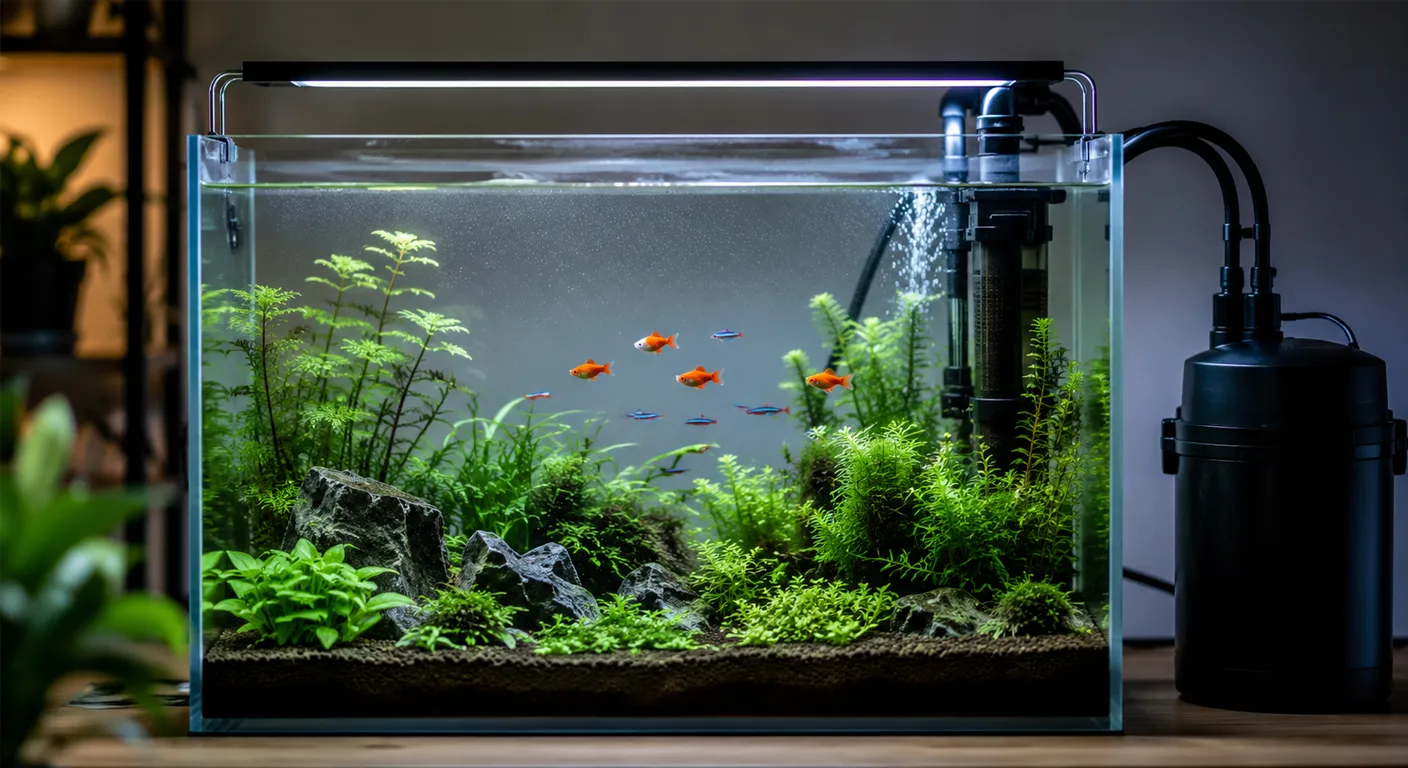
Most aquarium hobbyists size a filter by matching the number on the box to the number on their tank and most end up under-filtered as a result. Box ratings don’t account for how much water your tank actually holds after substrate and decorations displace it, or how much waste your specific fish produce. Get it wrong and you’ll face ammonia spikes, stressed fish, and filter media that needs replacing far too often.
This guide shows you how to calculate the exact flow rate you actually need, step by step.
Filter Size Affects Everything
A filter rated for your tank’s labeled volume isn’t necessarily sized for your actual tank. Substrate, decorations, and fish stocking all change the equation. Get it wrong and you’ll face ammonia spikes, stressed fish, and media that needs replacing far too often.
The right filter is calculated from three inputs: how much water is actually in your tank, how much waste your fish produce, and how many times per hour the filter needs to cycle that volume. This guide walks through each step and gives you the reference tables to do it quickly.
Key Takeaway
A correctly sized filter should turn over your tank’s entire water volume 5–7 times per hour, using your effective volume, not the number on the tank box.
Step 1 Calculate Your Tank’s True Water Volume
Manufacturers list the total geometric volume of the glass. What matters for filtration is the usable water volume after subtracting everything solid inside.
How to calculate it:
Measure length, width, and height in inches. Multiply together and divide by 231 to get gallons (1 cubic inch = 0.00433 gal).
Subtract substrate displacement using the table below.
Subtract an estimated 2–5% for decorations, rocks, and internal equipment.
Subtract any air gap between the waterline and the top of the tank.
| Substrate Type | Volume Reduction | Example |
| None (bare-bottom) | 0% | Hospital tanks, breeding setups |
| Gravel (1 in layer) | 6–7% | Classic freshwater community tank |
| Fine sand (1 in layer) | ~10% | Planted tanks, corydoras setups |
| Deep sand bed (3+ in) | 20–25% | Saltwater reef, planted Dutch |
A 10-gallon tank with 1 in of fine sand holds roughly 9 gallons — not 10. That 10% gap changes your required GPH.
Watch Out
Many manufacturers already account for substrate and list a slightly deflated volume. Check whether the spec sheet says “net” or “gross” volume before subtracting again.
Step 2 Calculate Your Bio-Load Score
Volume alone doesn’t determine how hard your filter works — waste output does. The bio-load scoring system lets you add up the waste potential of every fish in your tank so you can match it to the right filtration level.
Assign each fish a point value from the table below, then total the scores. Modifiers for plants and feeding habits adjust the final number up or down.
| Fish Category | Score Per Fish | Example Species |
| Small, low-waste (under 2 in) | 1 pt | Neon tetra, ember tetra, celestial pearl danio |
| Small, high-waste (under 2 in) | 3 pts | Fancy guppy, betta, endler’s livebearer |
| Medium fish (2–4 in) | 4–6 pts | Platy, corydoras, white cloud minnow |
| Large fish (4–8 in) | 8–12 pts | Angelfish, cichlids, large barbs |
| Very large fish (8+ in) | 15–25 pts | Oscar, koi, common pleco, goldfish |
Bio-load modifiers
| Condition | Adjustment | Effect |
| Dense live planting | −15% of total score | Plants absorb nitrates, reducing filter demand |
| Light or sparse planting | No change | Minimal impact on the nitrogen cycle |
| Overfeeding (daily excess) | +10–20% of total score | Uneaten food dramatically raises ammonia |
| Heavy feeding / carnivores | +10% of total score | Protein-rich diets produce more ammonia per fish |
Worked example: 30-gallon tank
| Fish | Qty | Score Each | Subtotal |
| Neon tetra | 8 | 1 pt | 8 pts |
| Platy | 5 | 5 pts | 25 pts |
| Betta | 1 | 3 pts | 3 pts |
| Total bio-load score | 36 pts |
Key Takeaway
With strong filtration, allow 1.5 gallons per bio-load point. With standard filtration, use 1 gallon per point. A 30-gallon tank with strong filtration can safely handle up to 45 points, stock to 80% of that ceiling (36 points) to keep a safe buffer.
Step 3 Find Your Required Filter Flow Rate (GPH)
Once you know your effective volume, the target GPH is straightforward. The 5–7× turnover rule covers most freshwater community setups. Push toward the high end for goldfish, cichlids, or any heavy bio-load tank.
Formulas
Minimum GPH = Effective Volume × 5
Maximum GPH = Effective Volume × 7
| Tank Size | Effective Volume* | Min GPH (×5) | Max GPH (×7) | Recommended Range |
| 10 gal | ~9 gal | 45 | 63 | 50–70 GPH |
| 20 gal | ~18 gal | 90 | 126 | 100–140 GPH |
| 40 gal | ~36 gal | 180 | 252 | 200–280 GPH |
| 75 gal | ~67 gal | 335 | 469 | 375–500 GPH |
| 125 gal | ~112 gal | 560 | 784 | 600–800 GPH |
Note: Effective volume estimated at 10% reduction for a 1 in gravel layer. Your number will differ — use the formula in Step 1.
Step 4 Choose the Right Filter Type
Selecting the suitable filter is also important.

GPH is only half the decision. The filter’s design determines which stages of filtration it handles and how well it manages bio-load. Biological filtration, housing the bacteria that convert ammonia to nitrate, is the most critical stage.
| Filter Type | Best Tank Size | Bio-Load Capacity | Key Advantage | Consideration |
| Sponge filter | 5–20 gal | Low–moderate | Excellent biological media; cheap | Low flow rate; may not suit heavy stock |
| HOB (hang-on-back) | 10–75 gal | Moderate | Easy to maintain; versatile media | Loses some GPH to head pressure |
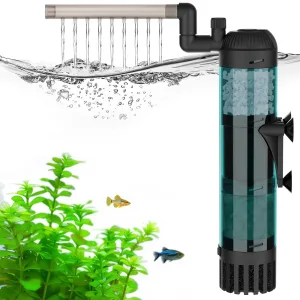
| Internal power filter | 5–30 gal | Low–moderate | Affordable; all-in-one | Displaces water volume inside tank |
| Canister filter | 40–200+ gal | High | Largest media capacity; external | Higher cost; more complex maintenance |
The three filtration stages
| Stage | What It Does | Priority for Bio-Load |
| Mechanical | Traps solid debris — fish waste, uneaten food, plant matter | Medium |
| Biological | Houses bacteria that break down ammonia → nitrite → nitrate | Critical |
| Chemical | Activated carbon removes odors, discoloration, and dissolved toxins | Supplemental |
Key Takeaway
When comparing filters at the same GPH rating, choose the one with more biological media volume. More surface area for bacteria directly raises the bio-load ceiling your filter can handle.
Step 5 Apply Safety Margins
Calculated values assume ideal conditions. Real tanks have detritus pockets, irregular feeding, fish that grow, and occasional neglect. These rules of thumb build in the buffer that keeps your fish healthy when life gets in the way.
| Safety Rule | Guideline | Why It Helps |
| Filter buffer | Buy a filter rated for 2× your actual tank size | Compensates for real vs. ideal stocking; extends media life |
| Stocking limit | Stock only 70–80% of maximum bio-load capacity | Leaves room for fish growth and feeding variability |
| Manufacturer GPH | Assume stated flow rate drops 10–20% under load | Head pressure, dirty media, and clogged intakes all reduce real GPH |
| Media maintenance | Rinse biological media in tank water — never tap | Chlorine in tap water kills the beneficial bacteria colony |
Small fish with deceptively high bio-load
Some species are sold at juvenile sizes that give no indication of their adult waste output. These are the most common culprits that quietly overwhelm an otherwise adequate filter.
| Species | Sold Size | Adult Size / Issue | Bio-Load Reality |
| Common pleco | ~2 in | Grows to 24 in | Very high — massive waste producer at maturity |
| Fancy goldfish | 1–2 in | 6–8 in; messy eater | Very high — one of the worst for ammonia output |
| Oscar (juvenile) | 1–2 in | 12–14 in; rapid growth | Extremely high — can overwhelm a 75-gal filter alone |
| Betta | 2–3 in | Protein-rich diet | Moderate — higher than its size suggests |
| Guppies (large group) | 1.5–2 in | Fast breeders, population grows | Cumulative — 20+ guppies rivals a single large fish |
Conclusion
Choosing the right aquarium filter isn’t about matching the number printed on the tank or the filter box. It’s about calculating the filter your aquarium actually needs based on effective water volume, bio-load, and the turnover rate required to keep water stable.
By working through the five steps in this guide: calculating true water volume, scoring bio-load, determining the correct GPH, selecting the right filter type, and adding sensible safety margins—you can size a filter that keeps up with your fish today and as the tank matures. That means fewer water quality problems, healthier fish, and less frequent maintenance.
A properly sized filter is one of the best long-term investments in any aquarium. Use these calculations whenever stocking changes or a new tank is planned, and your filtration system will be built on numbers rather than guesswork.
FAQ
1. Can I run two smaller filters instead of one large one?
Yes. Two filters that together meet your GPH target is often better than one. The redundancy protects your tank if one filter fails or needs cleaning, and spreading biological media across two units can increase total bacteria surface area.
2. Does a higher GPH filter always mean better water quality?
Not necessarily. Excessively high flow can stress fish that prefer calm water — bettas, discus, and many nano species included. Match the GPH to your bio-load, not the biggest number you can find. For sensitive species, use a spray bar or deflector to diffuse the output.
3. Why does my filter rate show higher on the box than in practice?
Manufacturers test flow rate at zero head pressure, meaning the outlet sits at the same level as the water surface with a clean, empty media chamber. In a real tank, head pressure, dirty media, and a full bio-media load all reduce the actual flow rate by 10–20%.
4. How often should I clean my filter?
Mechanical media (filter floss, sponges) should be rinsed or replaced when flow noticeably drops, typically every 2–4 weeks. Biological media should be rinsed gently in removed tank water only when clogged, and never replaced entirely, to preserve the bacterial colony.
5. Do live plants reduce the filter size I need?
Somewhat. Heavily planted tanks absorb nitrates, which reduces the load on the nitrogen cycle and can support higher stocking density. However, plants don’t replace mechanical filtration. They don’t remove solid waste. A densely planted tank still needs a filter sized to turn over its volume 5× per hour.
6. What is the 1-inch-per-gallon rule and is it still valid?
The 1-inch-per-gallon rule is a simplified starting point that treats all fish as equivalent. It doesn’t account for body mass, waste output, or filtration quality — a 6-inch goldfish produces far more waste than six 1-inch neon tetras. The bio-load scoring method in this guide is more accurate for modern stocking decisions.


Add comment
You must be logged in to post a comment.