
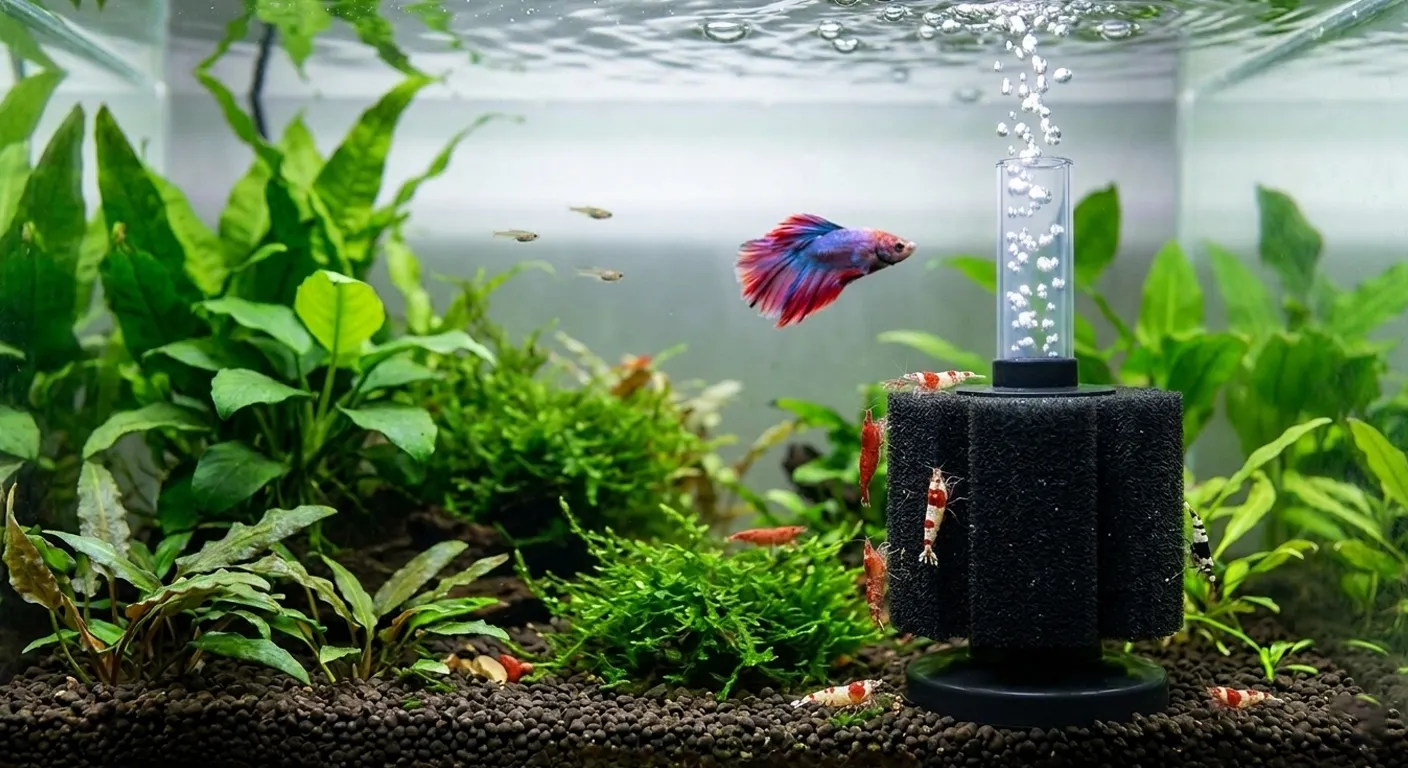
Your water looks crystal clear. Your fish seem happy. But ammonia keeps creeping up. Shrimp keep vanishing. And you have no idea why.
Sound familiar?
A beautiful tank can still have a filtration problem hiding beneath the surface. And nine times out of ten, the fix is simpler than you think. Enter the aquarium sponge filter.
It’s not flashy. It’s not expensive. But ask any experienced shrimp keeper, fish breeder, or planted tank enthusiast what filter they trust most and this humble foam device comes up every single time.
In this guide, we’re breaking down everything you need to know: how it works, why it’s so effective, who should use one, and how to pick the right one for your setup.
What Is an Aquarium Sponge Filter
It’s one of the oldest tools in the hobby and it’s still one of the best.
A sponge filter is exactly what it sounds like. A porous foam sponge attached to a plastic uplift tube and a weighted base. No complicated parts. No expensive cartridges. No moving pieces inside the tank.
It sits fully submerged. An air pump outside the tank pushes air through a tube connected to the filter. That airflow creates gentle suction. Water gets pulled through the sponge. And the magic happens inside that foam.
It looks simple. But don’t let that fool you.
Aquarists have been using sponge filters for decades: in professional fish rooms, breeding operations, and shrimp farms around the world. There’s a reason it never went out of style.
How Does It Work
You don’t need a biology degree to understand this. Promise.
Here’s what happens from the moment you plug in the air pump:
Air is pushed through the tubing into the filter
That creates an upward flow inside the uplift tube
Water gets pulled through the sponge to fill the gap
The foam physically catches debris as water passes through
Beneficial bacteria colonize every tiny pore inside the sponge
Those bacteria break down toxic ammonia into nitrite, then into nitrate
Rising bubbles hit the water surface and add dissolved oxygen
That’s two types of filtration happening at once.
Mechanical filtration: The foam acts like a net. It traps floating waste, uneaten food, and particles before they decompose and foul your water.
Biological filtration: This is the real superpower. Over time, beneficial bacteria build a colony inside the sponge. They process the nitrogen compounds that would otherwise poison your fish. This is called the nitrogen cycle and a mature sponge filter is one of the best places to host it.
As a bonus? Those bubbles gently oxygenate your tank on the way up. Three jobs. One device.
Pro Tip: The bacteria in your sponge ARE your filter. Never rinse it under tap water. Chlorine kills the colony instantly and that crashes your entire nitrogen cycle. Always clean it in a bucket of old tank water.
Key Benefits of Using a Sponge Filter
Here’s why so many aquarists — from total beginners to seasoned professionals — keep coming back to sponge filters.
1. Superior Biological Filtration
Most people underestimate how much surface area is packed inside a sponge filter.
Every pore is a potential home for nitrifying bacteria. There are thousands of them. That gives you far more biological capacity than most hang-on-back filter cartridges — at a fraction of the price. More bacteria means faster ammonia processing. Faster processing means more stable water. More stable water means healthier fish.
2. Dual Mechanical and Biological Action
Most filters specialize in one thing. Sponge filters do two.
The foam catches physical debris while simultaneously hosting your bacterial colony. You’re not choosing between clean water and a healthy cycle. You get both from one device.
3. Gentle, Fish-Safe Flow
Strong filters create strong currents. Strong currents stress fish. Bettas can’t swim properly in heavy flow. Long-finned species get torn against the current. Slow-moving fish get exhausted.
Sponge filters produce soft, diffuse water movement. Your fish swim naturally. Less stress means longer, healthier lives.
4. 100% Safe for Shrimp and Fry
This is the big one. The reason breeders worldwide swear by sponge filters.
Power filters have strong intake suction. Baby fish and shrimp get sucked right in — one of the most heartbreaking and common losses in the hobby. A sponge filter has no strong intake point. The flow is gentle and spread across the entire sponge surface. Fry and shrimp are safe.
If you’re breeding fish or keeping a shrimp colony, this isn’t a preference. It’s a requirement.
5. Built-In Oxygenation
Every bubble that rises to the surface disturbs the water and allows gas exchange. Oxygen in. Carbon dioxide out.
This is especially valuable in warm tanks, where water holds less dissolved oxygen. The constant surface agitation keeps oxygen levels stable without any extra equipment.
6. Near-Silent Operation
No impeller hum. No splashing. Just a gentle, steady stream of bubbles.
If your tank lives in a bedroom, office, or nursery — you’ll notice the difference immediately. It’s the kind of quiet that lets you focus on how beautiful your tank looks, not how loud it sounds.
7. Low Cost, Zero Consumables
Some hang-on-back filter cartridges cost $10–$20 to replace every single month.
A sponge filter costs $5–$20 total. One time. The sponge itself can last years with proper care. No cartridges. No monthly replacement costs. No surprises.
For anyone managing multiple tanks, the savings add up very fast.
Sponge Filter vs. HOB vs. Canister
No filter is perfect for every situation. Here’s an honest side-by-side comparison so you can decide what’s right for your tank.
Feature | Sponge Filter | Hang-On-Back | Canister |
Biological filtration | Excellent | Good | Excellent |
Safe for fry/shrimp | Yes | ✗ No | ✗ No |
Noise level | Very quiet | Moderate | Low–Moderate |
Average cost | $5–$20 | $20–$80 | $60–$300+ |
Ongoing costs | None | Monthly cartridge | Occasional |
Maintenance effort | Very easy | Easy | Moderate |
Flow strength | Gentle | Moderate | Strong |
Best for | Shrimp, fry, nano, planted | Community tanks | Large or heavy tanks |
Honestly, which one to choose is all depends on your tank.
For small tanks, shrimp, fry, and planted setups, the sponge filter wins every time. Gentler, cheaper, and safer than anything else at its price point.
For large, heavily stocked tanks, a hang-on-back or canister handles the volume better. But even then, many experienced aquarists run a sponge filter alongside their main filter for extra biological capacity.
The sponge filter isn’t trying to beat every other filter. It’s the best tool for the right job and for a lot of tanks, that job is yours.
Who Should Use a Sponge Filter
A sponge filter is brilliant, but it’s not for everyone. Here’s an honest breakdown.
A great fit if you have:
A shrimp tank: gentle flow keeps neocaridina and caridina shrimp safe
A breeding or fry tank: no intake suction to harm newborns
A betta fish: bettas hate strong current; this keeps them calm
A planted aquarium: soft flow won’t disturb CO2 or uproot stems
A hospital or quarantine tank: easy to move, no carbon to interfere with medication
A nano or small tank under 40 gallons
Multiple tanks: run several filters off one air pump with a simple airline splitter
Probably not enough on its own if you have:
A heavily stocked tank over 55 gallons: consider pairing it with a canister or HOB
High-bioload fish like goldfish, oscars, or large cichlids. The sponge may struggle alone
A tank where hidden filtration is a priority that sponge filters are functional, not invisible
How to Choose the Right Sponge Filter for Your Tank
Walk into any aquarium store and you’ll see a wall of options. Here’s what actually matters.
Tank Size
Every sponge filter has a rated gallon capacity. Match it to your tank or go slightly above. A filter rated for 30 gallons in a 20-gallon tank gives you a comfortable safety margin. Never size down , or you’ll regret the weak filtration.
Sponge Density
Coarse sponge → easier water flow, easier to rinse, best for general community tanks. Fine/dense sponge → catches smaller particles, better for shrimp and fry, needs more frequent cleaning.
Single vs. Double Sponge
Go double if you can. A dual-sponge filter lets you clean one side at a time while the other half stays intact — meaning your bacterial colony never gets fully wiped out. Small upgrade, big difference.
Air Pump Compatibility
The filter is only as good as the pump driving it. Match the pump’s output (listed in L/min or GPH) to the filter’s requirements. An undersized pump means weak filtration. Add a control valve on the airline to fine-tune the bubble rate.
Build Quality
Cheap filters have weak seams and foam that crumbles within months. Read reviews — specifically look for comments from people who’ve used theirs for 6–12 months. That tells the real story.
Note: A brand new sponge filter provides zero biological filtration. The foam is sterile. Allow 4–6 weeks for a full bacterial colony to establish. Want to skip the wait? Squeeze an established sponge from another tank into your new one. You’ll transfer bacteria instantly.
Maintenance: How & When to Clean It
Good news: sponge filter maintenance is probably the easiest chore in the entire hobby.
When to clean
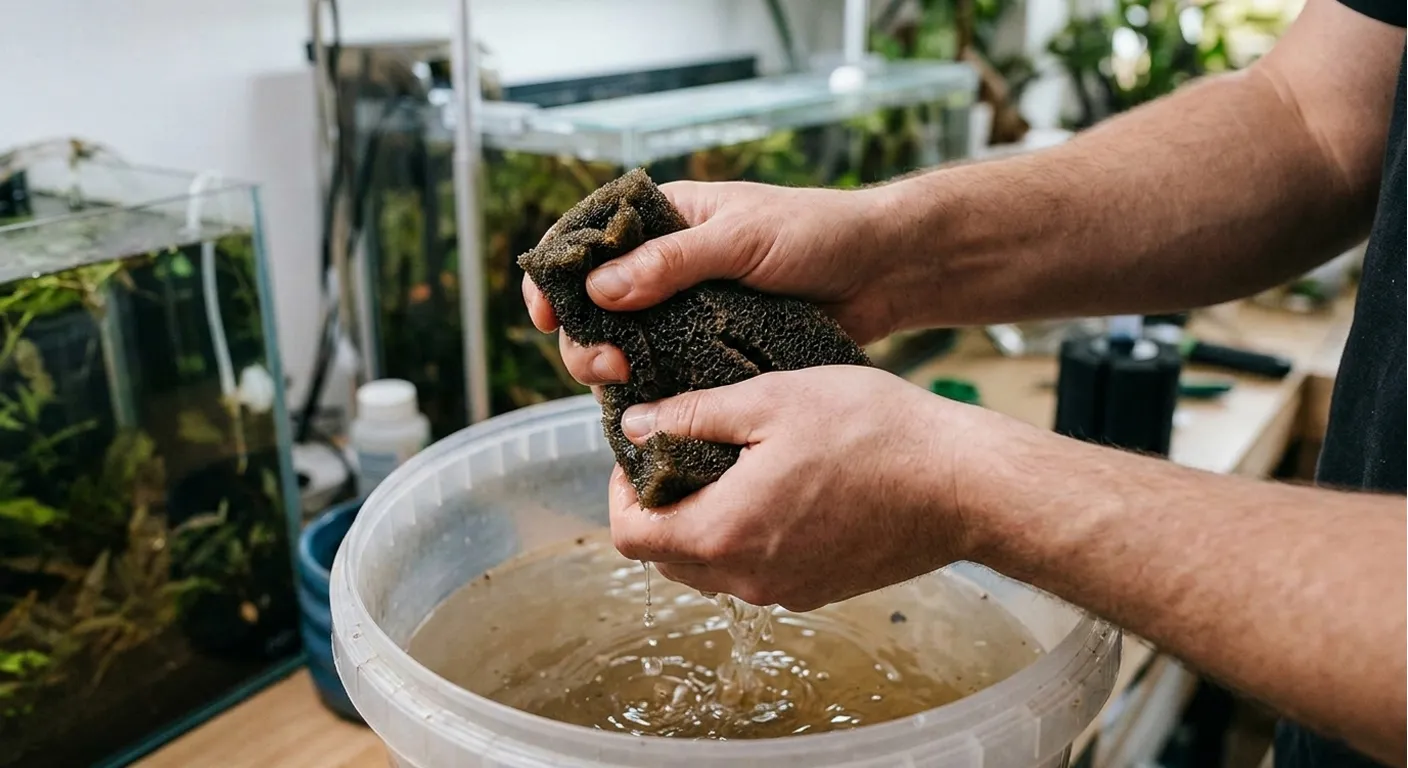
Every 2–4 weeks, or whenever you notice reduced bubble output. If the bubbles slow down noticeably, the sponge is clogged and needs a rinse.
How to clean it
Do: Remove the sponge and squeeze it into a bucket of old tank water. Squeeze repeatedly until the water runs mostly clear. Reinstall. Done.
Don’t: Rinse it under the tap. Ever. Chlorine and chloramine in tap water kill your bacterial colony. Even “just a quick rinse” can set your tank back weeks.
Don’t: Use soap, bleach, or boiling water to deep clean it. Same reason — you’ll destroy the biology entirely.
Don’t: Replace the sponge unless it’s physically falling apart. A worn, dark, well-used sponge is a sign of a thriving bacterial colony. That’s a good thing. Replacing it means starting your cycle from zero.
Note: Keep a spare sponge filter running inside your main display tank at all times. It costs almost nothing. But when you suddenly need a hospital or quarantine tank — illness, injury, aggression — you’ll have a fully cycled filter ready in seconds. No waiting weeks for a new cycle. Just move the sponge, fill the tank, and you’re set. Every experienced aquarist eventually learns this trick. Now you already know it.
Conclusion
The aquarium sponge filter is not the most powerful filter on the market. It’s not the most invisible. It won’t win any design awards.
But for shrimp keepers, fish breeders, betta owners, and planted tank enthusiasts? It is genuinely one of the best filtration decisions you can make.
If you’re setting up a new shrimp or fry tank, start with a sponge filter. No second-guessing needed. If you have an existing tank, add one as a supplemental filter. It costs less than dinner and adds a layer of biological security you’ll be glad to have.
FAQ
Can a sponge filter be the only filter in my tank?
For most tanks under 40 gallons with moderate stocking. Yes, absolutely. It handles both mechanical and biological filtration well. For heavily stocked or larger tanks, pair it with a HOB or canister for extra capacity.
How long does it take a sponge filter to fully cycle?
Typically, 4–6 weeks from scratch. You can speed this up by seeding the sponge from an established tank, using a liquid bacteria starter, or transferring some substrate from a cycled setup.
Will a sponge filter work in a saltwater tank?
Yes. Many aquarists use them in marine setups, especially for quarantine and frag tanks. The biology works the same in salt or fresh water. Just confirm the model is rated for saltwater, as some cheaper plastics degrade over time.
Can I use a sponge filter with a betta fish?
It’s actually the ideal filter for bettas. Bettas are labyrinth fish that breathe surface air and struggle in strong current. Sponge filters give them clean water without the flow stress. A perfect match.
Why is my sponge filter not producing bubbles?
Check three things: Is the air pump running? Is the airline tubing kinked or cracked? Is the sponge so clogged it’s blocking all flow? A good rinse in tank water usually solves the third issue instantly.
How often should I replace the sponge itself?
Only when it’s physically disintegrating, crumbling foam, large holes, or falling apart. A healthy sponge can last 2–5 years. The darker and more “seasoned” it looks, the better it’s probably working.
Can I run two sponge filters on one air pump?
Yes. Using an airline splitter. One air pump can typically run 2–4 sponge filters depending on its output. A control valve on each line lets you balance the flow between them.
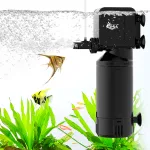
Dual-Use Aquarium Filter Pump For Fish Tank Filtering...
Original price was: $15.99.$9.99Current price is: $9.99.



Add comment
You must be logged in to post a comment.