

You wake up one morning, walk over to your fish tank with breakfast in hand, and notice something weird. Your bright orange goldfish has a black patch on its side. Or maybe the edges of its fins are turning dark. And now you are wondering if this is normal, if it is serious, or if you did something wrong.
Here is the thing: black spots on goldfish are not a disease. They are a symptom. And that symptom can mean about nine completely different things, ranging from “totally harmless” to “fix this today or your fish is in trouble.” Treating the wrong cause can actually make things worse, which is exactly why you need to figure out what is really happening before you start dumping chemicals into the tank or panicking.
In this guide, we are going to walk through nine confirmed causes of black coloration in goldfish. Some are emergencies. Some are just your fish being a fish. We will cover how to identify each one, what to do about it, and how to tell the difference.
Quick Symptom Diagnosis Table
Before you read through everything, use this table to get a rough idea of what you might be dealing with based on what the blackening actually looks like.
| Symptom Pattern | Most Likely Cause | Urgency | Reversible? |
| Blotchy black patches across body + lethargy | Ammonia burns | High | Yes, if caught early |
| Black edges on fins only, localized | Healing from injury | Low | Yes, fades as healed |
| Gradual full body darkening, no other symptoms | Natural color change | None | No, and normal |
| Small uniform black dots near snails or pond | Black spot disease | Medium | Yes, with treatment |
| Sudden blackening after water change | pH or temperature shock | High | Yes, if stabilized |
| Dull overall color shift + low appetite | Nutritional deficiency | Medium | Yes, with diet change |
| Diffuse darkening + hiding or clamped fins | Stress from tankmates | Medium | Yes, if environment fixed |
| Black patches growing or developing texture post ammonia event | Secondary infection | High | Yes, but needs medication |
9 Reasons Your Goldfish Is Turning Black
Each cause below has a different appearance, a different urgency level, and a different fix. Work through them systematically before you jump to conclusions.
Cause 1: Ammonia Burns
This is the most common cause by far. When ammonia from fish waste builds up in the water, it literally burns your goldfish’s skin. The black coloration you see is melanin, which is the fish’s way of trying to heal the damaged tissue.
What Is Happening
Ammonia accumulates when biological filtration is not established yet (new tank syndrome) or when the tank is overstocked and the filter cannot keep up. The ammonia burns the protective slime coat and skin. As the fish begins to heal, melanin deposits form over the damaged areas, which appear as black or dark gray patches.
How to Identify It
Black patches appear suddenly, usually within a day or two of a water quality crash
The fish may be lethargic, sitting at the bottom, or gasping at the surface
Patches are often blotchy and irregular, not symmetrical
Other fish in the same tank may also show symptoms
How to Test and Confirm
Use an API test kit to measure ammonia levels. Anything above 0 ppm confirms the problem.
Check nitrite levels as well. If ammonia is high, nitrites often follow.
Look at your maintenance routine. Did you skip water changes? Add too many fish at once?
Cause 2: Healing From Physical Injury
A fin nip from a tankmate, a scrape against sharp decor, or rough handling with a net can all leave marks. When goldfish heal from physical trauma, the new tissue often grows back darker before it eventually matches the original color.
What Is Happening
The damaged area triggers a localized melanin response. This is protective and temporary. As the tissue fully regenerates, the black coloration usually fades over weeks to months.
How to Identify It
Blackening is localized to one specific spot, usually where the injury occurred
The fish behaves normally otherwise (eating, swimming, alert)
You may remember a recent incident: aggressive chasing, a sharp ornament, or clumsy netting
How to Test and Confirm
Examine the tank for sharp objects or aggressive fish
Check if the dark area corresponds to a fin tear or visible wound
Monitor over time. If it is healing, the black area should slowly shrink or fade
Cause 3: Natural Genetics and Color Change
Goldfish are not locked into one color for life. They are genetically programmed to shift pigmentation as they mature. A fish that starts out orange might develop black patches, bronze tones, or even turn completely white. This is normal biology, not a problem.
What Is Happening
Goldfish are selectively bred from carp, which are naturally dark. The bright orange or yellow colors are the result of breeding, but the genes for darker pigmentation are still present. As goldfish age, those genes can express themselves.
How to Identify It
The darkening happens gradually over weeks or months
The fish shows no signs of illness (good appetite, active, bright eyes)
Water parameters are stable and normal
The change is even and symmetrical, not blotchy or localized
How to Test and Confirm
Rule out all other causes first
Research the specific variety of goldfish you own. Some breeds are more prone to color shifts
Accept that this is just what your fish looks like now. It is not reversible and does not need fixing
Cause 4: Black Moor and Naturally Dark Breeds
If you own a Black Moor, Telescope, or another naturally dark variety, black coloration is the baseline. Misidentifying the breed leads to unnecessary panic and potentially harmful treatment.
What Is Happening
You bought a fish that is supposed to be black. That is it. The fish is healthy and displaying its correct coloration.
How to Identify It
The fish was dark when you bought it, or the breeder/store labeled it as a black variety
The entire body is dark, not just patches
No other symptoms are present
How to Test and Confirm
Look up the breed online and compare photos
If the fish matches the standard appearance for that variety, there is nothing wrong
Cause 5: Black Spot Disease
This is a genuine parasitic condition where fluke larvae burrow under the skin and trigger melanin cysts. It is more common in outdoor ponds and tanks with snails than in typical home aquariums.
What Is Happening
The parasite lifecycle involves snails as an intermediate host. The larvae penetrate the fish’s skin, and the fish encases them in melanin as a defense mechanism. This creates small, uniform black dots.
How to Identify It
The black spots are small, round, and evenly distributed
The fish may scratch against objects (flashing)
You have snails in the tank or pond, or recently introduced new plants
The spots look raised or textured, not flat
How to Test and Confirm
Check for snails in the tank
Look closely at the spots under good lighting. They should be distinct dots, not blotches.
Research treatment options like praziquantel, which targets flukes
Cause 6: pH Shock and Temperature Fluctuations
Rapid swings in water chemistry or temperature trigger melanophore overactivation, which causes visible skin darkening. This cause is almost entirely absent from other articles despite being more common than most owners realize.
What Is Happening
When the environment changes too quickly, the fish’s cells react by expanding pigment cells. This is a stress response. It usually happens after a large water change with untreated tap water, moving the fish to a new tank, or a heater malfunction.
How to Identify It
Blackening appears within hours of a water change or temperature drop
The fish may also clamp its fins, hide, or refuse food
Water tests show a significant pH difference between old and new water
How to Test and Confirm
Test your tap water pH and compare it to your tank pH
Check the temperature with a reliable thermometer
Gradually acclimate fish to new conditions in the future to prevent recurrence
Cause 7: Diet and Nutritional Deficiency
Goldfish cannot produce carotenoid pigments on their own. They depend entirely on their diet. A prolonged deficiency causes colors to dull and darken in ways that are easy to mistake for disease.
What Is Happening
Without carotenoids from food, the bright reds, oranges, and yellows fade. What remains is the underlying darker pigmentation.
How to Identify It
The entire fish looks washed out, not just black in patches
The color change is gradual and affects all fish in the tank equally
You have been feeding low quality flakes or only one type of food for months
How to Test and Confirm
Review your feeding routine. Are you using high quality pellets with spirulina or krill?
Switch to a varied diet with color enhancing ingredients
Monitor over 4 to 6 weeks. If diet was the issue, colors should improve.
Cause 8: Stress From Overcrowding or Aggressive Tankmates
Sustained social stress elevates cortisol, which directly expands melanophores and produces diffuse skin darkening. This is a physiological link that most fishkeeping articles never make explicit.
What Is Happening
Chronic stress from being chased, nipped, or housed in too small a space triggers hormonal changes. The fish darkens as a result.
How to Identify It
The fish hides constantly or stays in corners
Fins are clamped or torn
There are aggressive fish in the tank, or the tank is overstocked
The darkening is overall and diffuse, not localized
How to Test and Confirm
Observe tank dynamics. Is one fish being bullied?
Calculate your stocking level. Goldfish need 20 gallons for the first fish, 10 gallons for each additional fish.
Separate aggressive fish or rehome if necessary
Cause 9: Secondary Bacterial or Fungal Infection After Ammonia Burns
This is the most overlooked risk. Damaged skin from ammonia burns destroys the protective slime coat, leaving tissue vulnerable to infections that are easily mistaken for continued healing.
What Is Happening
After ammonia burns, the open wounds provide an entry point for bacteria or fungus. The black areas may develop white fuzz, red streaks, or a slimy texture.
How to Identify It
Black patches appeared after an ammonia spike but are now getting worse or changing texture
White cottony growth appears on the edges
Red streaking or swelling develops around the dark areas
The fish becomes more lethargic even after ammonia is corrected
How to Test and Confirm
Examine closely for secondary symptoms (fuzz, redness, swelling)
Ammonia levels are now at 0, but the fish is not improving
Consider antibacterial or antifungal treatment after confirming water quality is stable
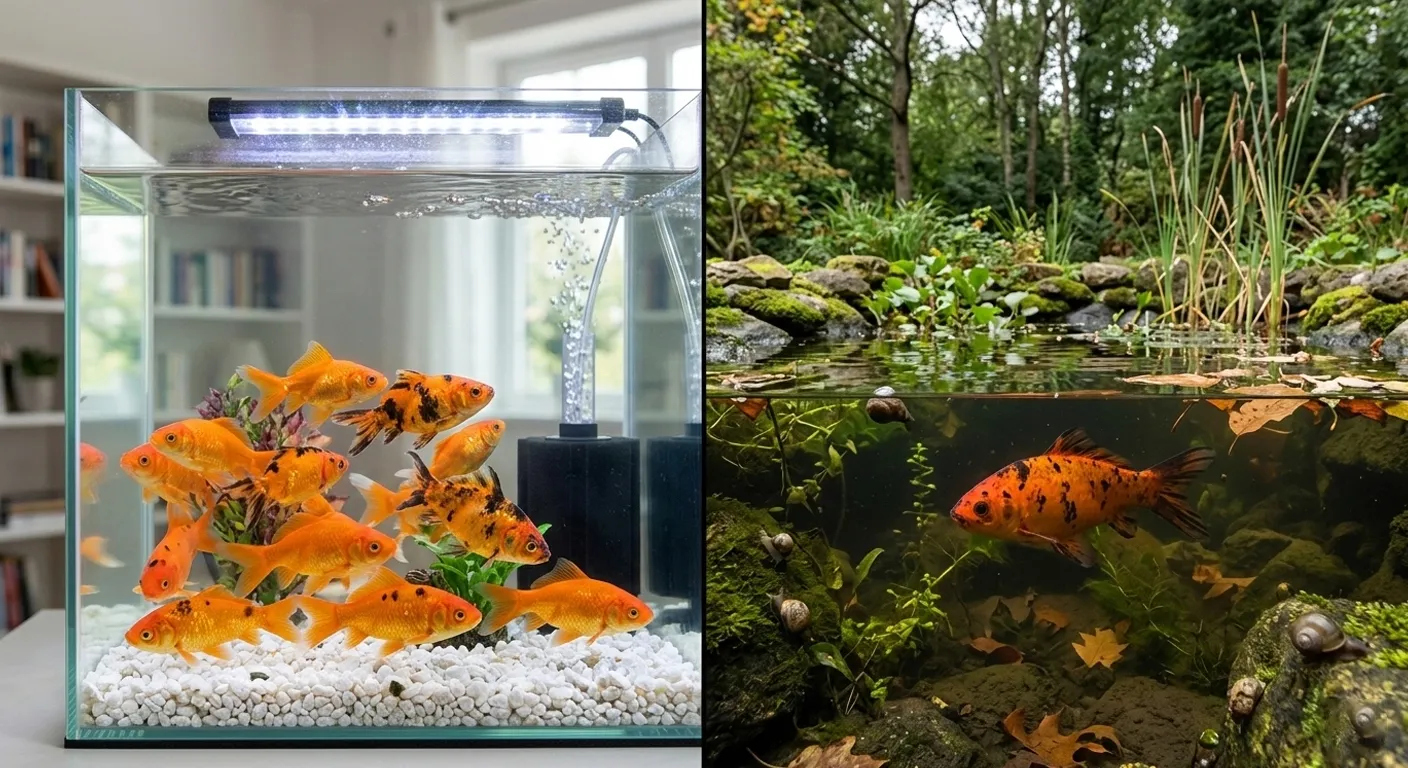
Pond vs. Aquarium Goldfish
Most articles treat all goldfish environments as identical, but the most likely cause of blackening shifts significantly depending on whether the fish lives in a tank or an outdoor pond.
Key Environmental Differences
Outdoor ponds face seasonal temperature swings, wildlife exposure, uncontrolled snail populations, and decaying organic matter
Aquariums offer controlled, stable conditions but are more prone to overcrowding and new tank syndrome
Cause Likelihood by Environment
| Cause | Aquarium | Outdoor Pond |
| Ammonia burns | Very common | Moderate |
| Black spot disease | Rare | Very common |
| pH or temperature shock | Common | Very common |
| Natural color change | Common | Common |
| Stress from tankmates | Very common | Rare |
| Nutritional deficiency | Moderate | Moderate |
Pond Specific Prevention Priorities
Test water at every season change, especially after spring thaw
Actively manage snail population to reduce black spot disease risk
Remove fallen leaves and organic debris before they decompose
Monitor for ammonia spikes during spring when waste from winter accumulates
How to Decide How Fast to Act
The most urgent practical question any owner has when they first notice blackening is how quickly they need to respond. Here is a clear framework.
Green Level: Monitor But Do Not Panic
Gradual darkening over weeks with no other symptoms
Fish is eating, swimming, and behaving normally
Water parameters are stable and within range
Action: Keep observing. This is likely natural color change.
Yellow Level: Investigate and Prepare to Act
Sudden appearance of black spots or patches
Fish shows mild behavioral changes (less active, occasional hiding)
Water tests show borderline readings (ammonia at 0.25 ppm, pH slightly off)
Action: Test water immediately, increase water changes, monitor closely over 24 to 48 hours.
Red Level: Act Immediately
Rapid blackening combined with lethargy, gasping, or clamped fins
Ammonia or nitrite levels above 0.5 ppm
Fish has stopped eating or is lying on the bottom
Secondary symptoms appear (white fuzz, red streaks, swelling)
Action: Emergency water change (50%), dose with water conditioner, consider moving to a hospital tank, seek treatment for infections.
How to Prevent Your Goldfish From Turning Black
The vast majority of blackening causes are entirely preventable with consistent, informed tank management.
Cycle your tank properly before adding fish. Establish beneficial bacteria to process ammonia.
Perform regular water changes. 20 to 30 percent weekly is standard for goldfish.
Avoid overstocking. Goldfish produce a lot of waste and need space.
Feed a high quality, varied diet that includes color enhancing ingredients.
Acclimate fish slowly to new water conditions. Match temperature and pH before transferring.
Remove sharp decorations and monitor for aggressive behavior.
Conclusion
There are nine possible reasons why goldfish turn black, ranging from serious water quality issues to entirely natural genetic processes. The key is identifying the correct cause, because the wrong treatment can make things worse.
Compare your symptoms to the table at the top of this post. Test your water. Observe your fish’s behavior. Most cases, if detected early, can be completely cured or will resolve on their own.
Take this seriously, but do not panic. Goldfish are tougher than you think, and with the right approach, your fish will be just fine.
FAQ
1. Can a goldfish turn black from stress alone?
Yes. Chronic stress elevates cortisol, which expands melanophores and causes diffuse darkening. This is reversible if the stressor is removed.
2. Why is my black goldfish turning orange?
This is the reverse of the usual problem. Black Moors and other dark varieties can lose melanin due to poor diet, warm water temperatures, or genetic factors. It is not harmful but is usually permanent.
3. My goldfish has black spots but is acting completely normal. Should I be worried?
Probably not. If the fish is eating, swimming, and alert, this is most likely natural color change or healing from a minor injury. Monitor for changes but do not treat.
4. Will ammonia burn kill my goldfish if left untreated?
Yes, eventually. High ammonia is toxic and causes organ damage. Even if the fish survives the initial burn, secondary infections can develop. Fix water quality immediately if ammonia is present.
3.7 Gal Aquarium Kit: Filter, 10-Color Light, Self-Cleaning,...
Original price was: $81.99.$77.39Current price is: $77.39.












Add comment
You must be logged in to post a comment.