
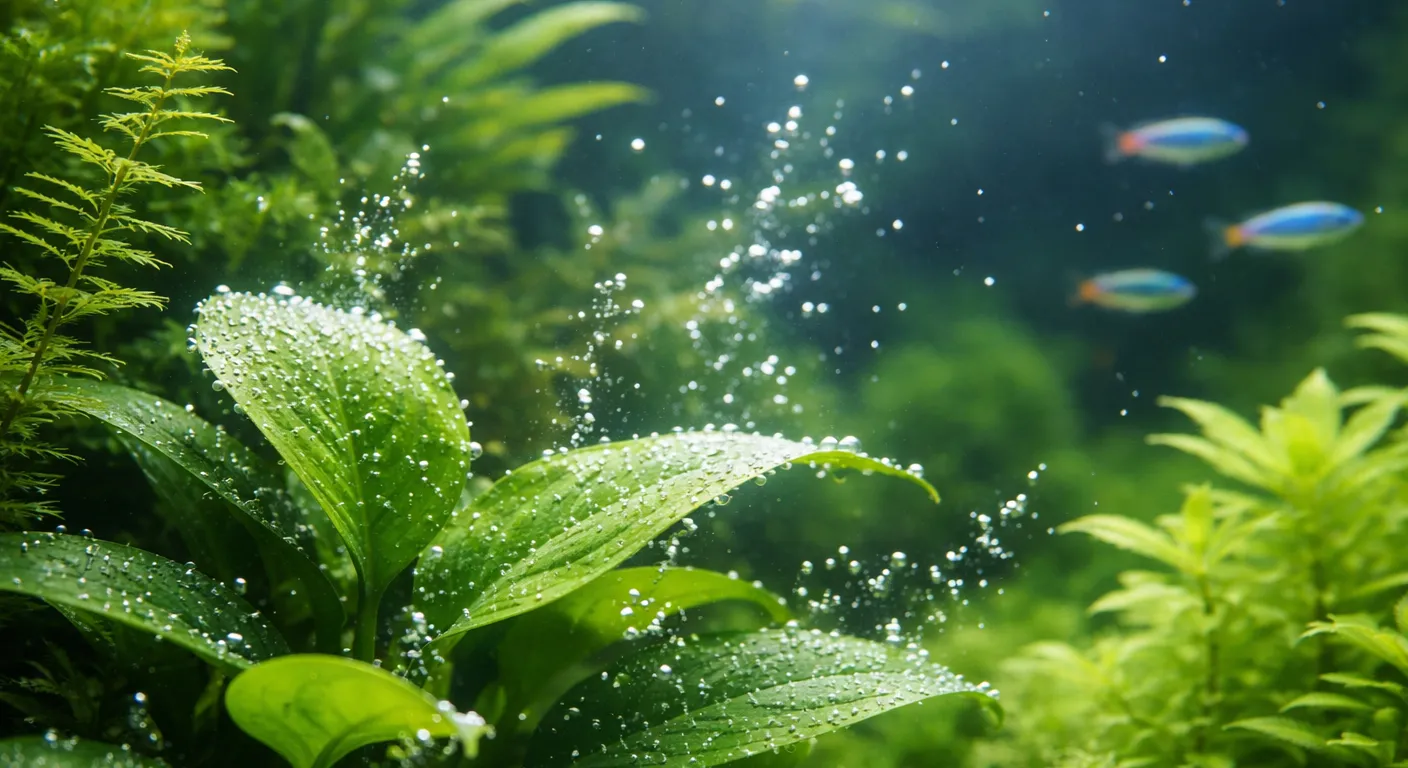
When I first started my aquarium, I saw these tiny bubbles on my plant leaves. I totally freaked out. I thought something was broken. Maybe I messed up the setup somehow. But then I move the lights. The bubbling just stopped. How amazing!
Later, I found out this is called pearling. Turns out it’s completely natural. Your plants are just releasing oxygen. This happens during photosynthesis.
If you’re new to fishkeeping, seeing pearling can get you excited. But it’s also easy to get confused about what’s happening. In this guide, we’ll explain why aquarium plants make these bubbles. We’ll cover what conditions cause pearling. And how you can help your plants grow healthy. Plus, we’ll make sure you don’t stress over things that are totally normal or end up with algae problems.
What Is Pearling in an Aquarium
Pearling happens when your aquatic plants make more oxygen than the water can actually hold. So you get these visible bubbles forming on the leaves or stems. You’ll see this most in healthy plants that are actively growing. They need strong light and good CO₂ plus nutrients to do this. Pearling is just a natural part of photosynthesis. It usually means your plants are growing really well.

Why Do the Bubbles Stick to Leaves
Bubbles stick to certain leaf shapes and textures more than others. Here’s what you’ll notice:
Smooth or broad leaves trap oxygen way easier. You get noticeable pearling on plants like Anubias, Amazon Sword, or Java Fern.
Fine-leaved plants might produce less even if they’re making the same amount of oxygen. You just can’t see it as well.
This is why some plants in your tank bubble like crazy while others look totally quiet. It’s just how their leaves are shaped.
Is Pearling Always a Good Sign
Pearling usually means your plants are growing actively. But it doesn’t automatically mean your tank is perfectly balanced.
The good stuff:
It shows your plants are photosynthesizing well.
You’ve got enough light, CO₂, and nutrients.
But here’s the thing:
A lot of beginners think constant bubbling means everything is perfect. That’s not always true.
Pearling alone doesn’t tell you if your pH is stable. Or if your hardness levels are good. Or if nutrients are actually balanced.
What matters more is that your plants stay healthy overall. Not just constant bubbling.
Why Aquarium Plants Release Oxygen Bubbles
To understand this, we need to know the basic principles of plant growth, and then we can learn how pearls are formed in aquariums. When environmental conditions align, plants naturally release excess oxygen as part of their growth process.
How Photosynthesis Works in Aquariums
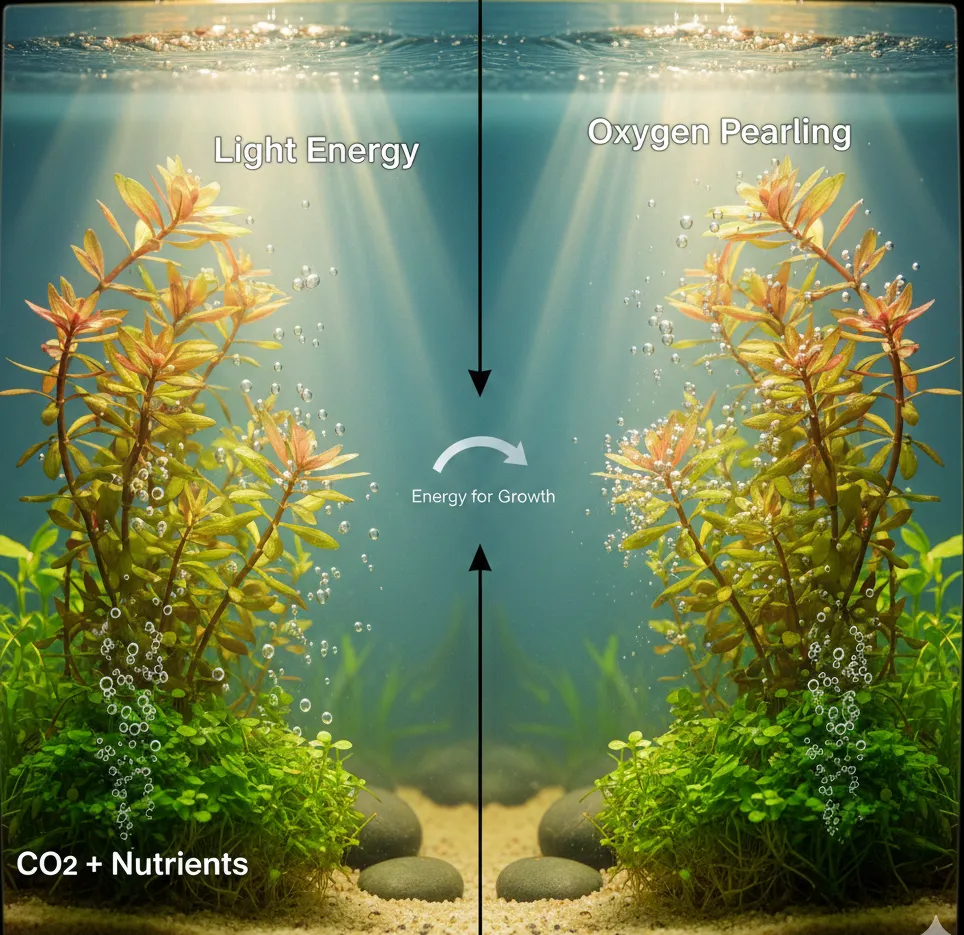
Your aquatic plants take light energy, CO₂, and nutrients. They convert all that into energy so they can grow. Oxygen gets released as a natural byproduct of this process. In tanks with good light and CO₂, your plants might make more oxygen than the water can actually hold. That’s when you start seeing visible bubbles.
Why Oxygen Turns Into Bubbles
Water can only hold so much dissolved oxygen. There’s a maximum limit. When your plants produce more than that limit, the oxygen has to escape somewhere. It comes out as gas and forms bubbles on the leaves and stems. You’ll see pearling a lot in tanks that have:
- Highlighting
- Good CO₂ supplementation
- Fast-growing plants
What Conditions Cause Aquarium Plants to Pearl
Pearling doesn’t just happen by accident. It needs multiple things to line up right. Your plants need to photosynthesize really well and make more oxygen than the water can hold. The following stuff works together to create the right environment for visible bubbling on your plant leaves.
Lighting
Light is what fuels photosynthesis. So, stronger and more consistent lighting usually leads to visible bubbling on the leaves. When your plants get enough light energy, they convert CO₂ and nutrients into growth way faster. This increases oxygen output as a byproduct.
But your lighting has to match your tank’s overall setup. In planted aquariums, moderate to high light only causes pearling when your plants have enough nutrients and CO₂. Too much light or unstable lighting often causes short bursts of pearling. Then you just get algae growth instead of healthy plants long-term.
Lighting stuff that affects pearling:
Higher light intensity increases how fast photosynthesis happens
Consistent photoperiods like 6 to 8 hours daily keep plant metabolism stable
Full-spectrum plant lights make chlorophyll work better
Even light distribution stops some plants from being shaded and underperforming
Gradual light changes reduce plant stress and shock
Notes:
Sudden lighting upgrades can trigger temporary pearling
Too much light without CO₂ or nutrients just leads to algae
CO₂ Availability
Carbon dioxide is one of the main building blocks of photosynthesis. When you have enough CO₂ available, your plants can fully use the incoming light. This results in faster growth and more oxygen release.
In low-tech tanks, CO₂ usually comes from fish breathing and surface gas exchange. This might be enough for slow-growing plants. In high-light or heavily planted tanks, injected CO₂ often leads to stronger pearling. It removes a major growth limitation.
CO₂ stuff that affects pearling:
Higher dissolved CO₂ lets plants process light efficiently
Stable CO₂ levels stop growth rates from going up and down
Good gas circulation gets CO₂ distributed to the leaves better
CO₂ injection often triggers pearling within hours of lights turning on
Nutrients
Even with strong light and lots of CO₂, your plants can’t grow without essential nutrients. Macronutrients and micronutrients support enzyme function, tissue growth, and chlorophyll production. All of this is necessary for sustained photosynthesis.
When nutrients are balanced, plants grow steadily and pearl naturally. When nutrients are lacking or unstable, pearling might happen briefly but then fade. Your plants struggle to keep growing.
Nutrient stuff that supports pearling:
Nitrogen helps leaf and stem growth
Phosphorus supports energy transfer during photosynthesis
Potassium makes plant tissue stronger and helps nutrient transport
Trace elements like iron and magnesium boost chlorophyll activity
Water Flow
Water flow plays an indirect but important role in pearling. Proper circulation makes sure CO₂ and nutrients reach plant surfaces. It also carries away excess oxygen so new bubbles can form.
In areas with no flow, oxygen builds up slowly. Pearling might be uneven or limited. Moderate flow helps keep conditions stable across your whole aquarium.
How water flow affects pearling:
Gets CO₂ and nutrients delivered to leaves better
Stops oxygen saturation pockets from building up around plants
Reduces debris piling up on plant surfaces
| Factor | How It Affects Pearling | Common Beginner Issue |
| Lighting | Drives photosynthesis and oxygen production | Too much light without nutrient support |
| CO₂ | Enables efficient use of light energy | Inconsistent or insufficient CO₂ levels |
| Nutrients | Sustain plant growth and enzyme activity | Overdosing or nutrient deficiencies |
| Water flow | Distributes resources and removes excess oxygen | Dead spots and poor circulation |
Should You Worry About Pearling
It’s easy to get focused on bubbling plants. But pearling is not the most important goal in a planted aquarium.
When Pearling Is a Good Sign
Pearling can confirm your plants are actively photosynthesizing. This happens especially under good conditions. You’ll see it right after the lights turn on or after you do routine maintenance.
When Pearling Can Be Misleading
Large water changes can cause temporary pearling. So can sudden parameter adjustments. You might get these bursts of bubbles even if your tank isn’t balanced long-term. These bubbles don’t always mean your plants are healthy for the long run.
Why Some Healthy Aquariums Never Pearl
Low-Tech Planted Tanks: Low-light tanks without CO₂ injection often grow plants slowly and steadily. You won’t see visible pearling, but they’re still doing fine.
Plant Choice Matters: Slow-growing plants and mosses might rarely pearl. Even when they’re perfectly healthy.
Stability Beats Showy Results: A stable aquarium with modest growth often does better than high-maintenance setups. You don’t need to chase constant bubbling.
Conclusion
Aquarium plants bubble because of pearling. This happens when plants release excess oxygen during photosynthesis. The process is totally natural. You’ll see it a lot in planted tanks under the right conditions.
Pearling is normal for many aquarium plants. Especially fast-growing species. But it doesn’t happen consistently in every healthy aquarium. If you don’t see it, that doesn’t mean you failed. And if you do see it, that doesn’t guarantee your tank is perfectly balanced.
Instead of chasing bubbles, just observe your aquarium closely. Focus on keeping things stable. Build your knowledge over time. Healthy plant growth comes from consistency. Not just visible pearling.
FAQ
1. I found that there are some white froms on the plants in my fish tank. Are they bubble too?
Some of them may be bubbles, others may be fish eggs.
If the white spots look shiny, round, and disappear when the lights go off or when you gently disturb them, they’re likely oxygen bubbles (pearling) from plants.
But if they stay firmly attached, look more solid or jelly-like, and don’t pop easily, they could be fish or snail egg.


Full Spectrum Aquarium LED Light (14W for 12″-18″)...
Original price was: $18.99.$13.99Current price is: $13.99.
Full Spectrum Aquarium Clip-On LED Light (8W) with...
Original price was: $25.49.$22.99Current price is: $22.99.



Add comment
You must be logged in to post a comment.