
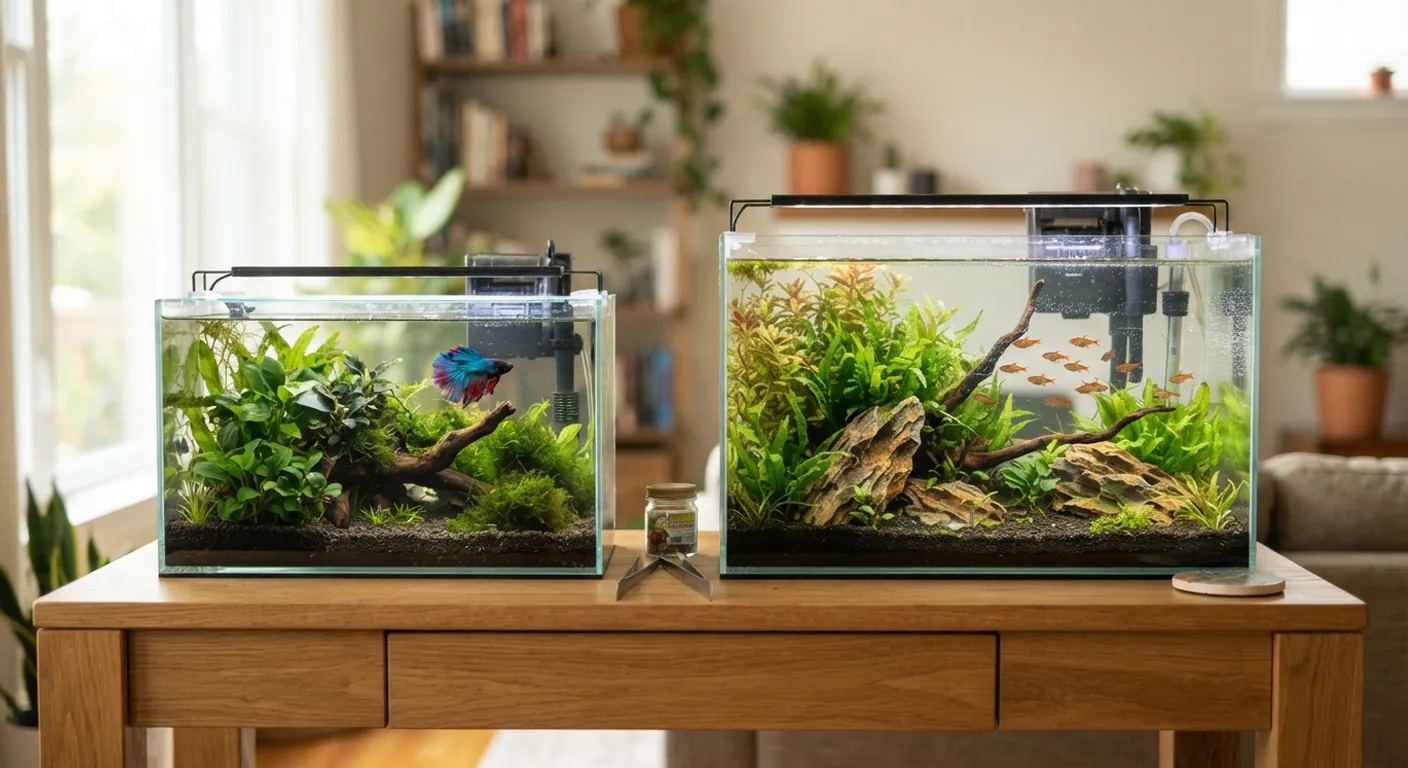
Here’s the short answer. Both sizes can work. They just fit different setups.
A 10-gallon tank is usually easier for a beginner. The extra water gives you more room for mistakes. It also gives you more options for what you keep. A 5-gallon tank can still be a good pick. You need the right equipment and steady care. And you need to plan it on purpose.
In this guide, I’ll compare the two on space, water stability, stocking, upkeep, and cost. I’ll also cover bettas and a few other setups. By the end, you’ll know which size fits your space, your experience, and your plans.
Table of Content
Toggle5-Gallon vs. 10-Gallon Fish Tank at a Glance
Quick note first. When I say “5 gallons,” I mean US gallons. Some standard tanks are sold as 5.5 gallons. Those are listed separately.
| Factor | 5-gallon | 10-gallon |
| Capacity | About 5 gallons (5.5 on some models) | 10 gallons |
| Stocking | Limited and deliberate | More room, but still limited |
| Water stability | Changes faster when something goes wrong | More margin for error |
| Maintenance | Less water to move per change | More water to move, same basic tasks |
| Best fit | Tight spaces, a single betta, a planted shrimp display | Beginners with space, roomier layouts |
| Main limitation | Little room for error | Needs more space and a stronger stand |
How Much More Space Does a 10-Gallon Tank Need
People look at the gallon number and think it’s a small jump. The real size on your desk tells a different story.
Compare Actual Dimensions
Take Aqueon as an example. Their standard 5.5-gallon tank is 16.25 × 8.375 × 10.5 inches. Their 10-gallon tank is 20.25 × 10.5 × 12.625 inches. That’s about four inches more length. And a little over two inches more width.
That might not sound like much. On a small desk, it is. Keep in mind these numbers only apply to this brand. Other brands and shapes will differ.
Measure the Space and Check Filled Weight
Before you buy, grab a tape measure. Check the room for the filter. Check that you can lift the lid and fit a siphon in. Make sure you can reach the plugs and equipment. And find a spot to keep your supplies.
Now think about weight. This is the part people skip. Your furniture has to hold the filled tank. That means the tank plus water plus substrate plus rocks and wood plus equipment. The empty weight doesn’t matter.
Use a stand rated for the load. Don’t judge a desk or dresser by how it looks. Sturdy-looking furniture can still fail under a full tank.
Which Tank Is Easier to Keep Stable
The bigger tank is easier. But there’s more to the story.
Why Extra Water Gives You More Margin
Think about it like this. Say your fish make a certain amount of waste. In 5 gallons, that waste gets packed into less water. In 10 gallons, it spreads out more. Same waste. Lower concentration.
Here’s a simple way to picture it. Put one spoonful of salt in a small glass of water. Now put that same spoonful in a big pitcher. The glass tastes way saltier. That’s just an example to explain the idea. It’s not a stock calculator.
Larger tanks are also steadier with temperature and water chemistry. They don’t swing as fast.
Now here’s the catch. More water doesn’t mean you can skip anything. You still need a filter. You still need to cycle the tank. You still need to test the water and do water changes.
Comparable Stocking and a Cycled Tank
Let’s be fair about this. The comparison only works when the stocking is equal. A lightly stocked 5-gallon beats an overcrowded 10-gallon every time. Size alone doesn’t save you.
Both tanks also need a cycled filter before any fish go in. That means the good bacteria are established. And you’ve confirmed it with water tests. Don’t guess on this one.
What Can You Keep in Each Tank
Tank size changes what you can keep. I won’t give you a giant species list here. Let’s just look at the main ideas.
When a 5-Gallon Setup Makes Sense
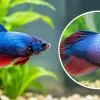
The most common pick is a single betta. Veterinary guidance supports 5 gallons or more for a betta. You also need gentle filtration, a heater, shelter, and regular upkeep. So it works. It just needs the right gear.
Another good pick is a planted shrimp display. A small tank can look great with plants and a few shrimp.
One thing to watch. Don’t toss shrimp or snails in with every betta. Some bettas will hunt them. Not every betta setup needs tankmates.
What a 10-Gallon Tank Changes
The extra space opens up a few things. You could do a roomier betta tank. You could do a shrimp layout with more space. Or you could keep one researched group of small fish.
Here’s one example. Ember tetras are tiny. Adults reach about 0.8 inches. They like to be in a group of at least eight. They do best in warm, soft, slightly acidic water. Always double-check these details for any species before you buy. Look at adult size, group needs, and water needs together.
Now, a warning. More capacity doesn’t make bettas good tankmates. Aqueon recommends 15 gallons or more for a betta community tank. So 10 gallons won’t get you there.
And there’s no maximum fish count for a 10-gallon. I know people want a number. But it doesn’t work like that. Pick the species first. Then check adult size, compatibility, and tank dimensions.
Is a 10-Gallon Tank Better for a Betta
This is the question I hear most. And the answer is a little more careful than yes or no.
A Suitable 5-Gallon vs. a Roomier 10-Gallon
A well-equipped 5-gallon fits the University of Illinois veterinary guidance. So it’s a solid home for a betta. A 10-gallon gives you more room and more water volume. That’s a nice bonus.
In both tanks, the same things matter. Plants. Shelter. Spots to rest. And open space to swim. Bettas don’t like strong current either. So don’t use the extra volume as a reason to crank up the flow.
What Recent Research Shows
A 2024 study looked at male bettas. It found that tank size and furnishings changed how they behaved. The largest tank in that study was about 19.3 liters. And it didn’t compare 5- and 10-gallon tanks head-to-head.
So here’s the takeaway. The environment matters. But nobody has proven an exact cutoff. Don’t let anyone tell you otherwise.
Does a 10-Gallon Tank Cost or Take More
“Less water to carry” and “easier to keep stable” are two different things. Let’s look at both work and money.
Maintenance Work
Most of the chores are the same in both tanks. Feeding and testing depend on what lives in there. Cleaning the glass and equipment depends on algae, lighting, and gear. Tank size isn’t the big factor.
Water changes are where you feel the difference. A 25% change is about 1.25 gallons in a nominal 5-gallon tank. In a 10-gallon, it’s about 2.5 gallons. Real volumes run lower once you add substrate and rocks. So treat those numbers as rough.
Don’t set your schedule by gallons. Set it by your stocking and your test results.
Up-Front and Running Costs
Compare the full setup. Not just the bare tank. You’ll need a tank or kit, a lid, lighting, a filter, and a heater if your fish need one. Add a thermometer, water conditioner, and a test kit. Then add substrate, rocks or wood, and plants. Don’t forget a siphon, a bucket, and a stand that can hold it all.
Check what’s inside any kit, item by item. Aqueon’s 5.5-gallon LED kit, for example, lists the tank, hood, filter, and cartridge. Other kits include more or less.
Ten gallons doesn’t cost twice as much as five. Some items work for either tank. And a fancy small kit isn’t the same as a basic larger tank. You can’t compare them one to one.
For running costs, look at actual wattage, heater needs, replacement filter parts, and other consumables. Those add up over time.
Which Tank Should You Choose
Let’s boil it down to two quick checklists.
Choose 5 Gallons If
You’ve measured your space, and it’s truly limited.
You’ve picked inhabitants that fit a small tank.
You’re happy with limited stocking.
You can provide proper equipment and steady care.
You don’t plan to build a mixed community later.
Here’s what I’d say to a friend. Five gallons should be a plan. It shouldn’t be a reaction to a lower price tag.
Choose 10 Gallons If
You’re a beginner, and you have the space and the support for it.
You want more room for plants and layout.
You want more margin under comparable stocking.
Your species need the extra space.
Even then, ten gallons has limits. It’s not a magic number.
Already Own a 5-Gallon? Decide Whether to Upgrade
Slow down before you buy a bigger tank. First look at what you have. Review your exact species needs and group requirements. Look at your current stocking, how your equipment fits, your test patterns, and your layout.
An upgrade won’t fix overfeeding. It won’t fix unsuitable stocking. And it won’t fix a filter that never finished cycling. Those problems just move to a bigger box.
If you do move, plan the transfer. Test the water along the way.
Conclusion
So which one should you pick? If you’re a beginner with enough space and a sturdy stand, the 10-gallon is often the better start. The extra water gives you more room for livestock. It also gives you a bigger margin to keep things steady.
A 5-gallon can still work. You just need a careful plan, the right inhabitants, and steady upkeep. And neither size is right for every species.
Here’s the main thing. Pick the tank based on the fish, not the price or the empty spot on your shelf. Look at adult size, behavior, and space needs first. More water helps. But it doesn’t make a bad stocking choice okay.
Before you buy, measure your space. Budget for the whole setup. And think about the upkeep you’ll be doing a year from now. Do that, and you’ll be in good shape.
Related Products For Your Reference
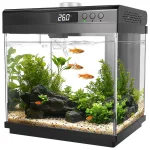
3.7 Gal Aquarium Kit: Filter, 10-Color Light, Self-Cleaning,...

Add comment
You must be logged in to post a comment.