
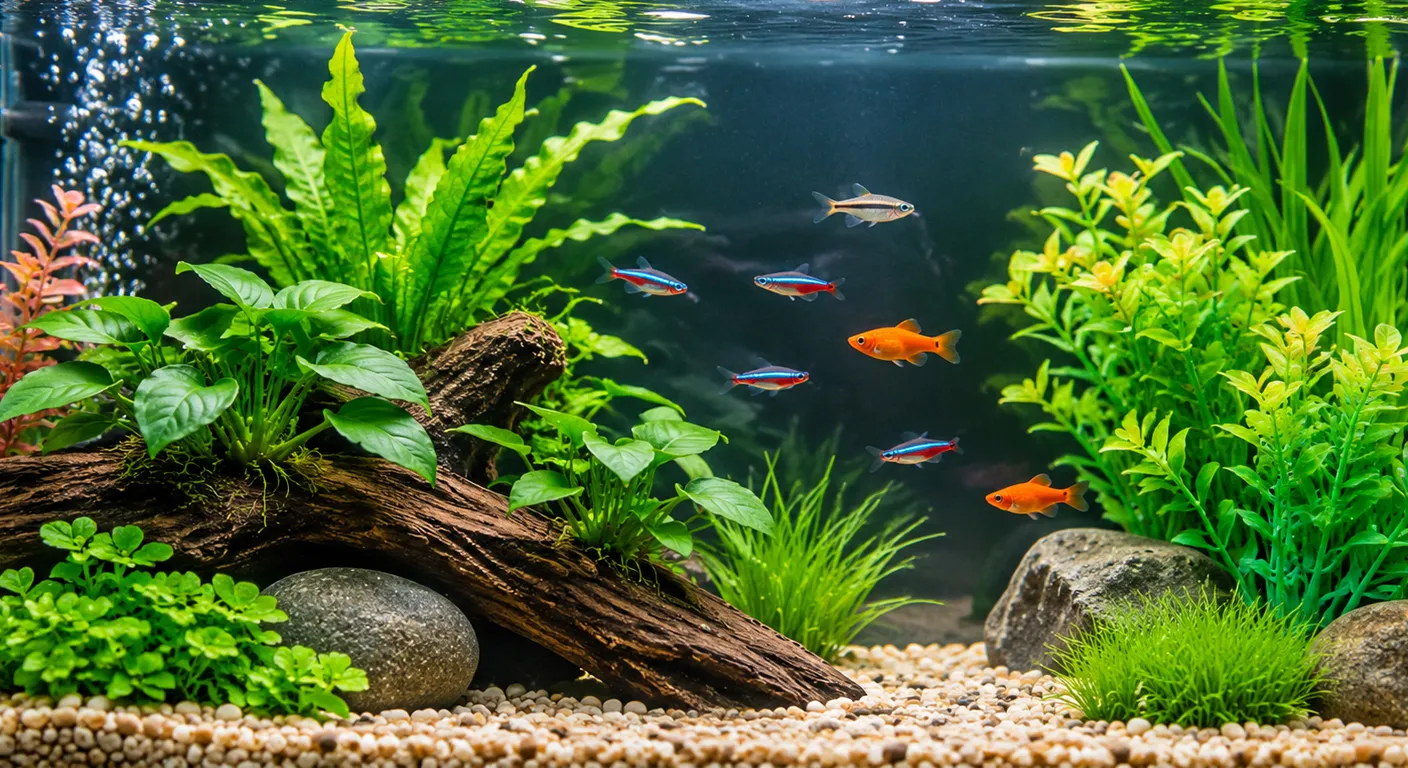
Yes, live and artificial plants can work well together in an aquarium. This mix suits a few common situations. You might want to keep a favorite decoration while adding live plants slowly. You might have fish that dig up or nibble on greenery.
You might also want a low effort setup on a tight budget. The trick is choosing safe artificial plants and live plants that match your tank conditions.
This guide explains when a mixed planting setup makes sense. It also covers how to pick compatible plants, arrange them for a balanced look, and keep both types healthy over time.
Table of Content
ToggleWhen a Mixed Aquarium Makes Sense
A mixed tank works best in three situations. The first is when you already own decorations you like. Fake plants let you keep them in the water while live plants fill in around them.
The second situation involves fish that tend to uproot greenery. Corydoras and some cichlids sift through gravel and pull at roots. Goldfish and other fish graze on soft leaves. Artificial plants can take the damage while you place the tougher live species in more protected spots.
The third situation is cost and effort. Live plants need suitable light, nutrients, and regular trimming. Fake plants need none of that.
Be clear about one thing, though. Fake plants add decoration, but they cannot do what live plants do. Live plants absorb nitrates, release oxygen during photosynthesis, and give fish natural cover. Artificial plants cannot replace those functions. The tank still needs regular water changes and proper filtration.
Choosing Plants That Work Together
Good results start with checking what you already have. After that, you match new live plants to the conditions in your tank.
Quick Check for Artificial Plants
Run three checks on every fake plant before it goes in the tank.
Stable base. The plant should stand upright or sit firmly in the substrate without tipping over.
No rough edges or exposed parts. Sharp plastic tips can scratch fish or catch on fins. Exposed wire stems cause the same problem.
No visible wear. Peeling paint, flaking coating, or faded dye can release particles into the water. Retire any plant showing these signs.
Rinse every new plant in warm water before use. If it has a strong factory smell, soak it in plain water for a day. For more detail on plastic plant materials, read our [link to plastic plants guide].
Matching Live Plants to Your Tank
Check four factors before buying any live plant. Match the plant to your light level, planting method, fish behavior, and mature size.
Light matters most. A plant that needs bright light will slowly decline in a dim tank. Planting method comes next. Some plants root into the substrate. Others need to be tied or glued to rock and wood. Floating plants simply drift. Fish behavior decides which spots are safe, and mature size decides how much room each plant needs.
These four beginner plants suit most mixed tanks:
Java fern (Microsorum pteropus). Low to moderate light. Tie or glue it to wood or rock. Never bury the rhizome, because it will rot.
Anubias (Anubias barteri var. nana). Low to moderate light. Attach it to hardscape the same way as Java fern. Its tough leaves discourage many grazing fish.
Vallisneria (Vallisneria spiralis). Moderate to high light. Plant the roots in substrate. It spreads through runners, so trim them regularly.
Amazon sword (Echinodorus bleheri). Moderate to high light. Plant it in substrate, and root tabs help it grow strongly. It gets large, so keep it toward the back.
How to Arrange Them
Arranging the tank works best when you follow a clear order. Start with the living plants, because their needs set the layout.
1. Place Live Plants First
Put high light plants where the lamp reaches most evenly. Position low light plants in shadier corners or beneath taller plants. Think about growth habit as well. A tall plant at the back keeps the front open. A creeping plant works well along the front glass.
Leave room to reach in for trimming and cleaning. A plant pushed against the filter outflow or the glass is hard to maintain. It also tends to struggle.
2. Add Fake Plants for Balance
Fake plants support the layout without taking over. Repeat a shape from the live plants, such as the long blades of an Amazon sword. Match leaf size and color so the two types blend together. Use a fake plant to cover a deliberate gap, like a bare patch near the glass.
Keep fake plants out of the live plants’ light. A tall artificial plant placed above a low light plant casts shade and slowly weakens it. Place fakes beside or behind the live plants instead.
3. Protect Swimming Space and Access
Keep an open swimming area in the center or along the front. Schooling fish need open water to move as a group. Leave a clear path to reach the heater, filter, and intake tube.
Check the setup from several angles. A layout that looks balanced from the front can look crowded from the side. View it from above too, since that angle shows whether light reaches every plant.
Layout Ideas for a Mixed-Plant Aquarium
These three layouts give you a starting point. None of them are fixed rules for every tank.
| Layout | Live-plant role | Fake-plant role | Specific tip |
| Gradual transition | Starts in one corner and fills in over several weeks | Holds the empty space until live plants establish | Add two or three live plants at a time and keep them in one zone |
| Open center | Frames the edges with Anubias and Java fern on wood | Sits low in back corners and never in the middle floor | Keep the center clear so fish can swim and sift freely |
| Feature focused | Makes one Amazon sword the centerpiece | Fills gaps around its base with low plants | Choose one focal plant and limit everything else to support it |
Here is one example for a 75 liter tank. A piece of driftwood sits on the left third, with Java fern and Anubias tied to it. A low fake plant fills the right back corner, and the front center stays open. Over several months, the Java fern spreads across the wood and softens the empty look on the left side.
Common Mistakes
Packing too many plants into one area blocks light and water flow.
Mismatched colors. Bright plastic greens placed next to soft live leaves look fake very quickly.
Decor shading plants. A tall ornament or fake plant can block light from reaching the live plants below it.
Maintaining an Aquarium with Live and Artificial Plants
Both plant types need ongoing attention, but the tasks differ. Live plants need active care. Fake plants mostly need occasional inspection and cleaning.
1. Caring for Live Plants
Watch how your plants grow each week. Trim stems and leaves that block light or crowd their neighbors. Move a plant if it stretches toward the light or stops growing. Yellowing leaves can point to a nutrient problem or insufficient light.
Re-check fake plant placement as live plants grow. A spot that once had clear light may now sit in shade. Work around the decorations gently during maintenance so nothing gets knocked loose.
2. Cleaning Artificial Plants
Clean fake plants about once a month, or sooner if algae builds up. Lift each plant straight up when removing it. Twisting can tear the roots of nearby live plants or disturb the substrate around them.
Rinse the plant in warm water and scrub gently with a soft brush. Skip soap, detergent, and bleach. Even small residues can harm fish. For a step by step walkthrough, see our [link to cleaning guide].
3. Common Questions
Do fake plants need replacing? Good quality plastic lasts for years. Replace any plant that cracks, fades, or sheds material.
Can fish that eat plants live with a mixed tank? Yes, if you choose tougher species like Anubias and Java fern. Fake plants also give fish extra cover and reduce pressure on the live plants.
Conclusion
A mixed planting setup combines the natural growth of live plants with the flexibility of artificial ones. There is no fixed ratio to follow. What matters is choosing suitable plants, arranging them without blocking light or swimming space, and keeping the whole setup easy to maintain.
Arrange live plants according to their light and growth needs first. Then use artificial plants to complement the layout. Check every decoration for sharp edges, exposed parts, and signs of damage before it goes in.
If you are unsure where to start, try one mixed planting area instead of redesigning the entire aquarium at once. A single zone lets you learn how your plants respond. It also gives you room to adjust before you commit to a larger change.



Add comment
You must be logged in to post a comment.