
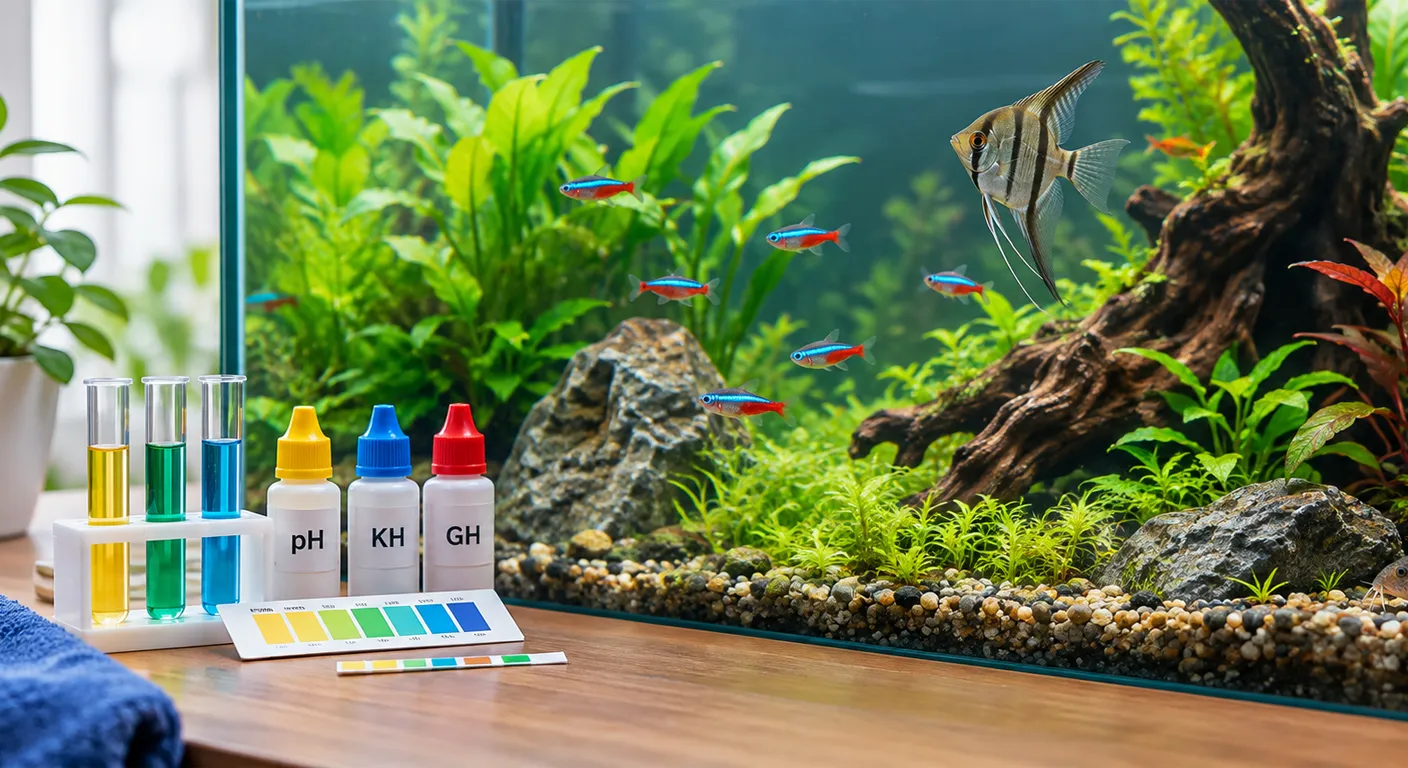
Lowering pH can benefit certain fish, shrimp, or planted setups, but chasing a specific number is often riskier than leaving a stable, species-appropriate pH alone. Before changing anything, test your pH, KH, and GH. Figure out what is keeping your water alkaline in the first place. A number on a test strip means very little without that context.
This guide walks through when lowering pH is actually necessary, how to trace the cause of high pH, which methods are safe and which are not, and how to make gradual adjustments without putting your fish under stress.
Table of Content
ToggleShould You Lower Your Fish Tank pH
Not every aquarium sitting above pH 7 needs treatment. A community tank with a pH of 7.6 that has stayed steady for months, housing fish that came from similarly hard water, usually does not need intervention. Fish species, current health, pH stability, and water hardness matter far more than a single reading on a test kit.
Many South American fish and blackwater species, including tetras, discus, and certain catfish, evolved in soft, acidic rivers and generally prefer that environment. Livebearers such as mollies and guppies, along with African rift lake cichlids, often tolerate or actively prefer harder, alkaline water. Moving a hardy livebearer into acidic water because a chart said pH 7 is the “ideal” number can do more harm than leaving the tank alone.
The real question is not what the number reads today. It is whether the current water chemistry matches what your fish needs and whether that chemistry stays consistent from week to week.
Test pH, KH, and GH First
pH should never be tested alone. On its own, it tells you almost nothing about what is driving the reading or how easily it will change.
pH measures how acidic or alkaline the water is.
KH (carbonate hardness) measures buffering capacity, or how strongly the water resists a change in pH.
GH (general hardness) measures dissolved minerals, mainly calcium and magnesium.
High KH is usually the real reason pH stays elevated. When carbonate hardness is high, water acts as a chemical shock absorber. Add an acid, and the KH neutralizes it almost immediately, pulling pH back toward its original point within hours. This is why quick pH-lowering attempts so often fail or produce a dangerous swing back.
Test both your tank and tap water before choosing any method. If your tap water already comes out of the faucet at pH 8.0 with a KH of 12 dGH, no amount of tank additive is going to hold a lower pH for long. The fix has to start with the source water, not the tank itself.
Find the Cause of High pH.
Identifying what is pushing your pH up matters more than repeatedly dosing pH-lowering chemicals. Treating the symptom without addressing the source turns pH management into a permanent chore.
Common causes include:
Naturally hard or alkaline tap water, which is common in many municipal supplies drawing from limestone-heavy aquifers.
Crushed coral, shells, limestone, aragonite sand, or certain decorative rocks that slowly dissolve and release carbonates.
Mineral-heavy gravel or substrate marketed for African cichlid tanks, which is designed specifically to raise and hold hardness.
High KH in the source water itself, independent of anything inside the tank.
Replacement water during water changes that differs significantly from the water already in the aquarium.
If the underlying carbonate source stays in place, whether that is a piece of limestone rock or hard tap water used for every water change, pH will keep drifting back toward its original level. A tank can look “fixed” for a week and then return to baseline the moment a water change is performed with untreated tap water.
Safe Ways to Lower pH in a Fish Tank
This is the section most aquarists come looking for, so it helps to frame it correctly first. The right method depends on your current KH, the species you keep, your tank size, and how much of an actual adjustment is needed. A half-point drop calls for a very different approach than cutting pH by a full point or more.
Generally, natural methods work well for small, gentle adjustments. RO or DI water is better suited to larger or long-term changes, particularly in tanks with persistently hard tap water.
Use RO or Distilled Water for Controlled Changes
Reverse osmosis (RO), deionized (DI), or distilled water contains very few dissolved minerals compared with typical tap water. Mixing it with your existing tap water dilutes both KH and GH, which allows pH to settle lower in a more predictable, natural way rather than being forced down chemically.
This is the most consistent long-term option for aquarists dealing with very hard tap water, or for species that genuinely need soft, low-mineral conditions such as wild-caught discus or certain rare tetras. A basic RO unit paired with a remineralizing product, dosed to bring GH back up to a safe minimum, gives far more control than any bottled additive.
The tradeoff is the upfront cost and the extra step of mixing water ahead of each change. For a small tank, this can mean keeping jugs of premixed water on hand rather than filling straight from the tap.
Add Driftwood, Indian Almond Leaves, or Peat Moss
These three options share a similar mechanism, so it makes sense to group them rather than repeat the same explanation three times.
Driftwood, Indian almond leaves, alder cones, and aquarium-safe peat all release tannins and mild organic acids as they break down in water. Tannins are the compounds responsible for that tea-colored tint often seen in blackwater aquariums. Over time, these materials can gently lower pH while also creating the kind of soft, tinted water that blackwater species evolved in.
A few safety points are worth following closely:
Use only aquarium-safe products, sold specifically for aquarium use rather than craft or garden supplies.
Start with a small amount, such as one or two almond leaves in a modest tank, rather than loading the aquarium at once.
Monitor pH, KH, and fish behavior over the following week before adding more.
Avoid garden peat moss that contains fertilizers or unknown additives, since these can introduce compounds that are harmful to fish and invertebrates.
Because these materials work gradually, they suit aquarists who want a mild, ongoing effect rather than a fast correction.
Manage CO2 Carefully in Planted Tanks
In a planted aquarium with injected CO2, dissolved carbon dioxide can lower pH, particularly while the lights are on and CO2 injection is active. This effect exists to support plant growth through photosynthesis. It should never be treated as a shortcut for hitting a target pH number.
pH typically rises again once CO2 injection stops for the night or when surface agitation from a filter outlet or air stone releases dissolved gas back into the atmosphere. That daily swing is normal in a healthy planted tank, but it also means CO2 is not a stable way to hold pH at a fixed point.
Excessive CO2 is genuinely dangerous. It can suffocate fish and shrimp by reducing dissolved oxygen and lowering blood pH, sometimes with very little warning before symptoms appear. CO2 should be dialed in for plant health, with a drop checker or similar tool confirming safe levels, not pushed higher in an attempt to chase a lower pH reading.
Use Commercial pH Reducers With Caution
Bottled “pH down” products can lower pH quickly, sometimes within minutes of dosing. What they do not do is solve the underlying KH or hardness problem that caused the high pH in the first place.
Because the carbonate buffering system remains intact, pH often rebounds after the next water change, especially if that change uses untreated tap water. This creates a cycle of repeated dosing that stresses fish more than a stable, slightly higher pH ever would.
These products should not be a first choice for routine pH management. Modifying the hardness of the source water, whether through RO water, natural tannin sources, or simply choosing fish suited to your existing water, is a far more sustainable path than relying on an acidifying additive week after week.
How to Lower pH Without Stressing Fish
Whatever method you choose, safety comes down to gradual change and consistent testing. Aquarists should avoid large, sudden shifts in pH, KH, or GH within a short period. A drop of more than 0.3 in a single day is generally considered risky for most freshwater species.
Watch for signs that fish are struggling to adjust:
Rapid breathing or gasping at the water surface.
Hiding, clamped fins, or unusual lethargy.
Erratic or frantic swimming.
Sudden loss of appetite or noticeable color changes.
These symptoms can stem from several different causes, not only pH swings. A fish showing stress signs should prompt a full round of water testing, covering ammonia, nitrite, nitrate, pH, KH, and GH, rather than an automatic reach for more pH-lowering treatment. Adding another dose of acid to a fish that is already struggling for an unrelated reason can turn a manageable problem into a serious one.
Quick Guide: Choosing a pH-Lowering Method
| Situation | Best Starting Approach | Important Note |
| Fish are healthy, and pH is stable | Leave the tank as is | A stable reading above 7 is usually safer than forcing a change |
| Tap water is hard with high KH | RO or distilled water blended with tap water | Address KH at the source rather than treating the tank alone |
| Slight pH reduction is needed | Driftwood, Indian almond leaves, or aquarium-safe peat | Start small and monitor for one to two weeks before adding more |
| Planted aquarium with injected CO2 | Adjust CO2 for plant health, not pH targets | Confirm safe levels with a drop checker, not a pH reading alone |
| pH keeps rebounding | Test KH and tap water before repeating treatment | Repeated dosing without fixing KH usually fails again |
Common Mistakes to Avoid
Most pH-related problems in home aquariums come from overcorrection, not the original pH reading itself.
Chasing a Perfect pH Number
Many care sheets list an “ideal” pH as though every fish of a species needs that exact figure. In practice, fish tolerate a reasonable range far better than they tolerate constant fluctuation. A tank held steadily at pH 7.4 is usually a better home than one being pushed down toward 6.8 every few days and drifting back up in between.
Using Household Acids or DIY Shortcuts
Vinegar, lemon juice, and other household acids sometimes get suggested online as cheap pH-lowering tricks. These are unpredictable in an aquarium. They can crash pH far below a safe range within hours, and they offer none of the buffering or gradual release that purpose-made aquarium products provide. The risk to fish far outweighs any cost saved.
Ignoring KH and Water Source
Treating symptoms in the tank while ignoring hard tap water or a carbonate-rich substrate guarantees the problem returns. Every water change reintroduces the same hardness that caused the issue in the first place. Testing tap water before it ever goes into the tank saves far more time than repeated troubleshooting later.
Conclusion
Lowering aquarium pH is not always necessary, and the real goal should be a stable, species-appropriate environment rather than a “perfect” number copied from a care guide. Start by testing your aquarium and tap water, then trace the underlying cause before reaching for any pH-lowering product.
For gentle, gradual changes, natural options such as driftwood or Indian almond leaves work well and suit most community tanks. RO or distilled water offers more controlled results when hard, high-KH tap water is the main obstacle, particularly for species that need genuinely soft conditions.
Whichever path you take, make changes gradually. Keep testing pH, KH, and GH, and watch fish behavior closely. Give the aquarium time to stabilize between adjustments rather than rushing toward a target number. A tank that holds steady, even at a higher pH than a chart recommends, will almost always serve your fish better than one in constant chemical flux.
Related Products For Your Reference
Ultra Quiet Aquarium Protein Skimmer for 50-80 Gallon...



Add comment
You must be logged in to post a comment.