
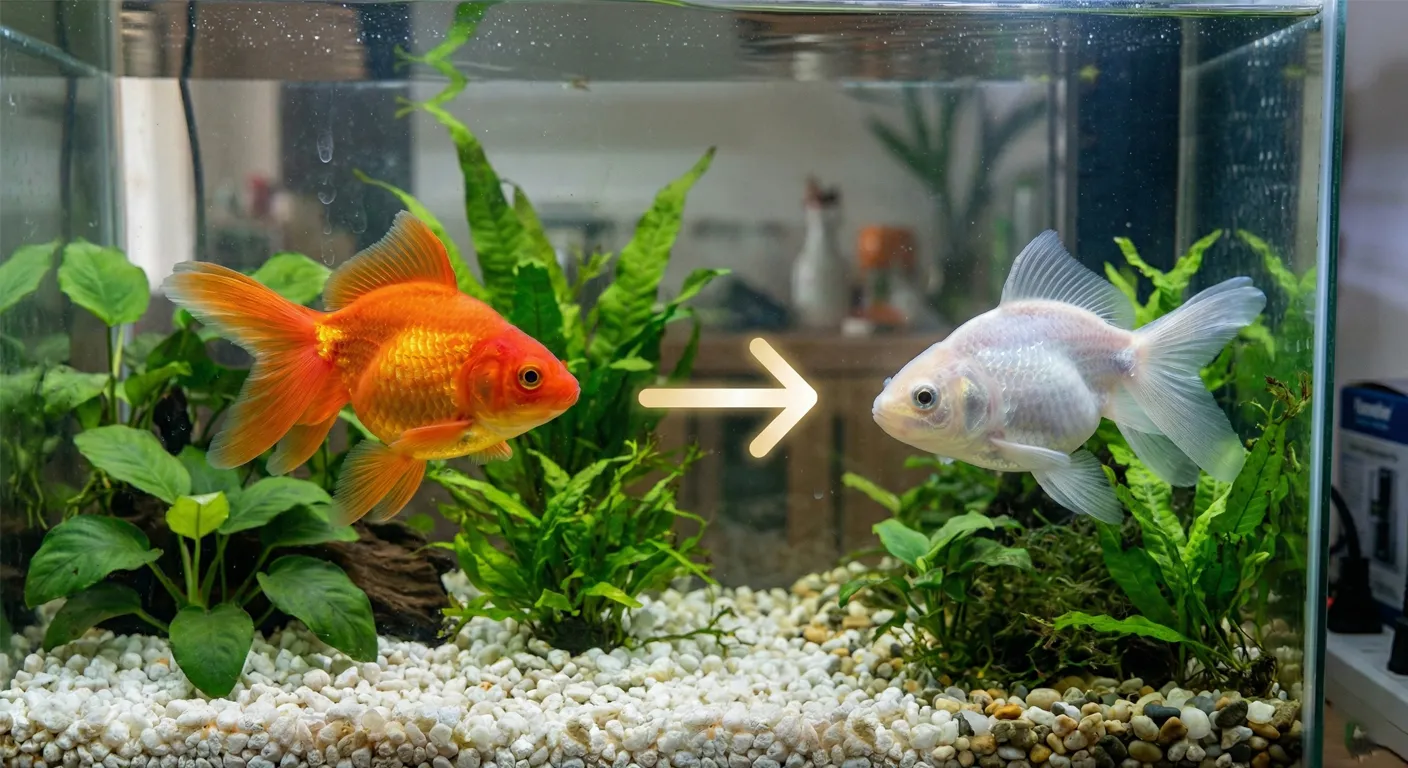
During a routine feeding, a goldfish that was bright orange just weeks prior appeared pale and patchy at the water’s surface. The immediate assumption was disease. As it turned out, the pattern of the color change itself pointed directly to the cause.
Goldfish turning white is not a single issue. There are several distinct ones. Moreover, some goldfish also turn black. Aging and genetics sit at the harmless end. Ich and water quality failure sit at the other. Correct identification matters far more than a fast reaction to the wrong cause.
In this guide covers the biology behind goldfish coloration, three diagnostic color change patterns, breed-specific tendencies, environmental and dietary influences, and clear guidance on determining what is happening and what action is actually needed.
The Biology Behind Goldfish Color Change
How Goldfish Actually Produce Color
Goldfish skin contains three specialized pigment cell types called chromatophores, and each one does a different job.
Xanthophores carry yellow and red pigments derived from dietary carotenoids. These cells cannot synthesize carotenoids independently. The fish must consume them through food, which makes the diet directly responsible for much of the orange and red coloration seen in domestic breeds.
Melanophores produce melanin, the same dark pigment found across vertebrate species. These cells control black, brown, and deep grey tones. When melanophores contract or are suppressed, underlying layers of the skin become visible, which contributes to whitening.
Iridophores reflect light using crystalline guanine platelets. They create the metallic sheen and iridescent quality common in many breeds. Structural changes in guanine arrangement directly alter how light bounces off the fish, shifting perceived color even without pigment loss.
When any of these cell types underperforms, either from suppression, diet, light deprivation, or cellular damage, the fish fades toward white or pale grey. The biology is specific: it is not simply “stress” causing the change. Actual cellular mechanisms are failing or shifting.
Worth noting. The vivid orange, red, and calico patterns that define pet goldfish do not occur in wild populations. Wild goldfish (Carassius auratus) are olive-brown. The striking colors seen in aquariums and garden ponds are the result of centuries of selective breeding, and they exist on a biological knife’s edge. Without the right inputs, namely carotenoids, light, and stable water chemistry, those colors retreat toward the ancestral baseline.
Why Pond Goldfish Tend to Hold Color Better Than Tank Goldfish
This comparison is worth understanding because it directly informs what tank owners can do differently.
Pond fish receive consistent advantages that most aquarium setups cannot replicate:
Full-spectrum and UV light: Natural sunlight delivers UV-A wavelengths that directly stimulate xanthophore activity. Most standard aquarium bulbs omit this range entirely.
Carotenoid-rich natural diet: Pond fish graze on algae, daphnia, insect larvae, and plant matter continuously. Each of these is dense with the carotenoids that xanthophores depend on.
Seasonal temperature cycling: Natural temperature fluctuation through seasons activates hormonal rhythms that regulate pigmentation. Flat, stable aquarium temperatures suppress those cycles.
Lower chronic stress: Open water with natural flow, more territory, and fewer artificial disturbances keeps cortisol levels lower. Chronic cortisol elevation suppresses chromatophore function.
If a tank goldfish is fading gradually over months with no other symptoms, the environment itself is the likely culprit, not disease or age.
Which Goldfish Breeds Are Most Likely to Turn White?
Color stability is not uniform across breeds. Genetics sets the baseline.
| Breed | Color Stability | Common Pattern |
| Black Moor | Low | Gradually shifts from black to bronze or grey with age; nearly universal |
| Shubunkin / Calico | Low to Moderate | Patches lighten unpredictably; blue areas are especially prone to fading |
| Ryukin | Moderate | Red and white patterns are generally stable, with some fading at red-white borders |
| Oranda (red cap) | Moderate | Cap coloration can shrink or pale; the body is usually stable |
| Common / Comet | High | Single-color orange or red typically holds well with a proper diet |
| Fantail | Moderate to High | Relatively stable; bicolor patterns occasionally shift at boundaries |
| Ranchu / Lionhead | Moderate | Dorsal coloration prone to lightening; wen development affects perceived tone |
Black Moor owners in particular should expect gradual bronzing. It is breed behavior, not illness. Shubunkin calico patterns are similarly unstable by design.
The Three Patterns of Goldfish Turning White
Identifying the specific pattern before concluding is the single most useful diagnostic step an owner can take. The pattern tells you what category of cause to investigate.
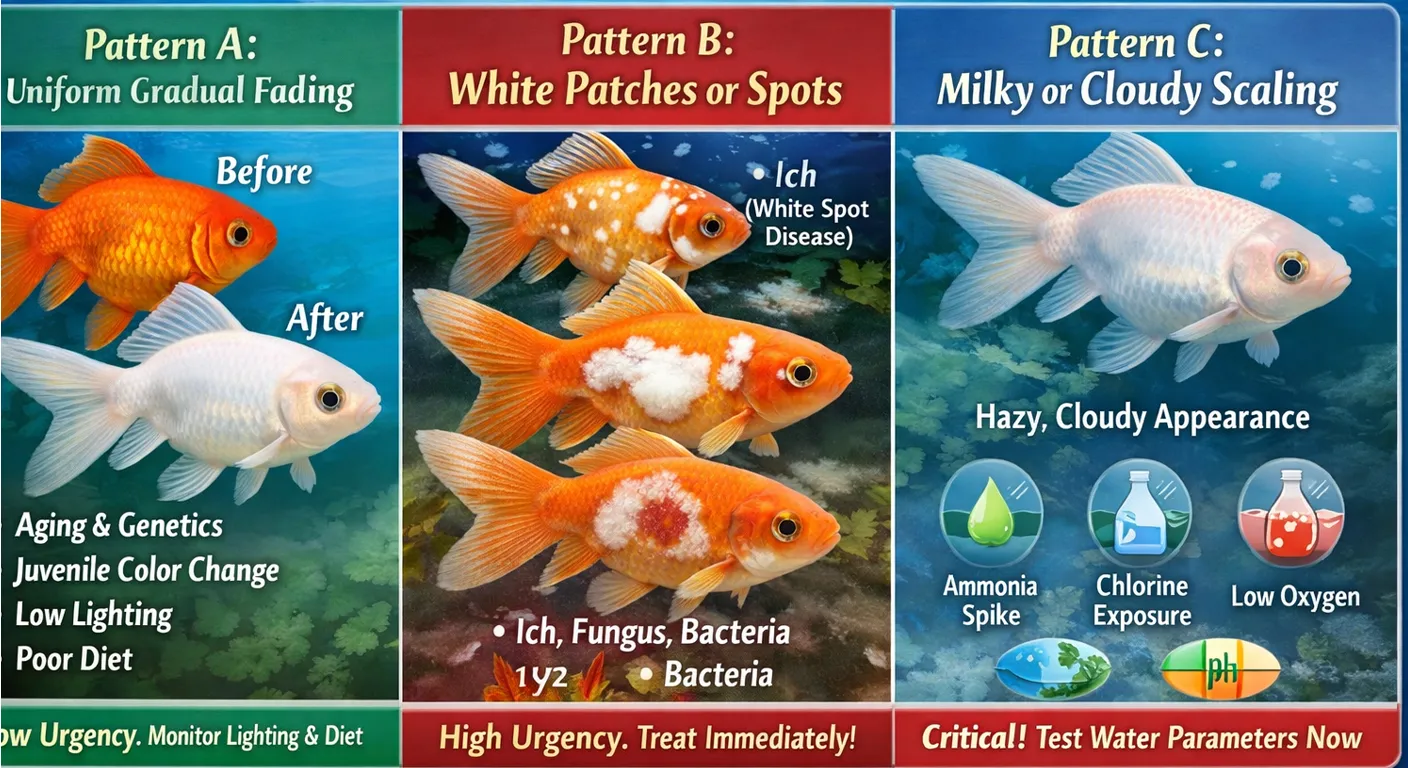
Pattern A: Uniform Gradual Fading
The entire body lightens slowly, over weeks or months, without spots, without texture changes, and without behavioral shifts. This is the least urgent pattern.
Likely causes, ranked from most to least probable:
Aging: Chromatophore density decreases naturally over time. A five-year-old goldfish that is paler than it was at age two is often simply aging.
Genetics: Some lineages carry genes for reduced pigmentation expression as the fish matures. This is especially true in Black Moors and some Shubunkin lines.
Juvenile color development: Young goldfish under 18 months frequently shift color as adult pigmentation establishes. Orange fry that appear white or translucent early in life often develop full color later.
Insufficient lighting: Tanks running bulbs older than 12 months, or lacking full-spectrum output, see gradual xanthophore suppression.
Dietary carotenoid deficiency: A pellet-only diet without carotenoid supplementation depletes xanthophore pigment stores over time.
Urgency level: Low. Monitor behavior. Investigate lighting and diet before assuming disease.
Pattern B: White Patches or Spots
This pattern warrants immediate, careful examination. White patches and white spots are easy to confuse with each other and with benign color shifts, but the distinctions carry serious health implications.
Ich (white spot disease): Caused by Ichthyophthirius multifiliis, a protozoan parasite. Presents as small, uniform, raised white dots resembling grains of salt scattered across fins and body. The fish typically scratches against surfaces (flashing) and may breathe rapidly. Highly contagious. Lethal if untreated.
Ordinary color change: Presents as flat, irregular patches with no texture change. The fish behaves normally. No scratching, no labored breathing.
Fungal infection: Cottony, fibrous white growth, usually following an injury site. Texture is visibly different from both ich and flat color patches.
Bacterial lesion: Often appears as a white or grey ulcer with reddened edges. Usually localized to one area.
Raised white dots mean treat for ich immediately. Use a heat-and-salt protocol or a proprietary ich treatment, raise water temperature gradually to 28°C (82°F) to accelerate the parasite’s life cycle, and isolate affected fish if possible.
Urgency level: High to critical. Ich spreads to tankmates within 48 to 72 hours.
Pattern C: Milky or Cloudy Scaling
The fish looks almost frosted. The scales themselves take on a hazy, opaque quality rather than white patches appearing on top of them. This is a water chemistry emergency.
The causes, in order of frequency:
Ammonia spike: Ammonia above 0.25 ppm damages gill tissue and triggers mucus overproduction across the body surface, creating a cloudy appearance.
Chlorine exposure: Tap water added without dechlorination burns mucous membranes immediately. Cloudiness appears within hours.
Low dissolved oxygen: Below 6 ppm, fish produce excess mucus as a stress response. Surface gasping accompanies the cloudiness.
pH extremes: Below 6.5 or above 8.5, scale cells absorb water abnormally and develop a swollen, milky look.
Test ammonia, nitrite, dissolved oxygen, and pH immediately. Any ammonia reading above zero requires a 30 to 40 percent partial water change within the hour.
Urgency level: Critical. This pattern reflects systemic physiological stress, not cosmetic change.
Key Causes Explained Further
What Lighting Spectrum and Duration Actually Do
Vague advice about “adequate lighting” misses the mechanism. UV-A wavelengths specifically activate photoreceptor pathways in goldfish skin that trigger xanthophore pigment production. Standard aquarium fluorescent or LED bulbs commonly omit UV-A output entirely.
Practical corrections for tank owners:
Replace bulbs older than 12 months regardless of visible brightness; phosphor degradation drops UV output before visible light fades
Use full-spectrum bulbs rated at 6,500K color temperature or higher
Set a consistent 10 to 12-hour light cycle using a timer; irregular photoperiods disrupt the circadian signals that regulate chromatophore rhythms.
Allow indirect natural light near the tank if placement permits, but avoid direct sunlight, which overheats water and promotes algae overgrowth.
Can Goldfish Food Restore or Prevent Color Loss?
Diet influences pigmentation at the cellular level through a specific biochemical pathway. Goldfish cannot synthesize carotenoids endogenously. Every molecule of red and orange pigment in a xanthophore arrived through food, was absorbed through the gut wall, transported via the bloodstream, and deposited into pigment cells. A diet lacking carotenoids means xanthophores gradually exhaust their pigment stores over weeks.
The most effective carotenoid sources:
Astaxanthin: The most bioavailable carotenoid for goldfish; found in quality color-enhancing pellets and krill-based foods. Produces deep red and orange tones.
Canthaxanthin: Enhances orange and yellow tones; often included in commercial color pellets alongside astaxanthin.
Spirulina algae: A whole-food carotenoid source with additional immune benefits. Available as wafers or as an ingredient in pellets.
Daphnia and brine shrimp: Live or freeze-dried; both provide natural carotenoids in a form that goldfish process efficiently.
Switch to a carotenoid-rich pellet and supplement two to three times weekly with spirulina wafers or freeze-dried daphnia. Visible pigment recovery takes 6 to 10 weeks because chromatophore regeneration is inherently gradual.
Will the Color Come Back? A Realistic Recovery Table
| Cause | Reversible? | Realistic Timeline |
| Insufficient lighting | Yes | 8 to 12 weeks after correction |
| Carotenoid-poor diet | Yes | 6 to 10 weeks |
| Water chemistry problems | Yes, if caught early | 2 to 4 weeks post-stabilization |
| Stress from environmental change | Yes | 3 to 6 weeks |
| Seasonal temperature-related fading | Yes | Returns with temperature rise |
| Fungal or bacterial infection | Partially | Depends on treatment speed |
| Juvenile color development | Yes, resolves naturally | Up to 18 months |
| Genetics | No | Permanent |
| Aging | No | Permanent |
| Breed-specific color instability | Partially | Manageable, not reversible |
| Severe or chronic illness | Unlikely | Prognosis-dependent |
A pale goldfish is not automatically an unwell one. A fish fading from genetics or age can live a full, healthy life with its lighter coloration. The objective of diagnosis is not always color restoration. It confirms the fish is well and addresses correctable causes while they remain fixable.
Conclusion
Goldfish coloration operates through three pigment cell types, each dependent on specific inputs: dietary carotenoids, UV-spectrum light, and stable water chemistry. When those inputs drop, color does too. Breed genetics add another layer, with Black Moors and Shubunkins fading predictably regardless of care quality.
The diagnostic priority is always pattern first: uniform fading points to environment or age, raised white dots point to ich, and milky scaling points to water chemistry failure. Observe behavior alongside appearance. Act on disease signs and water problems without delay. The rest calls for patience and consistency.
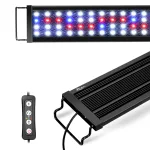
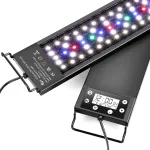
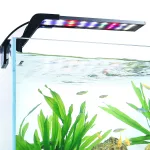
Full Spectrum Aquarium Clip-On LED Light (8W) with...
Original price was: $25.49.$22.99Current price is: $22.99.












Add comment
You must be logged in to post a comment.