
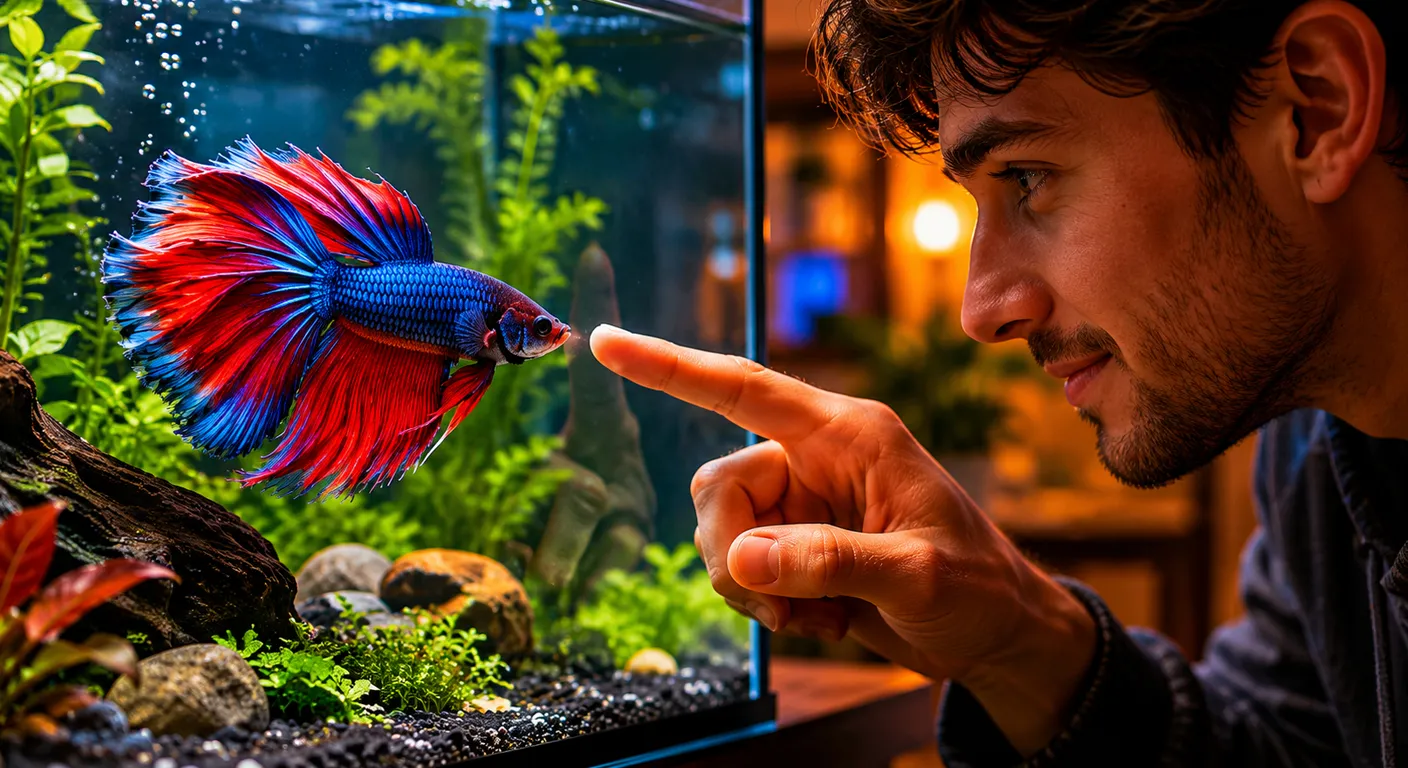
You walk up to your tank. Your betta shoots straight to the glass. Every time. But here’s the thing. Is it recognizing you? Or does it just know that anything moving near the tank usually means food is coming? That’s the question most fish owners never actually stop to ask.
Here’s the short answer. Yes, some fish do recognize their owners. But it’s not that simple. It depends on the species, the routine you’ve built, your tank conditions, and, honestly, what “recognition” even means for a brain that size.
In this guide, we’ll cover exactly how to tell if your fish knows you, how to actually build that bond on purpose, and there’s a behavior checklist at the end so you can track progress yourself.
Why This Question Matters More Than You Think
Fish owners constantly underestimate what’s happening behind the glass. Once you understand recognition, everything changes: how you set up your tank, how you build daily routines, how you interact. It’s not just a fun thought. It actually matters.
Fish cognition: Fish brains are simpler than mammal brains, but not empty. They process information, form associations, and adapt behavior based on experience.
Recognition behavior differs: A betta responds completely differently from a tetra. Species matters more than most people realize when it comes to social awareness.
Aquarium conditions directly: Poor visibility, bad lighting, and wrong tank placement, all of these cut off the visual input your fish needs to even begin recognizing you.
Knowing the signs: Most owners miss recognition behavior because they don’t know what to look for. Once you do, it changes how you read your fish entirely.
What “Fish Recognizing Owners” Actually Means
There’s a big difference between a fish that knows your face and a fish that knows your routine. Most people assume it’s one or the other. It’s actually more complicated than that. True face recognition exists in some species. But a lot of what owners experience is either routine association or simple conditioned response, and those are very different things.
Conditioned response is basically Pavlov’s for fish. Movement near the tank equals food. That’s it. Routine association goes a step further: the fish starts responding to specific people, specific times, specific cues. True recognition is rarer. It means the fish can distinguish your face from a stranger’s, even outside of a feeding context. Knowing which one your fish is doing helps you understand what’s actually going on in that tank.
| Type | What it Looks Like | Species Most Capable |
| Face recognition | Reacts differently to owner vs. stranger, no feeding cue needed | Oscar, Discus, large Cichlids |
| Routine association | Responds to specific times, angles, or people consistently | Betta, Goldfish, Oscar |
| Conditioned response | Reacts to any movement or presence near the tank | Most species |
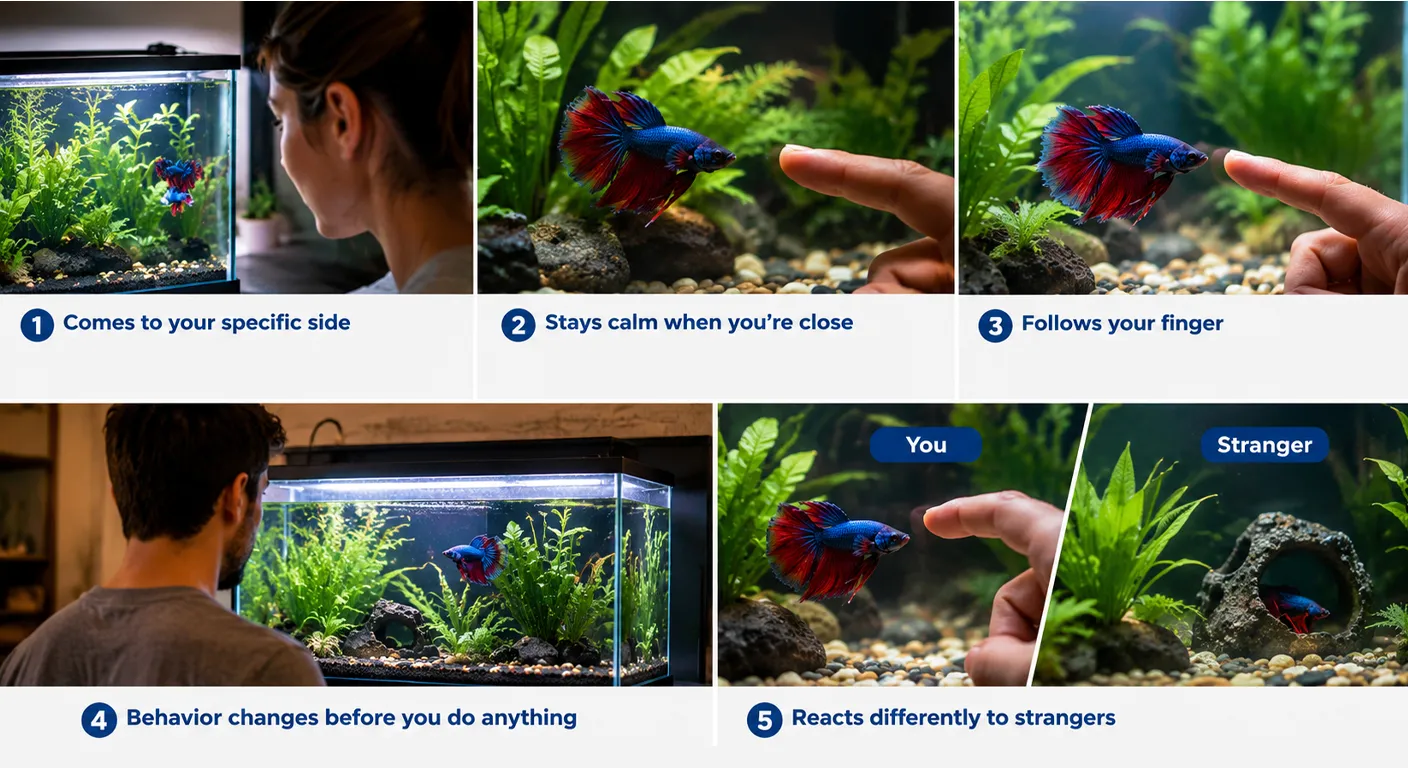
5 Signs Your Aquarium Fish Recognizes You
The real question isn’t “does my fish react to me?” It’s “Does my fish react differently to me than to strangers?” That distinction is everything.
It comes to your specific side of the tank: Not just any movement. Your side. When you approach, it moves toward you. When someone else does, it doesn’t. That’s not a coincidence.
It stays calm when you’re close: Some fish hide from most people. But not you. If your fish holds its position and stays relaxed while you’re right at the glass, that’s a recognition sign.
It follows your finger: Slowly drag your finger along the outside of the glass. A fish that tracks it consistently, especially without food involved, is responding to you specifically.
Its behavior changes before you even do anything: You walk into the room. It’s already active. You haven’t tapped the glass, haven’t opened the lid. It just knows you’re there.
It reacts differently to strangers: This is the clearest sign. Someone else walks up to the tank, and the fish hides, freezes, or ignores them completely. You walk up, and it’s immediately at the glass. Same tank, same movement, completely different response.
Which Aquarium Fish Are Most Likely to Recognize You
Not all fish are equal. Some are surprisingly aware. Others are just reacting to shadows. Here’s a practical breakdown for common aquarium species.
| Species | Recognition potential | What owners typically notice | Notes |
| Betta | High | Follows the finger, reacts to the owner specifically | Strong individual personality |
| Oscar | Very High | Comes to the owner, ignores strangers | Most dog-like freshwater fish |
| Goldfish | Moderate | Responds to routine and familiar faces | Better memory than the myth suggests |
| Cichlid (African/South American) | Moderate-High | Territory display changes around the owner | Varies heavily by individual |
| Discus | High | Calm with owner, skittish with strangers | Very sensitive to unfamiliar people |
| Common tetras/danios | Low | Reacts to movement, not individuals | Schooling instinct overrides recognition |
Common Misconceptions
Any movement near the tank triggers a reaction in most fish. That alone means nothing. It has to be a specific reaction to you.
Swimming to the surface is often just conditioned feeding behavior. If it does it for everyone, it’s not recognition.
Hiding from strangers could be general shyness, not recognition. Look for the contrast: calm with you, cautious with others. That pairing is what matters.
How to Actively Build Recognition With Your Fish
Recognition isn’t passive. You can train it. Here’s a step-by-step approach that actually works.
Step 1: Establish a consistent visual presence
Always approach from the same angle. Same side of the tank, same time of day. Fish learn through repetition and pattern. When your presence becomes predictable, they stop treating you as a threat and start treating you as a fixture. That’s the foundation everything else builds on.
Step 2: Create a unique feeding cue
Pick one specific signal before every feeding. A single tap on the glass. A slow finger wave. A light flick. Use it every single time, nothing else.
Always use the cue before opening the lid
Never feed without doing it first
Give it a few seconds, let the fish respond to the cue before the food hits the water
Over time, the fish links that specific signal to you specifically. Not just movement. You.
Step 3: Extend non-feeding interactions
Spend time near the tank without feeding. Just sit there. Move your finger slowly along the glass and watch what happens. Which fish follows it? Which ones ignore it completely?
This matters because it breaks pure food-conditioning. If your fish only reacts when food is coming, that’s not recognition. If it reacts to you outside of feeding, that’s something else entirely.
Step 4: Test for individual recognition
Have someone else approach the tank the same way you do. Same angle, same time of day, same movements. Watch closely.
Does the fish come forward or pull back?
Does it stay calm or get skittish?
Does the feeding cue response change when a stranger does it?
How long before it returns to normal behavior after the stranger leaves?
If your fish responds to you one way and everyone else another way, you’ve got real recognition on your hands.
How Tank Conditions Affect Recognition Ability
Your tank setup isn’t just about water quality. It affects whether your fish can even see you well enough to recognize you in the first place.
Glass clarity and algae: Dirty glass or algae buildup blurs what your fish sees. Clean the glass regularly. Your fish needs a clear view of you to build any visual association.
Tank placement: Eye-level tanks work best. A tank on the floor or mounted too high puts you at an awkward angle. Fish learn faces and shapes that give them a consistent, clear view.
Lighting: Bright room lighting behind you creates glare on the glass. Your fish sees a shadow, not you. Position the lighting so your face is visible from inside the tank.
Tank size: In a very large tank, fish spend most of their time far from the glass. Smaller tanks naturally create more face-to-face time, which speeds up recognition significantly.
Does Your Fish Miss You When You’re Gone?
Honest answer, probably not in the way you’d hope. Fish memory is longer than the old “three-second” myth, but it’s not emotional memory. It’s routine memory. They don’t pine for you. But they do notice when things change.
Studies suggest fish can retain learned associations for months. What breaks down isn’t memory of you specifically, it’s the routine. The consistent cues, the feeding signal, the familiar presence at the glass. When those disappear, the fish notices the absence of pattern, not the absence of a person.
Physiologically, a broken routine raises baseline stress slightly. Cortisol levels increase. Appetite may dip. Nothing dramatic, but it’s measurable.
Signs of routine disruption include reduced activity, less interest in food, and more time spent hiding, none of which means the fish misses you personally.
Practical note: If you’re away for an extended period, a consistent automatic feeding schedule matters more than you’d think. Keeping the feeding cue and timing intact preserves the routine even when you’re not there.
Conclusion
So yes, fish recognize their owners. Not all of them, and not all in the same way. But the capability is real, and it goes far deeper than most fishkeeping literature ever gives them credit for. Species matters. Routine matters. Tank conditions matter. And the complexity of what’s happening behind that glass is genuinely surprising once you start paying attention.
Build consistent routines. Optimize your tank for visibility. Run the stranger test; it’s the clearest way to know if what you’re seeing is real recognition or just a general reaction to movement. The signs are there if you know what to look for.
Your fish has a cognitive world that most people never bother to explore. That’s worth something.














Add comment
You must be logged in to post a comment.