
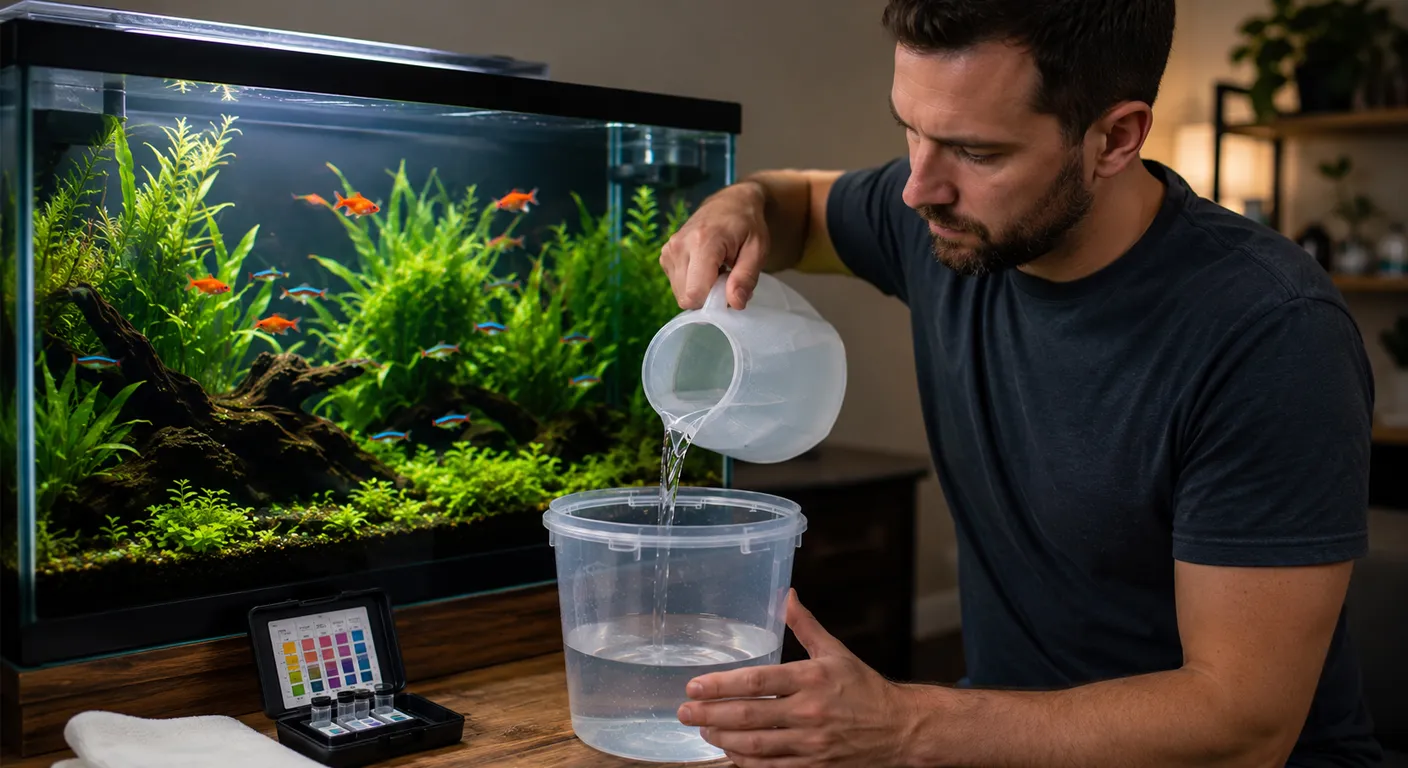
You pick up a gallon of distilled water at the grocery store. The label says “pure.” No chlorine, no heavy metals, nothing added. It sounds like the safest possible thing you could put in a fish tank, so you use it for a water change and feel good about it.
Then your fish start acting up. Sluggish. Hiding and not eating.
Here is what happened: distilled water is so stripped of everything that it actually creates a dangerous environment on its own. No minerals, no buffering, nothing to keep water chemistry stable. By itself, it is usually the wrong choice for filling or changing tank water.
But. Used properly, it is genuinely one of the most useful tools in a fish keeper’s toolkit. Remineralize it, mix it with tap water, or use it specifically for topping off evaporation, and it goes from harmful to helpful fast.
This article covers exactly when distilled water becomes a problem, when it actually gives you an edge, and how to use it step by step without risking your fish.
What Distilled Water Actually Is
Distillation works by boiling water into steam, then condensing that steam back into liquid form. Everything that cannot evaporate, which includes minerals, salts, heavy metals, chlorine, and bacteria, gets left behind.
What comes out is almost entirely H₂O. Nothing else.
Three specific things are missing that matter for aquariums:
Minerals and electrolytes (calcium, magnesium, sodium, potassium)
Carbonate hardness, or KH, which stabilizes pH
Dissolved gases, which need to be reintroduced through aeration
Here is a quick comparison so you can see where distilled water sits relative to other water sources:
| Water Type | Minerals Present | Needs Conditioner | Needs Remineralization | Typical Use |
| Tap Water | Yes | Yes (dechlorinator) | Rarely | General fish keeping |
| Distilled Water | No | No | Yes | Topping off, mixing, specialty setups |
| RO/DI Water | Stripped (trace amounts may remain) | No | Yes | Reef tanks, sensitive species |
Why Pure Distilled Water Can Hurt or Kill Fish
Water wants to reach equilibrium. When fish sit in water with almost no dissolved minerals, their bodies do all the work. Minerals inside the fish leach outward into the surrounding water through a process called osmosis. The technical term for this condition is an osmotic void.
The result is a fish that is slowly losing the electrolytes it needs to regulate internal processes. Heart rate, nerve function, and gill operation. It all depends on a proper mineral balance.
What you will see in the tank:
Rapid breathing or gasping near the surface
Flashing (fish rubbing against objects, a stress response)
Lethargy and loss of appetite
Poor immune response, leading to disease
Sudden death after large water changes done with pure distilled water
Effects on plants follow the same logic. Aquatic plants pull nutrients from the water column. Zero minerals means deficiencies. Yellowing leaves, root problems, and stunted growth are common signs.
Does Distilled Water Affect pH?
Yes, but not in a straightforward way. The bigger issue is KH, or carbonate hardness. KH acts as a buffer. It prevents pH from swinging up or down with every small change in the tank, like CO₂ fluctuations or waste buildup.
Distilled water has no KH. That means pH becomes unstable and unpredictable. Chasing a specific pH number with distilled water is a losing battle unless you also address the buffering capacity first.
When Distilled Water Is Actually Useful
This is where things get interesting. Distilled water is no substitute for aquarium water. It is a correction tool.
1. Topping Off Evaporation
When water evaporates from a tank, only the H₂O leaves. All dissolved minerals remain in a smaller volume of water. Over time, this increases hardness (GH and KH) and shifts water chemistry in ways that stress fish.
Distilled water is genuinely ideal for evaporation top-offs. You are putting back exactly what was left: pure water, no minerals, no chlorine. Doing this with tap water instead gradually makes your tank harder over months.
2. Mixing With Hard Tap Water
Some tap water is extremely hard, with GH readings above 20 dGH. Many fish and shrimp species struggle in that range. Mixing distilled water into the equation lets you dial the hardness down.
A reasonable starting point is 25% distilled and 75% tap, but that ratio is a starting point only. Test the mixed water before it goes anywhere near the tank. Adjust the ratio until it matches your target parameters. Then use that same ratio for every single water change. Consistency is what keeps fish healthy, not perfection.
3. Building Custom Water for Sensitive Species
Softwater fish like discus, cardinal tetras, and many South American cichlids thrive in water that closely mimics their natural habitat: low hardness, slightly acidic, and minimal minerals. Blackwater setups add tannins and botanicals on top of that.
Starting with distilled water and adding back only what you want gives you precise control. Paired with remineralizing salts and Indian almond leaves or catappa bark, the result is water that matches wild parameters far better than conditioned tap water ever could.
4. Saltwater and Reef Setups
RO/DI water is the standard for marine tanks. Distilled water falls in a similar category when it is properly remineralized and mixed with quality marine salt. Most hobbyists running smaller reef setups have used distilled water from the store with solid results, though for larger systems, an RO/DI unit is more economical long-term.
How to Remineralize Distilled Water
There are two main approaches, depending on what you have access to.
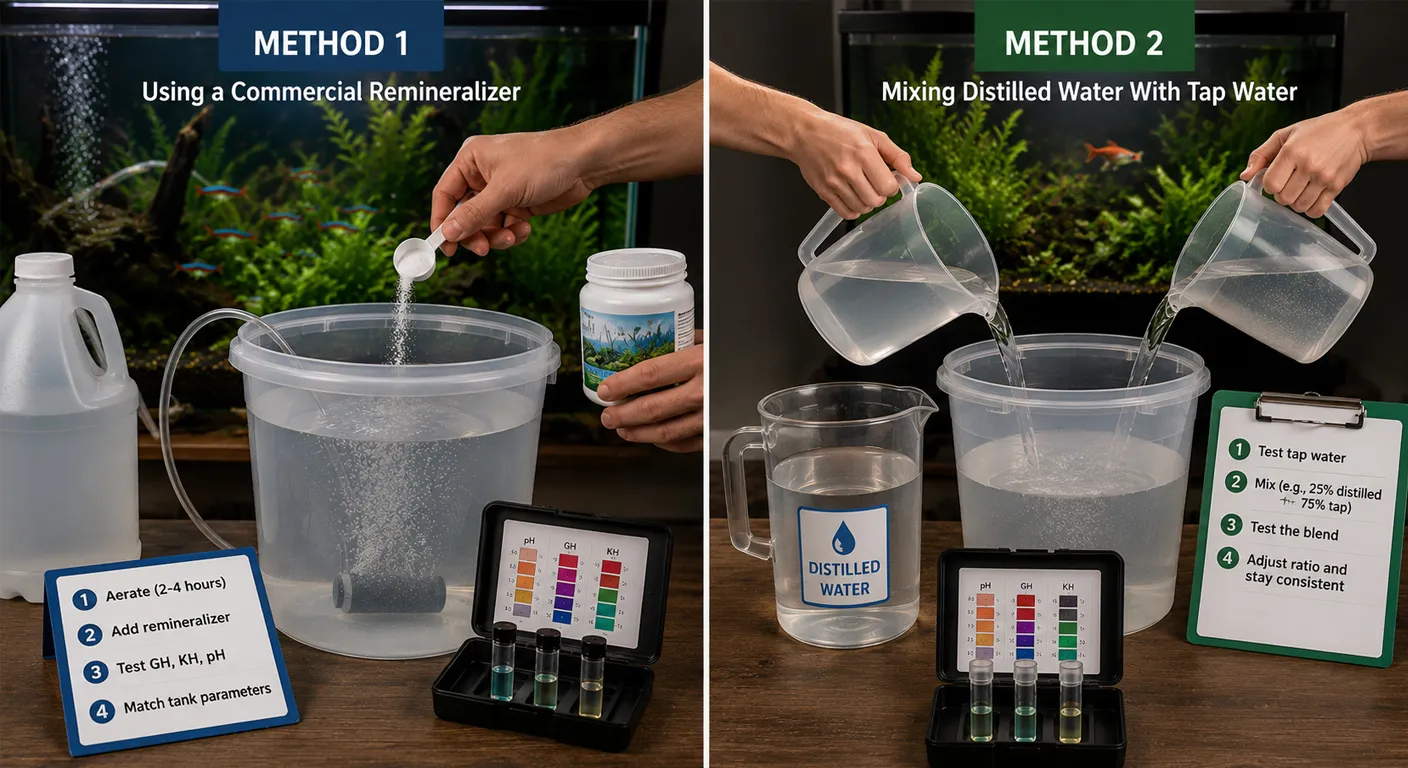
Method 1: Using a Commercial Remineralizer
Products like Seachem Equilibrium (for freshwater) or Salty Shrimp GH/KH+ (for shrimp tanks) add back specific minerals in targeted ratios.
Aerate the distilled water for two to four hours using an air stone, or simply let it sit in an open bucket. This returns dissolved oxygen to the water.
Add the remineralizer according to the label dosage for your tank volume.
Test GH, KH, and pH after mixing. Do not adjust everything at once.
Before adding water to the tank, make sure the new water parameters are close to the existing tank water. A sudden shift of even one or two dGH can stress fish that are adapted to stable conditions.
Method 2: Mixing Distilled Water With Tap Water
No remineralizer on hand? Tap water itself becomes the mineral source.
Test your tap water first. You need baseline numbers for GH, KH, and pH.
Mix 25% distilled water with 75% tap water in a clean bucket.
Test that blended water. Compare it to your target range.
Adjust the ratio until it lands where you want it, then write it down. Use that exact ratio going forward.
The goal is not to find perfect water once. The goal is to replicate good water reliably.
Should You Even Bother With Distilled?
Sometimes the honest answer is no.
Distilled water from the grocery store costs around one dollar per gallon in most areas. That is fine for a small 10-gallon tank where you do modest water changes. For a 75-gallon tank doing 30% weekly water changes, you are looking at over 20 gallons per change. The cost adds up fast.
For larger setups, an RO/DI unit pays for itself within a year. Entry-level units run between $50 and $150 and produce water that is essentially equivalent to store-bought distilled, without the trips to the store.
For smaller tanks, occasional use, or specific situations like softening water or topping off evaporation, distilled water from the store is a reasonable option. Just do not default to it for 100% of your water volume.
Common Mistakes to Avoid
A few things go wrong repeatedly, and they are all easy to sidestep:
Filling a brand-new tank with pure distilled water and adding fish. No buffering, no minerals, no stability. Do not do this.
Doing large water changes with undiluted distilled water. A 50% water change in pure distilled water can crash parameters fast enough to kill within hours.
Skipping aeration before use. Distilled water has very low dissolved oxygen. Adding it straight from the jug, especially in large amounts, lowers the overall oxygen level in the tank temporarily.
Switching fish that are adapted to hard tap water to distilled-based soft water without a gradual transition. Fish adapt to stable conditions over time. Sudden shifts are more dangerous than imperfect water.
Conclusion
Distilled water is no threat to your aquarium. Using it without understanding what it lacks is where things go sideways.
Think of it as a blank slate. On its own, it is missing everything fish need. But that blankness is exactly what makes it so useful when you want control over water chemistry. Remineralize it, mix it with tap water, or use it strictly for evaporation top-offs. Any of these approaches works well.
The underlying goal in every case is the same: stable, consistent parameters that match what your fish need. Distilled water, used with some understanding of what it is and what it is not, gets you there more reliably than almost any other option.







Add comment
You must be logged in to post a comment.