
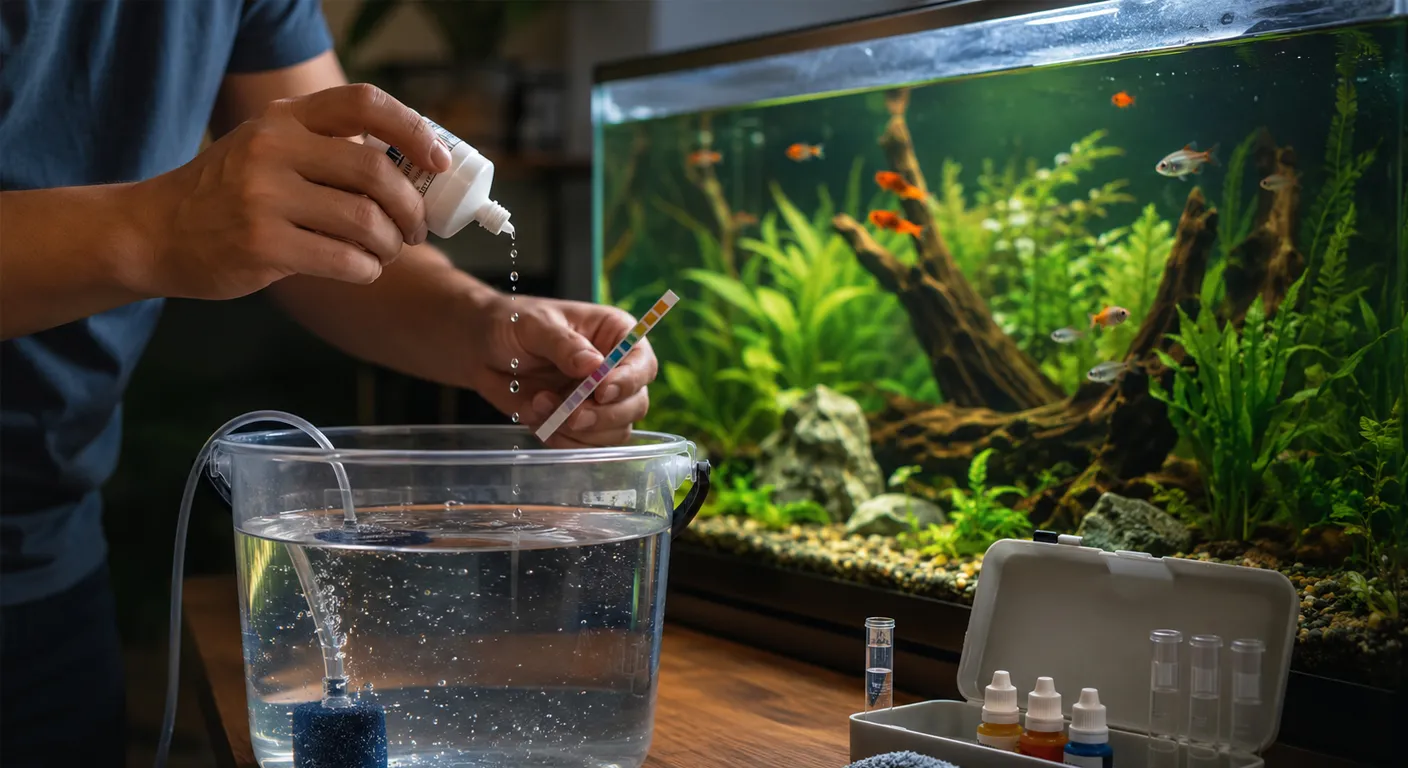
A beginner once filled a brand-new aquarium straight from the kitchen tap, assuming “water is just water.” The tank looked clear at first; nothing seemed off. But within days, the fish were gasping near the surface and showing visible signs of stress, even though the setup was brand new and everything looked fine on the surface.
Tap water is safe for most fish tanks, but only when it is tested and treated correctly. Straight from the faucet, it carries disinfectants, dissolved minerals, and sometimes contaminants that affect fish health in ways that are not visible.
This post covers what tap water actually contains, how to test it before use, how to treat it properly, how to handle difficult source water, and when tap water is simply not the right choice at all.
What Tap Water Actually Contains (And Why It Matters)
The Chlorine vs. Chloramine Problem
Every municipal water supply uses disinfectants to keep drinking water safe for humans. For fish, those same disinfectants are damaging to gill tissue and can destroy the beneficial bacteria that run your biological filter.
The two most common ones are chlorine and chloramine, and they are not interchangeable when it comes to treatment.
Chlorine is volatile. Leave a bucket of water sitting out for 24 hours with an airstone running, and most of the chlorine will dissipate on its own. Chloramine does not work that way. It is a chlorine and ammonia compound and is chemically stable. Aeration will not remove it. When chloramine breaks down, it releases free ammonia directly into your water.
This distinction matters because they require different treatments. A basic sodium thiosulfate dechlorinator handles chlorine perfectly, but does nothing adequate for chloramine. Using the wrong product is a common reason people treat their water and still see problems.
To find out which disinfectant your utility uses, check your city or municipality’s water quality report. Many utilities have shifted to chloramine over the past decade because it is more persistent in distribution pipes.
The Mineral Side: GH, KH, and pH
Three water parameters determine whether your tap water will support your fish long term.
GH (General Hardness): Total dissolved minerals, mainly calcium and magnesium. Fish from soft-water rivers (discus, wild bettas, most South American tetras) struggle in hard water. African cichlids and livebearers thrive in it.
KH (Carbonate Hardness): The buffering capacity of your water. KH stabilizes pH by resisting swings. Very low KH, typically below 3 dKH, can lead to pH crashes, sometimes overnight, which will kill fish even if every other parameter looks fine.
pH: The resulting acidity or alkalinity after all minerals are accounted for. pH alone tells an incomplete story without knowing the KH behind it.
Nitrate and Heavy Metals
Some tap water, particularly in agricultural regions, comes out of the faucet with 10 to 20 ppm of nitrate already present. Starting a water change with 20 ppm nitrate from the source and then adding it to a tank that already has elevated nitrate makes the entire water change counterproductive.
Older homes with lead or copper plumbing present another issue. Both metals are toxic to fish at very low concentrations, and standing water in pipes accumulates them. Running the tap for 30 to 60 seconds before filling a bucket flushes the standing water and reduces this risk meaningfully.
Step 1: Test Your Tap Water Before Using It
Skipping this step causes more early tank failures than almost anything else. Testing tap water gives you a clear starting point before you ever add fish, and it tells you exactly what you are working with.
Use a liquid test kit, not test strips, as they are inconsistent. A basic liquid kit from API or similar brands will cover:
pH
GH and KH
Ammonia
Nitrate
Run the test on fresh tap water, not water that has been sitting. Note the readings and compare them to the requirements of the fish you plan to keep. Run the same test again every few months, since municipal water chemistry shifts seasonally and after infrastructure maintenance.
A rough guide:
| Result | What it signals |
| pH 6.8–7.6, moderate GH/KH | Works for most common community fish without adjustment |
| High GH/KH, pH 7.8+ | Ideal for livebearers and African cichlids; may need blending for soft-water species |
| KH below 3 dKH | Buffering is unstable; pH crash risk is present |
| Nitrate above 10 ppm from tap | Water changes will be less effective; additional control strategies are needed |
| Any ammonia from the tap | Address before use; indicates chloramine breakdown or pipe issues |
Your city water utility is required to publish an annual water quality report. It will list pH, total hardness, and disinfectant type. These reports reflect averages and do not capture pipe effects or seasonal fluctuations, but they are a useful starting reference.
Step 2: Treat the Water Correctly
Choosing the Right Conditioner
For chlorine only, a sodium thiosulfate dechlorinator works immediately and costs almost nothing. It neutralizes chlorine on contact.
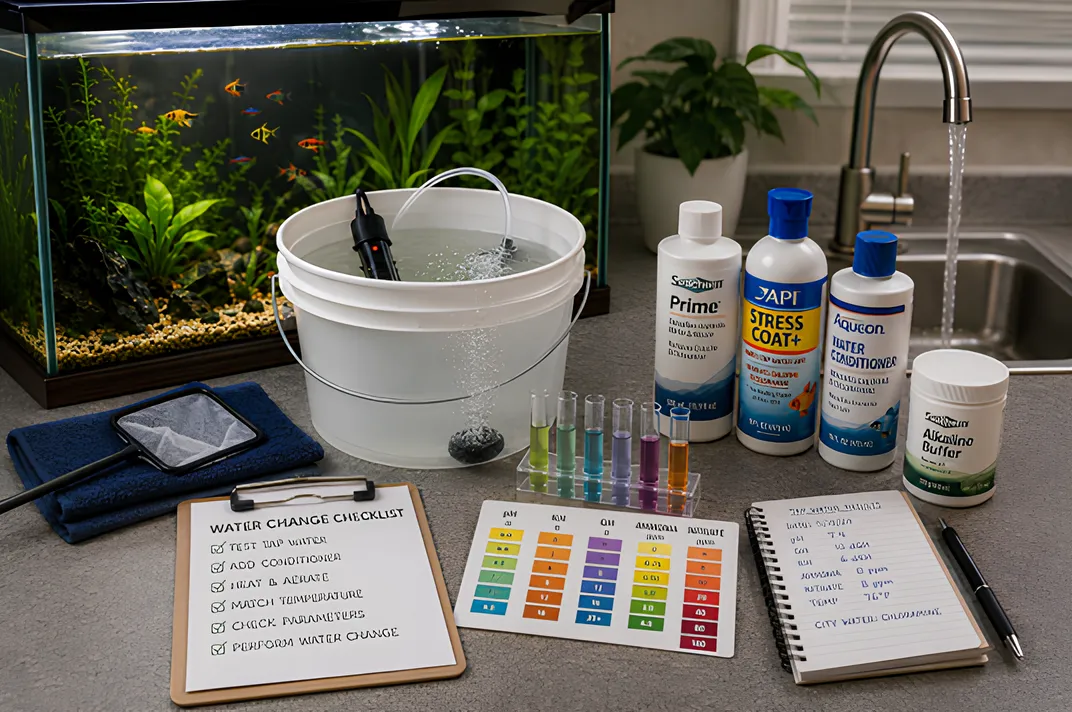
For chloramine, you need a product that explicitly states it handles chloramine and detoxifies the ammonia released during breakdown. Seachem Prime is widely used for this reason. API Stress Coat Plus also handles both. Read the label. If it does not mention chloramine, assume it does not cover it.
A Practical Water Change Workflow
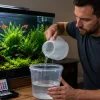
Many experienced hobbyists prepare water in buckets rather than adding conditioner directly to the tank. The reason is control.
Fill a 5-gallon bucket with tap water. Add the correct dose of conditioner immediately. Drop in a small submersible heater set to match your tank temperature. Add a battery-powered airstone if you have one. Let it sit for 30 to 60 minutes while the temperature evens. Check with a thermometer before pouring.
This process is simple once it becomes routine, and it eliminates most of the variables that cause problems during water changes.
Step 3: Match Temperature Before Adding Water
Water chemistry is only part of the equation. A 4 to 5 degree Fahrenheit temperature swing between new water and tank water is enough to suppress fish immune systems, trigger ich outbreaks, and stress the beneficial bacteria in your biological filter.
The fix is straightforward. Use a small submersible heater in your preparation bucket and set it to your tank temperature. Confirm with a thermometer before adding water. Do not rely on feeling. Water that seems close enough by hand can still be several degrees off.
Step 4: Handling Difficult Tap Water
Very Hard, High-KH Water
Hard water with high KH is genuinely excellent water for certain fish. Livebearers (guppies, mollies, platies), African cichlids, and goldfish thrive in it. If those are the fish you want to keep, this water requires zero adjustment.
For soft-water species, the options are blending tap with RO (reverse osmosis) or distilled water to reduce mineral content, using peat filtration or botanical tannins for modest softening, or simply selecting fish that match your existing water parameters. That last option tends to produce the healthiest tanks with the least ongoing effort.
Very Soft, Low-Buffer Water
Low KH creates pH instability. The buffer that holds pH steady is depleted, and biological processes in the tank consume what little remains. A pH crash can happen within hours under the right conditions.
Remedies include adding crushed coral to the filter or substrate for slow-release buffering, using a KH booster product such as Seachem Alkaline Buffer, or carefully dosing baking soda into prepared water. Never add baking soda directly to an established tank. The rapid pH shift will cause more harm than the low KH.
High Nitrate From the Tap
If your tap water already tests at 20 ppm or above, standard water change schedules become inadequate for nitrate control. You are adding nearly as much nitrate as you are removing.
Practical solutions include inline nitrate-reducing resin filters, blending tap water with RO water, heavy live planting to actively consume nitrate, or more frequent, smaller water changes rather than large infrequent ones.
When Tap Water Is Not the Right Choice
For most freshwater community tanks, treated tap water is completely adequate. Some situations make that less practical:
Source water that is extremely hard, chemically contaminated, or carries high nitrate from agricultural runoff
Delicate soft-water species like discus, wild-type bettas, or altum angelfish, which require precise low-mineral water that is difficult to achieve from a hard tap
Marine and reef aquariums, where RO/DI (reverse osmosis with deionization) is the standard; tap water introduces silicates and phosphates that fuel nuisance algae and harm corals
In these cases, an RO unit with a quality remineralizer gives far more reliable control over water parameters than constantly adjusting difficult source water.
Quick Reference: Water Parameters for Freshwater Tanks
| Parameter | Comfortable Range | Watch Out For |
| pH | 6.5–7.8 for most community fish | Readings outside 6.0–8.5; rapid swings |
| GH | 4–12 dGH general community | Below 3 or above 20 for sensitive species |
| KH | 4–8 dKH | Below 3 dKH (pH crash risk) |
| Nitrate (tap) | Below 10 ppm preferred | Above 20 ppm makes water changes less useful |
| Ammonia (tap) | Zero | Any detectable amount requires addressing |
Conclusion
Tap water can absolutely work for a healthy aquarium. Most people keep fish in it for years without issue. The difference between those tanks and those that keep struggling comes down to preparation.
Test your source water before anything else. Use the correct conditioner for your disinfectant type. Match the temperature carefully during every water change. And if your tap water falls outside a workable range for the fish you want to keep, either adjust the water or adjust the fish selection.
None of this requires expensive equipment or hours of effort. It requires knowing what is in your water, which takes about ten minutes with a liquid test kit, and responding to that information correctly. That single habit eliminates most of the preventable problems that end beginner tanks in their first two weeks.




Add comment
You must be logged in to post a comment.