

A quiet evening at the tank, and suddenly one goldfish is barreling after another, weaving between plants, bumping the glass. New owners tend to swing between two extremes here. Some panic and assume a fight to the death is underway. Others shrug it off as normal swimming and miss a real problem developing.
Neither reaction serves the fish well. Goldfish chase each other for several distinct reasons, and each demands a different response.
This guide walks through seven common causes, gives you a way to tell them apart, and includes a quick reference chart so you know when to simply watch and when to step in.
Is Your Goldfish Chasing Normal or Not
Goldfish are more socially aware than most people give them credit for. They recognize individual tank mates, develop preferences for certain fish over others, and sort themselves into a rough pecking order over time.
Because of that, not every instance of chasing signals trouble. There is a real difference between incidental contact during normal swimming, purposeful chasing tied to a specific trigger, and sustained harassment that leaves one fish exhausted or injured. The same behavior can mean different things depending on the sex of the fish involved, how the tank is set up, and even the time of day.
| Behavior Pattern | Likely Meaning | Action Needed |
| Brief, occasional chasing that stops quickly | Normal social interaction | None |
| Chasing focused on one fish, tied to feeding time | Feeding competition | Monitor, adjust feeding |
| Constant chasing across the whole tank | Space or water quality issue | Investigate immediately |
| One fish relentlessly pursued cannot rest or eat | Bullying, illness, or breeding stress | Intervene now |
Cause 1: Breeding Behavior
When goldfish spawn, males chase females with real intensity, often nudging or bumping their hinds and belly to encourage egg release. This tends to happen in spring or after a temperature increase, and it can look alarming to someone who has not seen it before.
Signs the fish are breeding:
A male persistently follows one particular female, ignoring other tank mates
Nudging concentrated near the belly and vent area
White pimple-like spots (tubercles) appearing on the male’s gill covers or pectoral fins
The chase intensifies in the morning, often after a water change or feeding
The female can become physically exhausted or develop torn fins if the male will not let up. This is especially risky with fancy goldfish varieties, since their rounder bodies and shorter fins make it harder for them to outswim a determined suitor.
What to do: If breeding is the goal, set up a proper spawning tank with spawning mops or fine-leaved plants. If it is not, separate the fish temporarily and lower the water temperature by a couple of degrees to reduce spawning drive.
Cause 2: Dominance and Social Hierarchy
Goldfish sort out pecking order the way many schooling fish do, through repeated small confrontations that establish who gets first access to food and favored resting spots. Over weeks, a stable hierarchy usually settles in.
One frequently overlooked trigger is mixing body types. Fast single-tailed goldfish, such as commons, comets, and shubunkins, will consistently outcompete slower fancy varieties like Orandas, Ryukins, and Telescopes. This happens gradually, and without dramatic aggression, so owners often mistake it for personality rather than a structural mismatch in the tank.
How to tell dominance apart from breeding:
Dominance chasing is generally less intense and does not focus on the body.
It is more about controlling position and access than physical contact.
Both fish may be the same sex.
The chased fish tends to get pushed away from food or a resting spot rather than nudged along the belly.
What to do:
Keep single-tail and fancy varieties in separate tanks where possible
Add plants, rocks, or décor that break up sightlines across the tank.
Feed from multiple spots so no single fish can control the food source.
Cause 3: Overcrowding and Insufficient Space
Small tanks amplify nearly every behavioral issue goldfish have, and chasing is no exception. When fish cannot maintain distance from each other, ordinary social friction turns into constant low-grade conflict.
Warning signs:
Chasing that covers the entire tank without pause.
Multiple fish are showing stress signs at once, including clamped fins, reduced appetite, and hovering near the surface.
No clear trigger, meaning chasing happens throughout the day rather than around feeding or specific events.
What to do: Check your tank size against actual goldfish space requirements rather than the vague rule-of-thumb figures often repeated online. A single fancy goldfish typically needs at least 20 gallons, with 10 additional gallons for each fish added. Reduce stocking or upgrade the tank first. Adding décor before fixing the space problem only masks the symptom.
Cause 4: Poor Water Quality
Goldfish in degraded water do not simply get sick; they get agitated first. Elevated ammonia, elevated nitrite, or low dissolved oxygen create physical discomfort that shows up as restlessness, darting, and heightened aggression well before visible illness appears.
If several fish suddenly start chasing at once, water quality should be the first suspect, not personality clashes.
Signs water is the trigger:
Gasping at the surface or clustering near the filter outlet.
Clamped fins combined with sudden bursts of erratic movement.
Flashing or scratching against gravel, décor, or the glass.
Appetite dropping across the whole tank rather than in one fish.
What to do:
Test ammonia, nitrite, nitrate, and pH immediately.
Perform a partial water change if any parameter is off.
Identify the root cause, whether that is overfeeding, insufficient filtration, or a spike triggered by a dead fish or decaying plant matter.
Cause 5: Feeding Competition
Food creates urgency, and urgency creates chasing. This is one of the most straightforward causes to identify because it clusters tightly around a specific time.
What it looks like:
Chasing spikes at feeding time and drops off sharply once food is gone
Fish dart and circle near the surface as soon as food hits the water
One fish consistently eats more and grows noticeably faster than its tank mates
What to do:
Feed from several spots simultaneously instead of one drop zone
Use sinking pellets or wafers to spread food across different levels of the tank
Watch whether slower or calmer fish are actually getting enough. If not, consider target feeding them separately
Cause 6: New Fish, Tank Disruption, or Environmental Changes
Any disruption resets the social balance of a goldfish tank. Introducing a new fish, rearranging décor, or shifting the water chemistry can trigger a temporary wave of chasing while the group re-establishes its order.
What to observe:
Did the chasing start within a day or two of a specific change?
Is one fish, likely the newcomer, being targeted specifically?
Is the chasing decreasing over the following days, or getting worse?
What to do:
Rearrange the décor when adding a new fish. This removes existing territorial claims and levels the playing field.
Quarantine new fish for two to four weeks before introducing them, which reduces both disease risk and social disruption.
Give the tank one to two weeks to settle before making further changes.
Cause 7: Illness or Weakness in One Fish
Sometimes what looks like aggression is really a response to a sick or weakened tank mate. Goldfish notice abnormal swimming patterns, unusual coloring, or erratic movement, and they may investigate or harass a fish that is already struggling.
This is easy to misread as bullying when the actual problem is health-related.
Red flags:
One fish is singled out consistently, regardless of location in the tank
The targeted fish swims oddly, hangs near the surface, or isolates itself in a corner
Visible wounds, fin damage, or rapid gill movement appear on the chased fish
What to do: Observe the chased fish as closely as the one doing the chasing. Test the water first, since illness and poor water conditions frequently show up together. Quarantine the sick fish to protect it and limit disease spread to the rest of the tank.
When Should You Intervene
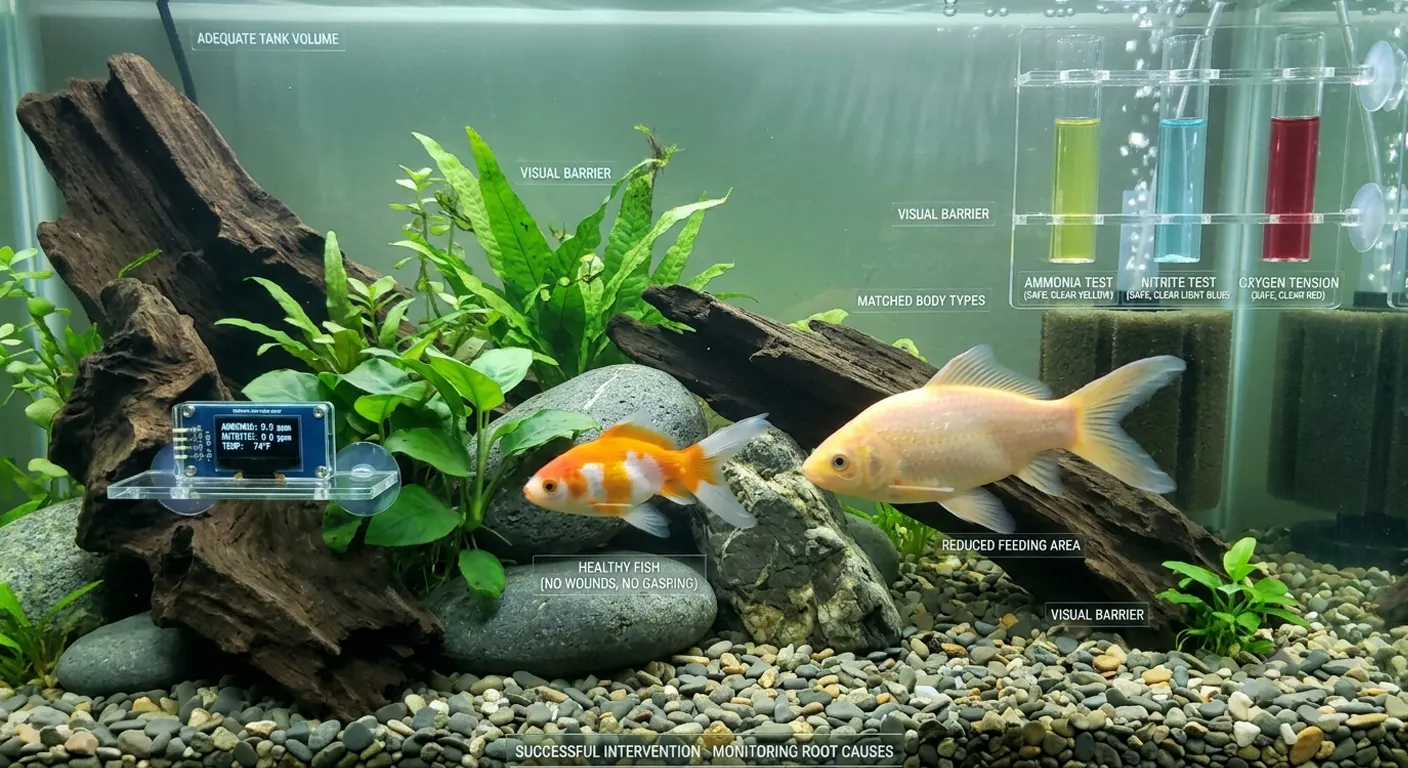
The clearest threshold is simple: intervene when the chased fish cannot eat, rest, or escape the pursuit. Secondary triggers worth acting on include visible wounds, a fish hiding constantly, or gasping at the surface.
Eliminate water quality issues first in each case. Correcting ammonia, nitrite, or oxygen issues often resolves behavioral chasing entirely, without any other intervention needed.
How to Reduce Chasing in a Goldfish Tank
Fixes work best in a specific order, since treating symptoms before root causes tends to waste time and stress the fish further.
Fix water quality first, always.
Check tank size against real space requirements
Separate incompatible body types, such as single-tails and fancies
Improve the feeding method to reduce competition
Add visual barriers like plants or rocks to break sightlines
Separate fish physically, only as a last resort
Décor adjustments alone will not solve a problem rooted in insufficient space or poor water. Treat those first, and the décor changes work far better as a supporting step rather than a fix on their own.
Conclusion
This guide covers the seven most common reasons goldfish chase each other, from breeding drive and social hierarchy to water quality and illness. Distinguishing normal social behavior from a genuine problem comes down to pattern recognition: what triggers it, how long it lasts, and whether the chased fish can still eat and rest.
Goldfish chasing is a symptom, not a diagnosis. The underlying cause could be anything from a natural pecking order settling into a water parameter spike that needs immediate attention. Build the habit of watching your fish regularly and keeping water conditions stable. Most chasing episodes will resolve well before they become a real welfare concern.
FAQ
1. Can goldfish chase each other to death?
It is rare but possible, particularly with relentless breeding chases or persistent bullying in an overcrowded tank. A female goldfish being chased nonstop can become exhausted to the point of injury or death, especially in fancy varieties with limited swimming ability. Sustained, targeted chasing should always be treated as a serious warning sign.
2. Why is my goldfish chasing the same fish over and over?
Repeated targeting of one fish usually points to either breeding behavior, dominance related to body type differences, or an underlying illness in the fish being chased. Check whether the targeted fish shows any signs of weakness, abnormal swimming, or physical damage before assuming it is simple aggression.
3. Do goldfish become more aggressive as they grow?
Larger goldfish can become more assertive as they mature and their space needs increase, particularly if the tank has not been upgraded to match their size. What looks like growing aggression is frequently a space or resource problem rather than a change in temperament.
4. My goldfish were peaceful for months. Why are they suddenly chasing?
Sudden onset chasing after a stable period usually traces back to a specific trigger: a new fish added, a water parameter shift, a temperature change, or an early illness in one tank mate. Review anything that changed in the tank over the past few days before assuming it is a permanent behavioral shift.















Add comment
You must be logged in to post a comment.