

There’s a particular kind of worry that comes with a new fish tank: is the water actually the right temperature, or does it just feel about right? Heaters are one of the few pieces of equipment where “close enough” can genuinely put your fish at risk, so it’s worth taking a few extra minutes to size one properly rather than guessing.
The good news is that you don’t need an engineering background to get this right. You need to know your tank’s volume, a rough sense of how cold your room gets in winter, and a chart that turns those two numbers into a wattage you can actually shop for.
This guide walks through exactly that, along with the handful of situations where the standard chart needs a small adjustment, and closes with real heater options matched to each size.
Table of Content
ToggleThe basic rule of thumb
The long-standing guideline among aquarium keepers is 3 to 5 watts per gallon of water, adjusted upward as the gap between your room temperature and your target tank temperature grows. A tank in a warm, steady room needs less wattage to hold its temperature than the same tank in a drafty room or an unheated garage.
Three things drive where you land in that range:
How cold your room gets. This is the single biggest variable, and the one most people underestimate. A heater in a climate-controlled living room has an easy job compared to one in a basement that dips into the 50s overnight.
Whether your tank has a lid. Open-top and rimless tanks lose real heat to evaporation off the water’s surface. A tank with a lid or canopy holds warmth far more efficiently.
What you’re keeping. Tropical fish and most corals want a stable 75–80°F. Planted tanks often run a touch warmer. Coldwater species like goldfish may need no heater at all.
Rather than rely on a loose range, it helps to work from a table that already accounts for room temperature, since that’s the variable most sizing mistakes come down to. For the tables below, we’re assuming a fairly standard tropical target of 78°F, since that’s the middle of the range most community tanks are kept at. If your target temperature runs warmer or cooler, adjust the temperature difference accordingly using the second table.
Quick-reference wattage chart
This first table gives you a wattage range by tank size and the coldest your room realistically gets, not the average temperature, since it’s the cold nights that determine whether a heater is doing its job.
By room temperature
| Tank Size | Normal Room (~70°F) | Cool Room (~65°F) | Cold Room/Garage (<60°F) |
| 10 gal | 50W | 75W | 100W |
| 20 gal | 100W | 150W | 200W |
| 29 gal | 150W | 250W | 300W |
| 40 gal | 200W | 300W | 400W |
| 55 gal | 300W | 500W | 600W |
| 75 gal | 400W | 600W | 800W |
| 100 gal | 500W | 800W | Two 500W heaters |
These figures assume a target water temperature of 78°F, and are rounded up to the nearest commonly sold heater wattage, since it’s safer to round up than down. For 100-gallon tanks in cold rooms, splitting the wattage across two heaters is both more practical to find and safer, which the section below explains in more detail.
If you’d rather work from the temperature difference directly, this second table shows the underlying watts-per-gallon figure for each degree range, which is what the chart above is built from.
By temperature lift
Watts per gallon by temperature lift
| Temp Lift (Room → Target) | Watts per Gallon | Example (40-gal tank) |
| ≤ 5°F | 3 W/gal | 120W |
| 6–10°F | 5 W/gal | 200W |
| 11–15°F | 7.5 W/gal | 300W |
| > 15°F | 10 W/gal | 400W |
When to size up from the chart
The tables above assume a fairly typical setup: a lidded tank, moderate stocking, and a target temperature in the standard tropical range. A few situations quietly push your actual wattage need higher than the chart suggests, and they’re worth knowing before you buy:
Open-top or rimless tanks. Popular for planted and shrimp setups because they look clean, but the tradeoff is faster heat loss through evaporation. Without a lid or canopy, move up one wattage tier from the chart.
Sump systems on reef tanks. Water in a sump counts toward your total heated volume, even though it sits in a separate compartment. A 75-gallon display tank with a 20-gallon sump should be heated as if it were a 95-gallon system.
Heavily planted or densely decorated tanks. Decor technically displaces water and lowers your real volume, but dense planting also tends to slow water flow and create pockets that heat unevenly, so it’s worth erring generous rather than sizing down.
None of these require a different formula, just a mental note to size up before you check out.
One heater or two
This is a question the wattage chart alone can’t answer, and it matters just as much as getting the watts right, because it’s really a question about what happens when a heater eventually fails.
Every heater fails sooner or later, and it tends to fail in one of two ways: stuck on, which means it keeps heating past the setpoint and can overheat the tank, or stuck off, which means it stops heating and the tank slowly chills. A single heater offers no backup for either scenario. Splitting the same total wattage across two heaters means that if one fails, the other keeps working, buying you time to notice the problem before it becomes an emergency.
| Tank Size | Single Heater OK? | Recommended Dual Setup |
| Under 30 gal | Yes | Not needed |
| 30–54 gal | Yes, backup optional | Two heaters at 50% of total wattage each |
| 55–74 gal | Borderline | Two heaters recommended for redundancy |
| 75+ gal | No | Two heaters at 50% of total wattage each (recommended) |
Picking an actual heater: AQQA options by tank size
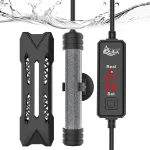
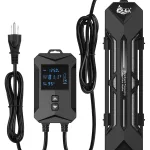
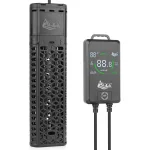
Once you’ve settled on a wattage target, matching it to a real product is the easy part. AQQA’s heater lineup covers the full range in the chart above, and most of the line shares a few safety features worth knowing regardless of which size you land on: automatic shutoff if the heater is lifted out of water, an automatic cutoff if the water temperature spikes past a safe threshold, and an external digital controller so you’re reading a display rather than guessing at a dial.
AQQA models by tank size
| Tank Size Range | Wattage | AQQA Model Type | Key Feature |
| 8–20 gal | 100W | PTC ceramic, external digital controller | ±1°F accuracy, child lock |
| 20–55 gal | 200–300W | Quartz glass tube with dual-display controller | Auto shutoff out of water, over-temp cutoff at 95°F |
| 55–250 gal | 500–800W | Double quartz-glass tube, LCD controller | Real-time power and temperature display |
| 170–290 gal | 1200W | Heavy-duty submersible, external thermostat | Intelligent protection system for large systems |
For smaller tanks in the 8 to 20-gallon range, the 100W PTC ceramic model is a comfortable fit, heating quickly and holding within about a degree of your setpoint. Mid-size tanks between 20 and 55 gallons are well served by the 200–300W quartz-glass models in the same family, which shut off automatically if the water level drops and cut power if the tank ever runs hot. Larger setups, from roughly 55 gallons up into the 200-plus range, can step up to the 500–800W double quartz-tube units, which add a live readout of power draw and water temperature, a genuinely nice touch if you like keeping an eye on things without a separate thermometer. And for large tanks or pond-style setups between 170 and 290 gallons, the 1200W heavy-duty submersible model is built with the kind of redundant safety features that matter most at that scale.
Running two heaters together
If you’re running two heaters on a larger tank, splitting your target wattage across two mid-range AQQA units rather than reaching for one oversized heater gives you the redundancy discussed above without complicating the setup.
Quick setup tips
Getting the wattage right won’t help much if the heater is installed poorly. A few habits go a long way toward keeping things stable:
Mount it near the filter outflow, not tucked into a quiet corner, so heated water actually circulates through the tank instead of pooling near the heater itself.
Install it vertically or at the manufacturer’s recommended angle, rather than laying it flat or burying it in substrate, which can create dangerous hot spots.
Verify with a separate thermometer. Heater dials and even digital displays can drift over time, so a simple stick-on or digital thermometer placed elsewhere in the tank is the real check on whether your setup is holding temperature.
Unplug before water changes. Letting a heater run while the water level drops below its minimum line is one of the more common, and most avoidable, ways heaters crack or fail early.
Conclusion
Sizing a heater doesn’t have to be a guessing game. Start with your tank’s volume, be honest about how cold your room actually gets on its worst night, and let the chart do the rest. Nudge the number up if your tank is open-top, runs a sump, or sits in a particularly drafty spot, and lean toward two smaller heaters instead of one large one once you’re past 55 gallons, simply because redundancy is cheap insurance against the two ways every heater eventually fails.
None of this needs to be perfect on the first try. A heater with a reliable external controller gives you room to adjust once you see how your tank actually holds temperature through a real week, rather than a single reading. Get the wattage in the right neighborhood, verify it with a separate thermometer, and check back in after the first cold snap of the season, that’s really all sizing a heater correctly comes down to.
FAQ
1. What size heater do I need for a 10-gallon tank?
A 50W heater covers most 10-gallon tanks in a normal room. Step up to 75W or 100W if the room runs cool or cold.
2. What size heater do I need for a 20-gallon tank?
100W is the standard baseline in a typical room, with 150–200W recommended for cooler spaces.
3. What size heater do I need for a 55-gallon tank?
300W covers a normal room, rising to 500–600W in cooler conditions. At this size, it’s worth considering two heaters for redundancy, especially if the tank holds sensitive fish or corals.
4. Do bettas need a heater?
Yes. Bettas are tropical fish that need water in the high 70s to low 80s°F, and few homes stay that warm consistently without one.
5. Can a heater be too powerful for a tank?
An oversized heater on a reliable thermostat isn’t dangerous by itself, since it simply cycles off once it reaches the setpoint. The bigger risk runs the other way: an undersized heater will run constantly and still fall short on the coldest nights.
Related Products For Your Reference












Add comment
You must be logged in to post a comment.