
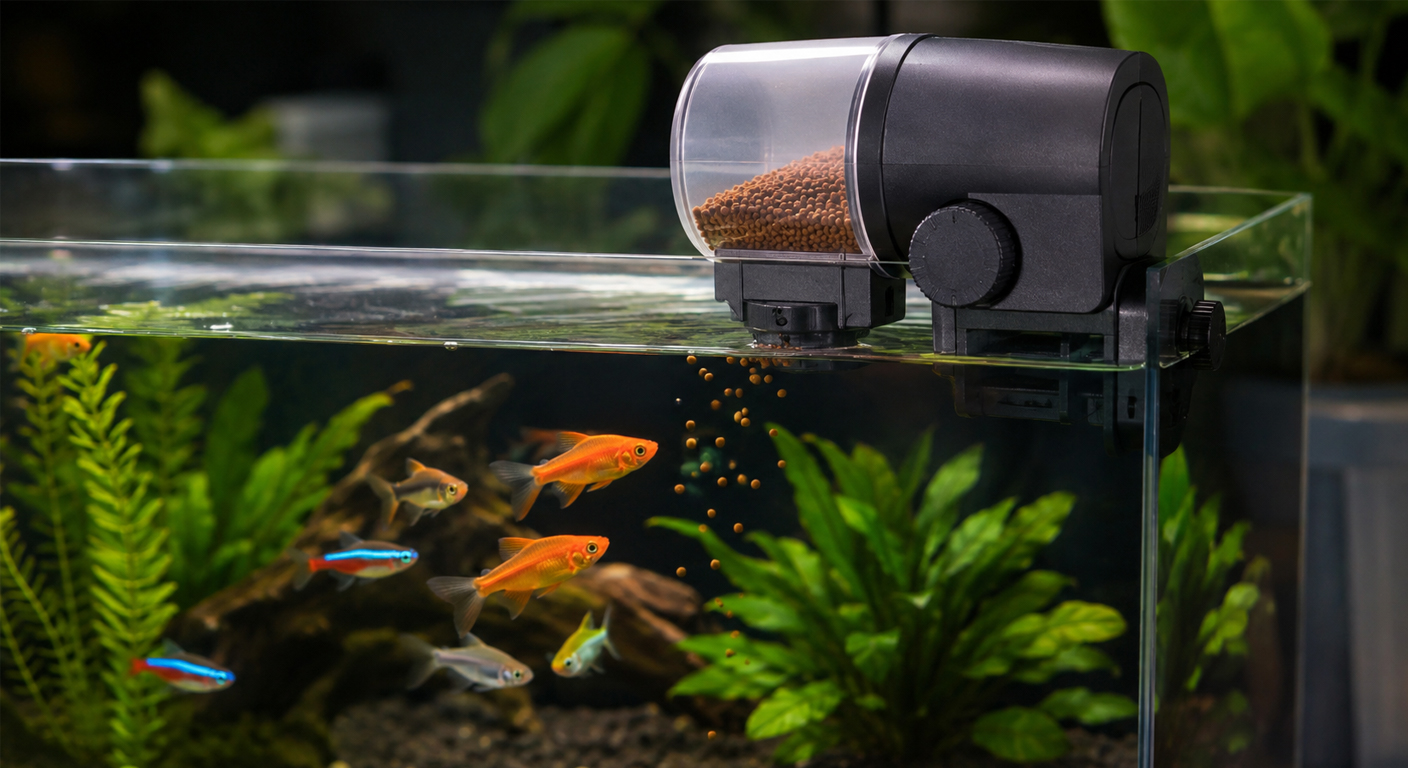
An automatic fish feeder should make aquarium care easier without creating a new problem: overfeeding. The AQQA 250ml Automatic Fish Feeder aims to do that with a large food reservoir, adjustable portion outlet, manual feeding button, and four timer intervals: 8, 12, 24, and 48 hours.
After reviewing its features and customer feedback, this is a practical, budget-friendly option for fish keepers who need dependable scheduled feeding for daily routines, weekends away, and short trips. Its biggest strength is its simple design. Its main limitation is that you need to spend time testing the portion setting, particularly in small tanks or shrimp aquariums.
Table of Content
ToggleFeatures
Feature | AQQA 250ml Automatic Fish Feeder |
Food capacity | 250ml |
Feeding intervals | Every 8, 12, 24, or 48 hours |
Feeding modes | Automatic timer mode and manual feeding mode |
Portion control | Adjustable outlet with side knob |
Power | 2 AA batteries, not included |
Best food types | Small pellets, granules, and similar dry foods |
Best for | Community tanks, busy routines, weekends and short trips |
Not ideal for | Untested vacation use, very fine food, or owners who need exact micro-portions |
Quick Verdict
The AQQA 250ml automatic fish feeder is a sensible choice for aquarium owners who want a straightforward, battery-powered feeder without a complicated display or app. The feeder is easy to mount, simple to program, and has enough capacity to reduce frequent refilling for most home aquariums. It is especially useful if you feed dry pellets or granules and want a repeatable schedule.
The adjustable food outlet is the feature that matters most in real-world use. It gives you control over how much food drops into the tank, but it also requires a little patience. Several product reviewers found that the feeder worked consistently once adjusted, though getting very small portions right could take trial and error, especially for shrimp, nano tanks, or small fish.
At its listed price of $17.99, the feeder is positioned as an affordable automation tool rather than a high-end smart aquarium device. It does not offer app control, custom clock-based feeding times, or highly precise gram-level dosing. However, for a simple interval-based feeder, it delivers the functions many fish keepers actually need.
What the AQQA 250ml Feeder Does Well
The AQQA feeder focuses on convenient operation rather than unnecessary complexity. You can use the feeder in automatic mode for scheduled feedings or press the manual control when you want to feed your fish immediately. That manual option is helpful when you are home and still want to observe feeding behavior, give an occasional extra meal, or test food flow before leaving for a trip.
The four timer intervals—8, 12, 24, and 48 hours—offer more flexibility than a feeder limited to once- or twice-daily feeding. For instance, the 12-hour setting can work for a twice-daily pellet-feeding routine, while the 24-hour setting may fit aquariums fed once per day. The 48-hour option may be useful for certain lightly fed adult fish tanks, but it should not be selected automatically without considering the species, stocking level, and normal feeding routine.
A 250ml food container is another advantage. For many aquariums, it can hold enough dry food to cover a weekend or an extended period without constant refilling. The practical duration will depend on the timer selected, the outlet opening, and food size. A heavily stocked community aquarium on an 8-hour schedule will naturally use food faster than a lightly stocked aquarium fed every 24 hours.
Reviewers also consistently highlight the feeder’s simple setup. One owner described the timer programming as easy to understand without repeatedly checking the manual, while another noted that installation was simple and the device had operated reliably over several months.
Portion Control: Useful, but Test It First
The adjustable food outlet is what makes this feeder suitable for different aquariums, but it is also the part you should test most carefully. A side knob changes the size of the outlet opening, which controls how much dry food can fall out during a feeding cycle. Because pellets, granules, powders, and flakes flow differently, there is no universal “correct” setting.
Start with the smallest possible opening. Add the exact food you normally use, trigger the manual feeding mode, and observe the amount released. If the portion is too small, adjust the opening slightly and test again. Repeat until the feeder releases approximately the same amount you would feed by hand.
This process is important because overfeeding can cause more trouble than missing a single meal. Excess food can settle into the substrate, create waste, and increase the maintenance burden on the aquarium. A feeder should reduce stress, not add avoidable water-quality problems.
Product feedback indicates that the feeder generally works best with smaller, solid dry foods such as pellets and granules. Flakes can work, but users reported that larger flakes may not dispense as evenly unless they are broken into smaller pieces. That means this feeder is likely a better fit for fish keepers who already use pellets or granules as their primary daily food.
For a shrimp tank, betta tank, or small nano aquarium, be particularly cautious. One reviewer liked the large capacity and consistency for travel but found it difficult to reduce the portion enough for shrimp until further adjustments were made. In these setups, it may be better to use a very small outlet opening, test over several days, and consider whether a lower-capacity feeder provides more appropriate portion control.
Real-World Use: Busy Days and Short Trips
The most practical reason to buy an automatic fish feeder is not to avoid all aquarium maintenance. It is to make a reliable feeding schedule easier when life gets busy.
The AQQA 250ml feeder is well suited to fish keepers who leave early for work, return home late, travel for a weekend, or want less dependence on a friend or neighbor for routine feeding. It can also be useful for office aquariums, where feeding may be forgotten over weekends or holidays.
For a short trip, the setup process should look like this:
Install the feeder firmly on the aquarium and make sure the outlet points toward an open area of water.
Fill it with a dry food that has already proven to dispense consistently.
Start with a small portion setting.
Test manual feeding several times.
Run the timer for at least a few days while you are home.
Check that fish eat the food promptly and that no excess food is accumulating.
Confirm battery condition before leaving.
This last point is easy to overlook. The feeder runs on two AA batteries, which are not included. Use fresh batteries before relying on it for travel, rather than assuming partially used batteries will last through your absence.
It is also worth setting realistic expectations. An automatic feeder can dispense food, but it cannot replace an aquarium check-in during long trips. It will not notice a heater failure, filter issue, leak, power outage, dead fish, or sudden water-quality problem. For a longer vacation, ask a trusted person to inspect the aquarium periodically even if the feeder handles daily food.
Design, Installation, and Everyday Convenience
The feeder uses a knob-style mounting design intended to secure it to the aquarium. Once positioned properly, it should keep the dispenser aligned over the tank and help prevent accidental movement during normal use.
Placement matters. Avoid positioning the feeder directly above heavy splashing from a filter outlet or a highly humid area beneath a tightly sealed lid. Moisture can affect dry food and may cause it to clump or dispense less consistently. If your tank has a lid, make sure there is enough room for the feeder to sit securely and still allow the food outlet to point into the water.
The feeder’s food container is made from food-grade ABS material, according to AQQA. That is a welcome detail for fish keepers who want a dedicated food-storage compartment rather than placing fish food into an unknown material.
The control system is also intentionally basic. A one-button approach may appeal to beginners and fish keepers who do not want to configure a digital clock, touchscreen, or Wi-Fi app. You choose an interval rather than an exact time of day. That simplicity is a strength for some users but a limitation for others.
For example, if you want food to dispense precisely at 8:00 a.m. and 6:00 p.m., this feeder may not be the best match because its operation is built around repeating intervals. If you simply want to feed every 12 or 24 hours, it is a much better fit.
Pros and Cons
Pros | Limitations to Consider |
Four feeding intervals: 8, 12, 24, and 48 hours | Does not offer app control or custom clock-based schedules |
250ml reservoir reduces frequent refilling | Portion adjustment takes testing and patience |
Manual feeding option remains available | May dispense large flakes less evenly than pellets |
Adjustable outlet offers control over food quantity | May be harder to fine-tune for shrimp and small nano tanks |
Simple setup and operation | Batteries are not included |
Suitable for busy schedules and short trips | Not a replacement for aquarium checks on long vacations |
Budget-friendly listed price | No indication of advanced alerts or low-food notifications |
Who Should Buy It
The AQQA 250ml Automatic Fish Feeder is a strong match for:
Community-tank owners who feed pellets or granules.
Fish keepers who want a simple backup for busy weekdays.
People planning weekend trips or short business travel.
Beginners who prefer straightforward controls over an app-based feeder.
Aquarium owners who want to reduce reliance on vacation feeding blocks.
Fish keepers who are willing to test and adjust portions before leaving the feeder unattended.
It may be less suitable for aquariums where extremely tiny or highly precise portions are essential, including some shrimp tanks, very small betta tanks, or tanks using only large, light flakes. It is also not the best choice if you specifically need Wi-Fi monitoring, feeding history, programmable clock times, or smartphone alerts.
If your tank needs a smaller reservoir and a simpler schedule, AQQA also offers a 110ml Automatic Fish Feeder. That model offers 12-, 24-, and 48-hour intervals, runs on two AA batteries, and is designed for powder and pellet food rather than flakes. It can be clipped onto aquarium glass up to 20mm thick or placed on a tank lid.
Final Recommendation
The AQQA 250ml Automatic Fish Feeder is a useful and affordable tool for automating routine fish feeding. Its large capacity, 8/12/24/48-hour timer intervals, adjustable outlet, and manual mode cover the needs of many everyday aquarium setups.
The key to getting good results is simple: test it before you need it. Use the same food you normally feed, begin with a minimal outlet opening, watch several feeding cycles, and make small adjustments until the portion is right. Once properly set up, this feeder can make daily care and short trips substantially easier—while helping you maintain a more consistent feeding routine for your fish.
Related Products For Your Reference
AQQA Automatic Fish Feeder, 12H/24H/48H Timer, 110ml Capacity,...
AQQA 200ML Auto Fish Feeder, Quiet Smart Timer...


Add comment
You must be logged in to post a comment.