
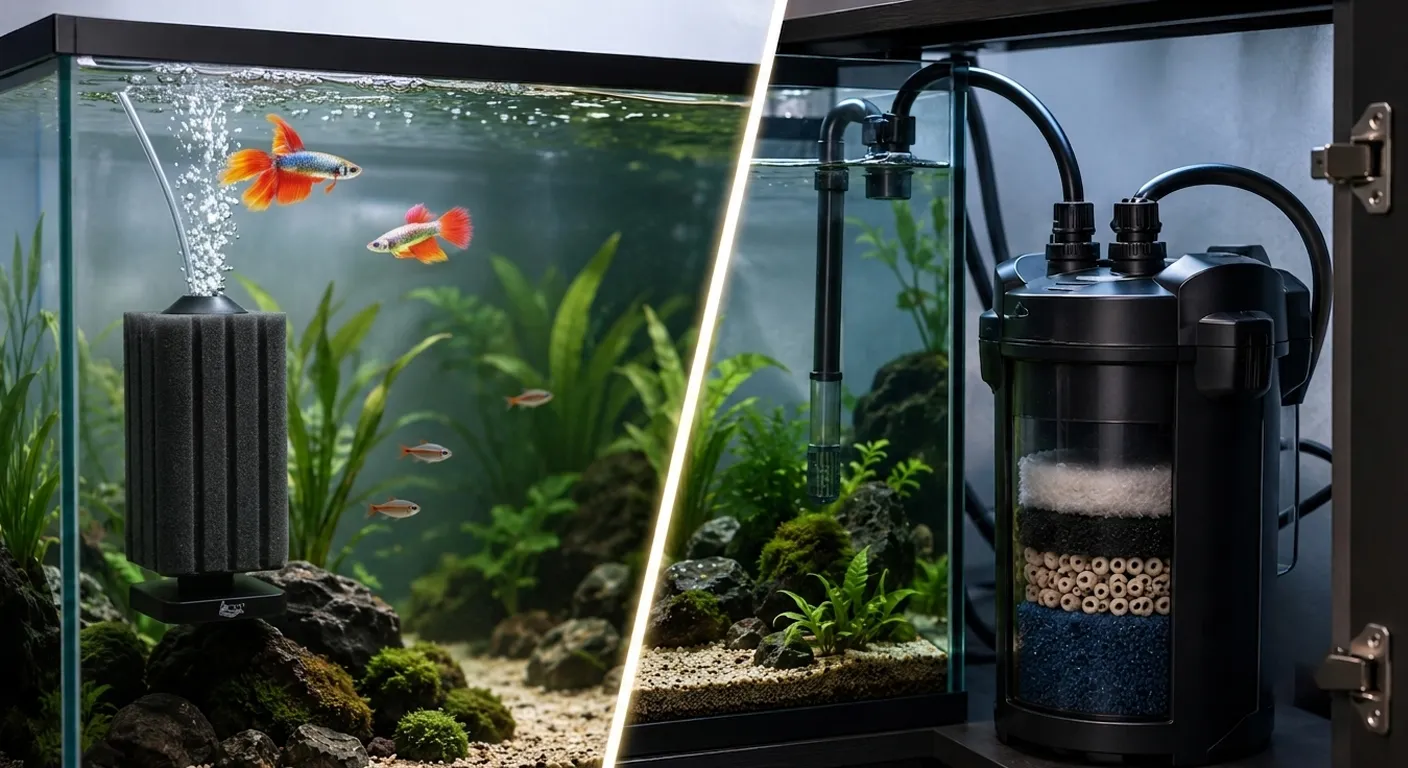
If you’ve spent any time browsing aquarium forums or filter listings, you’ve probably run into the same debate over and over: external filter or submersible filter? Both do the same basic job, keeping your water clean and your fish healthy, but they go about it in very different ways, and the “right” choice really comes down to your tank, not a universal winner.
The comparison usually boils down to five practical factors: how much noise you’re willing to live with, how much space you have (inside and outside the tank), how much filtration power your bioload demands, how easy the unit is to install, and how much maintenance you’re realistically willing to do. None of these factors exist in isolation, a filter that’s technically more powerful isn’t automatically “better” if it’s overkill for a 10-gallon betta tank, and a compact internal filter isn’t automatically “worse” just because it holds less media than a canister three times its price.
This isn’t a brand-specific review. It’s a buying guide meant to help you match the filter type to your actual setup, whether that’s a heavily stocked 55-gallon community tank or a 5-gallon desktop shrimp bowl. By the end, you should have a clear sense of which category fits your tank, and a practical checklist to run through before you actually click “buy.”
Table of Content
ToggleWhat Is an External Filter
An external filter — often called a canister filter — sits outside the aquarium, usually in the cabinet below it or tucked beside the tank. Water is pulled out through an intake tube, pushed through a canister packed with filter media, and then returned to the tank through an output tube. Because the entire filtration unit lives outside the water, it can be built much larger without crowding your aquascape.
How External Filters Work
The canister houses multiple media stages — mechanical, biological, and often chemical — stacked in trays or baskets. Water is forced through each stage in sequence, which means you get much more thorough filtration per pass compared to a small in-tank unit.
Key Strengths
The biggest advantage is media capacity. More media means more surface area for beneficial bacteria, which translates to stronger biological filtration, essential for tanks with a heavy bioload (lots of fish, large fish, or messy eaters like goldfish and cichlids). External filters also tend to move more water per hour relative to their footprint, which is useful in larger tanks.
Because the canister sits outside the tank, you also get more freedom to mix and match media types without worrying about how much visible space they take up. It’s common to see a canister running mechanical floss, a layer of biological media like ceramic rings or bio-balls, and a chemical stage such as activated carbon or purigen all stacked in one unit, all invisible once the lid is closed.
Who Tends to Choose Them
Hobbyists running large tanks, planted setups with heavy stocking, or advanced systems (like sumps and multi-stage filtration) usually gravitate toward external canisters. They’re also popular with people who want flexibility to customize their media stack over time, or who are running species that produce a lot of waste and need consistent, high-volume turnover to keep ammonia and nitrite in check.
It’s worth noting that this flexibility comes with a small learning curve. Priming a canister (getting water flowing through the tubes without air pockets), sealing the lid properly, and remembering to occasionally rinse the impeller are all things a new fishkeeper has to learn. None of it is difficult, but it’s a step up from unboxing a submersible unit and dropping it straight into the tank.
What Is a Submersible Filter
A submersible filter, also called an internal filter, sits entirely inside the tank, typically attached to the glass with suction cups. Water is drawn in through an intake, passed through a compact media chamber, and pushed back out, all within the same self-contained unit.
How Submersible Filters Work
Because everything happens inside the tank, there’s no external tubing, no cabinet plumbing, and nothing to seal or route through the stand. The unit plugs in, gets submerged, and starts running.
Key Strengths
Submersible filters are compact and quiet, since the water itself dampens the sound of the motor. They’re also about as easy as filtration gets. No external hoses to prime, no canister lids to seal, and minimal setup time. For smaller tanks, this simplicity is a real advantage.
Example: Compact Submersible Options
AQQA’s internal filter lineup is a good reference point for this category, since it covers several tank sizes with the same core promises: quiet operation, efficient filtration for the unit’s size, and a compact design that doesn’t eat up visible tank space. A few examples from their submersible range illustrate how the category scales:
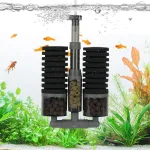
AQQA Ultra Quiet Aquarium Sponge Filter (5–20 Gallon) — a gentle, air-driven sponge filter aimed at nano tanks, betta setups, and fry or shrimp tanks where low flow and quiet operation matter more than raw power.
AQQA USB Sponge Aquarium Filter, up to 26 Gallon (3W, 66 GPH) — a USB-powered option that’s handy for small desktop tanks or setups without a nearby outlet.
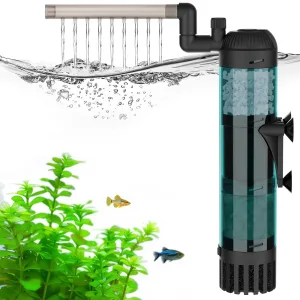
AQQA 158 GPH Submersible Filter for 30–60 Gallon Tanks — a larger internal unit with multi-layer filtration and adjustable airflow, showing that submersible filters can scale up to mid-sized tanks too, not just nano setups.
These examples are useful less as specific recommendations and more as a demonstration of the range: submersible filters aren’t a one-size-fits-all category, and picking the right one still comes down to matching flow rate and media capacity to your tank size.
External Filter vs Submersible Filter
Here’s how the two stack up side by side across the factors that matter most:
| Category | External Filter | Submersible Filter |
| Noise | Motor hum is audible but located outside the tank | Runs underwater, which naturally muffles motor noise |
| Filtration power | Higher media capacity, better for heavy bioloads | Solid for smaller or lightly stocked tanks |
| Tank space | Keeps the inside of the tank clear | Takes up physical space inside the aquarium |
| Installation | Requires tubing, priming, and cabinet setup | Plugs in and submerges — minimal setup |
| Maintenance | Easier to service since it’s outside the tank | Simple to clean, but often needs more frequent attention |
A quick note on that noise row, since it’s the one people misread most often: it’s not really about which filter is “louder,” it’s about where the noise comes from. External filters produce mechanical hum from a motor sitting in your cabinet, easy to muffle with a bit of foam or distance. Submersible filters produce a different kind of sound: water movement and vibration transmitted through the glass, which some people find more noticeable in a quiet room even though the actual decibel level is lower.
Best Use Cases by Tank Type
When an External Filter Makes Sense
External filters make the most sense once your tank starts working harder than a basic setup can handle. Think 40+ gallon tanks, heavily stocked community tanks, cichlid setups, or anything with large or messy fish. They’re also the better pick if you’re running a planted tank and want the flexibility to fine-tune your media (adding extra biological media, chemical filtration, or fine polishing pads) without redesigning the whole system.
When a Submersible Filter Makes Sense
Submersible filters shine in smaller tanks — think nano tanks, betta setups, shrimp tanks, or anything in the 5–20 gallon range, though as the AQQA examples above show, larger internal units can comfortably handle tanks up to 60 gallons as well. They’re also a strong choice for beginners who want something they can set up in minutes without learning canister maintenance, and for anyone placing a tank in a bedroom or office where quiet operation and a clean external footprint matter.
What to Look for Before Buying
Before deciding, run through this quick checklist:
Tank size — Larger tanks generally benefit from the extra capacity of an external filter; smaller tanks often don’t need it. As a rough rule of thumb, once you’re above 40–50 gallons, the media capacity of a canister starts to pay off noticeably.
Fish load — Heavily stocked tanks need stronger, more consistent biological filtration. Think about not just fish count but fish size and species — a single large goldfish can produce as much waste as a small school of tetras.
Desired water movement — Some fish (and plants) prefer stronger flow, while others do better in calmer water. Bettas and shrimp, for example, generally do better with gentler, adjustable output than a high-flow canister return.
Noise sensitivity — Consider where the tank will live and how much ambient noise is already in the room. A tank in a busy living room can tolerate more mechanical hum than one in a bedroom.
Space available — Factor in both cabinet space (for external units) and visible in-tank space (for submersible units). If you’re working with a nano tank or a rimless aquascape, a bulky internal filter can be just as visually disruptive as tubing running out the back of the tank.
Maintenance preference — Be honest about how often you’ll actually clean the filter, and pick the format that matches your habits. Sponge and internal filters need more frequent rinsing since their media is smaller, while canisters can often go longer between services.
Conclusion
There’s no universally “better” filter here, just a tradeoff. External filters win on raw filtration capacity, media flexibility, and long-term scalability, which makes them the stronger choice for larger, more heavily stocked tanks. Submersible filters win on simplicity, quiet operation, and space-saving convenience, making them the better fit for smaller tanks, beginners, and anyone who wants a low-maintenance setup that just works.
If you’re setting up a big, established tank with a real bioload to manage, an external canister filter is worth the extra setup effort. If you’re running a smaller tank, a quiet room, or you just want filtration that’s easy to install and maintain: a submersible filter like the AQQA internal filter is a solid, practical choice for that category. The best filter, in the end, is the one that matches your tank’s size and your fish’s needs, not the one with the most features on paper.
Related Products For Your Reference
Aquarium Filter, 8W 200GPH, for 15 – 60...
AQQA Aquarium Filter, Dual Sponge, Multi-Stage Filter, 360°...


Add comment
You must be logged in to post a comment.