
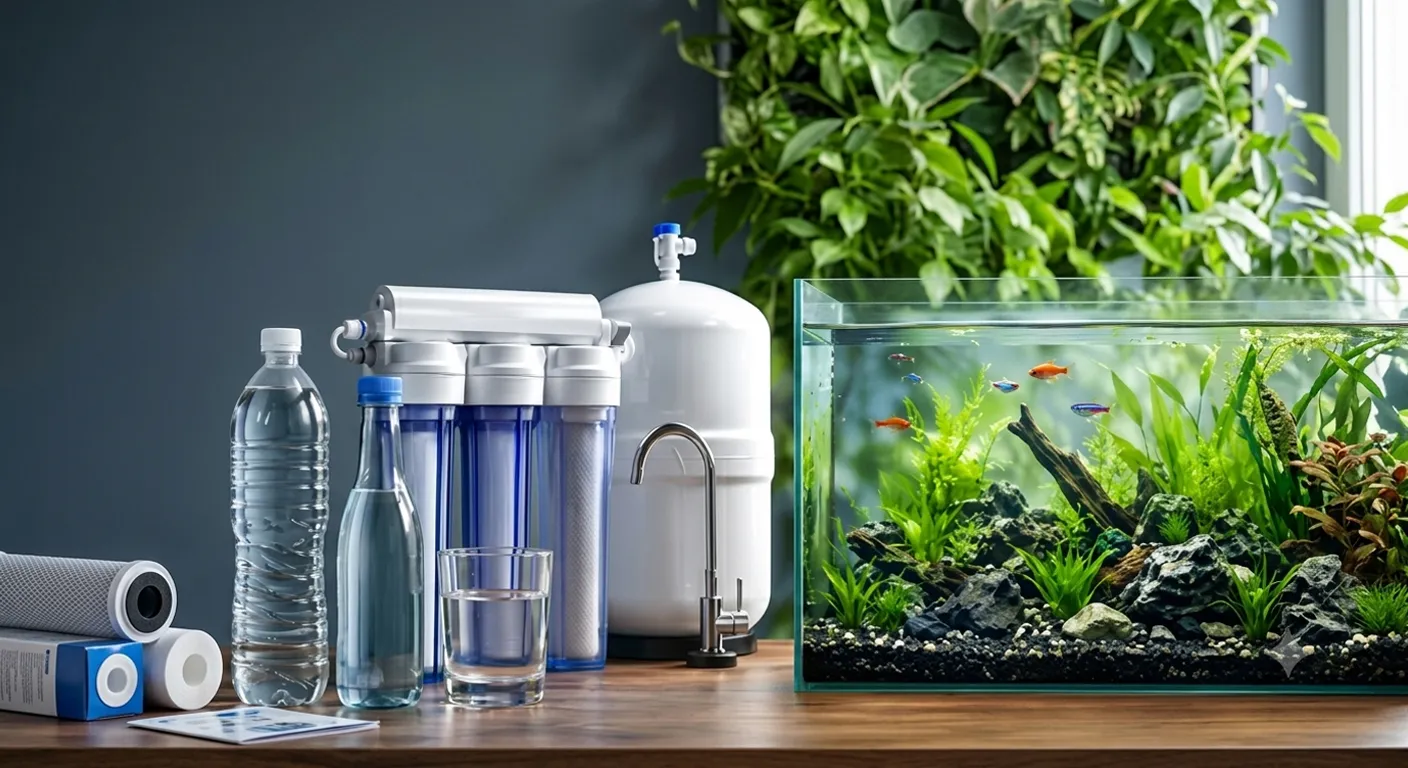
Most people setting up a fish tank assume “purified” means safe. It sounds clean, filtered, refined. Better than tap water, surely. But that assumption has caused many fish deaths, and it keeps causing them because the term itself is genuinely misleading. Understanding what these water types actually are, and when each one belongs in your tank, changes how you approach the whole setup. By the end of this article, you will know exactly which water source fits your situation and how to use it without harming your fish.
Table of Content
ToggleWhat “Purified Water” Actually Means
The word “purified” does not describe a single process. It is a broad label applied to water that has gone through some form of filtration or treatment to remove contaminants. That might mean reverse osmosis, deionization, carbon filtration, distillation, or a combination of methods. What links all of them is what they remove, not what they leave behind.
The main types you will encounter are reverse osmosis (RO) water, RO/DI (reverse osmosis combined with deionization), household filtered water or water with activated carbon, and commercially bottled water sold as “purified” or “spring.” Each one behaves differently in an aquarium. They are not interchangeable.
Do You Even Need Purified, RO, or Bottled Water?
For most freshwater community aquariums, treated tap water works perfectly well. Dechlorinate it, let it reach room temperature, and you are already ahead of the curve. The problem is that many aquarists jump straight to alternatives without first understanding their tap water quality.
Before spending money on RO systems or bottled water, test your tap. A basic liquid test kit or a TDS (total dissolved solids) meter gives you a real starting point. What matters is whether your tap parameters fall within a workable range for the species you are keeping.
There are situations where switching away from tap is genuinely necessary:
Your tap water has very high TDS (above 400-500 ppm for sensitive species)
GH and KH are too hard or too soft for your target species
You are keeping soft-water fish like discus, cardinal tetras, or wild-caught bettas
You are breeding shrimp and need precise mineral control
Heavy chloramine treatment or unpredictable municipal water chemistry is causing problems
Simple Decision Point
| Tap Condition | Recommendation |
| TDS under 300 ppm, parameters within species range | Conditioned tap water is fine |
| High TDS or hardness, but only slightly above range | Blend tap with RO to adjust |
| Extreme hardness, chloramines, or sensitive species | Switch to RO and remineralize |
| Parameters unknown | Test first before spending anything |
RO and RO/DI Water: The Blank Canvas
What RO and RO/DI Do to Your Water
Reverse osmosis pushes water through a semipermeable membrane that strips out dissolved solids, chlorine, chloramines, heavy metals, nitrates, and most other contaminants. What comes out is extremely soft, low-mineral water, usually sitting around 0-20 ppm TDS. RO/DI goes further. The deionization stage removes nearly everything that passes through the RO membrane, bringing TDS to nearly zero.
That near-zero starting point is exactly what makes RO and RO/DI so valuable. You control everything that goes back into the water. For soft-water species, marine systems, and precise breeding setups, that level of control is not a luxury. It is a necessity.
Why Pure RO Water Can Be Dangerous for Fish
Unmineralized RO water is not safe for direct use in an aquarium. Zero or near-zero mineral content causes osmotic stress. Fish regulate their internal chemistry against the surrounding water. When that water has nothing in it, the gradient difference pulls vital minerals out of their bodies. You also lose buffering capacity entirely, which means pH crashes with almost no warning.
The guiding principle here: RO and RO/DI are raw materials, not finished products. They require preparation before they ever touch your tank.
How to Use RO and RO/DI Safely
Remineralization is the standard approach for most setups. Products like Seachem Equilibrium raise GH for planted tanks and freshwater fish. Shrimp-specific remineralizers such as Salty Shrimp GH+ or Bee Shrimp Mineral GH+ give you tighter control over calcium-to-magnesium ratios. For marine tanks, quality reef salt mixes serve the same function.
Blending with tap water is a more practical option when your tap is reasonable but slightly outside the range. A 50/50 blend of tap and RO cuts TDS roughly in half and softens hardness without requiring you to remineralize from scratch. This works well for community freshwater tanks where you just need to bring parameters down a bit.
Filtered and Bottled Drinking Water for Aquariums
Is Filtered Drinking Water Actually Safe for Aquariums?
This category is the widest and least consistent. Filtered drinking water can mean a Brita pitcher, an under-sink carbon block, a whole-house softener, or a multi-stage reverse osmosis unit installed under the counter. The results vary enormously depending on what the filter actually removes.
Carbon filters remove chlorine and improve taste but leave TDS largely unchanged. Water softeners are a different story. They replace calcium and magnesium ions with sodium through ion exchange, which creates water that is chemically unsuitable for most freshwater fish. Sodium-softened water has low GH but high sodium content. That combination causes long-term health issues.
To evaluate filtered household water for aquarium use, test it. Check TDS, GH, KH, and pH. If GH is low and TDS is under 200 ppm, it may be workable. If sodium softening is involved, treat it as you would RO water and remineralize appropriately.
Filtered drinking water works best as a temporary or supplemental source, particularly in areas where tap chloramine levels are the main concern.
When Bottled Water Makes Sense
Commercial bottled water falls into two main categories:
Spring water contains naturally occurring minerals. TDS typically ranges from 50-300 ppm depending on the source, and GH and KH vary widely between brands. Some spring waters are genuinely suitable for freshwater community tanks out of the bottle. Others are hard enough to cause problems.
Bottled purified water (labeled as “purified” or “distilled“) has been stripped in a similar way to RO water. It is essentially mineral-free and should not be used directly in a tank.
Bottled water is a reasonable option for small tanks, hospital setups, or short-term use when the tap is temporarily compromised. It becomes impractical for water changes on tanks larger than 20-30 gallons. Cost and plastic waste add up fast.
The key principle: if you decide to use a specific bottled water brand, stick with that brand. Mineral content varies between sources and even between batches. Consistency matters more than perfection.
Quick Reference: Water Types Compared
| Water Type | Typical TDS | GH / KH | Ready to Use? | Best For |
| Conditioned tap | 100-400 ppm | Varies by region | Yes, after dechlorination | Community freshwater |
| RO water | 0-20 ppm | Near zero | No, must remineralize | Soft-water species, shrimp, marine |
| RO/DI water | 0-5 ppm | Essentially zero | No, must remineralize | Marine, ultra-sensitive setups |
| Household filtered water | Variable | Variable | Test first | Situational |
| Bottled spring water | 50-300 ppm | Varies by brand | Test first | Small tanks, short-term use |
| Bottled purified water | 0-20 ppm | Near zero | No | Blending only |
Matching Water to Your Setup
The right water source depends almost entirely on what you are keeping and what your tap provides. There is no universal answer.
Community freshwater tanks (tetras, danios, livebearers, corys): Conditioned tap water with TDS under 350 ppm and moderate hardness works well for most species.
Soft-water species (discus, wild-caught bettas, apistogramma, South American cichlids): RO water remineralized to GH 3-6, and KH 1-3 is the standard approach.
Planted tanks: RO remineralized with Seachem Equilibrium or similar allows you to dial in the GH/KH ratio plants prefer. CO2 injection also affects KH, so buffer control matters.
Hard-water species (African cichlids, livebearers from alkaline environments): Tap water is often ideal. If your tap is too soft, add crushed coral or specific mineral additives.
Reef and marine systems: RO/DI is the baseline. Anything less risks introducing phosphates, silicates, or heavy metals that destabilize coral health and drive nuisance algae.
Common Mistakes to Avoid
Using unmineralized RO or distilled water directly: Fish placed in ultra-pure water experience osmotic stress almost immediately. Always add minerals before use.
Assuming bottled spring water is consistent, TDS and mineral content shift between brands and sometimes between production batches. Test any new bottle before committing to it.
Using softened household water without retesting: Ion-exchange softeners add sodium. That sodium does not read as hardness on standard GH tests, but still affects fish physiology over time.
Changing water sources mid-cycle without transitioning gradually: Switching from hard tap to soft RO water suddenly can shock fish through rapid parameter shifts. Blend gradually over several water changes.
Conclusion
These water sources are tools, not automatic solutions. RO water is not better by default. Bottled water is not safer simply because it comes from a store. Tap water is not a shortcut. Each one has a place, and that place depends entirely on your fish, your goals, and your local water chemistry.
Start with your tap. Test it. Find out what you are actually working with before making any decisions. From there, identify what your fish specifically need and whether your source water can deliver that with minor adjustment or whether you need a fundamentally different approach. Test any alternative water sources the same way. Build a clear strategy and stick to it. Consistency in water chemistry matters as much as hitting the right numbers, and chasing perfection with the wrong tool causes more harm than a well-managed, tested tap water setup ever would.





Add comment
You must be logged in to post a comment.