

I still remember one of my first weeks with my tank. I noticed two fish chasing each other constantly, doing these tight circles, and at one point, they actually locked mouths. I panicked immediately. I thought they were fighting or something was seriously wrong, and I almost pulled one out of the tank without even understanding what I was looking at.
Turns out this happens to pretty much everyone who keeps fish. We see our fish doing something weird and immediately jump to thinking they’re sick or attacking each other. But here’s the thing. A lot of the most alarming stuff you’ll see is actually either stress or completely normal courtship behavior. When you can’t tell the difference, it’s really easy to mess things up and make choices that actually hurt your fish.
In this guide, we’ll show you how to tell stress from courtship. We’ll explain behaviors that look totally bizarre but are actually normal, depending on what kind of fish you have. And we’ll go through real examples using the types of fish most people keep in their tanks.
Stress vs Courtship Decision Framework
Before you do anything, just slow down and watch for a bit. This framework helps you figure out if your fish is stressed out or just trying to breed.
Step-by-Step Diagnostic Flow
Step 1: Check Immediate Health Red Flags
Start with the basics. Watch how fast they’re breathing, check their fins, and look at their body. If you see rapid gill movement, clamped fins, any wounds, white spots, fungus stuff, or they’re straight up refusing to eat, that’s pointing way more toward stress or sickness than courtship.
Step 2: Check the Environment
Think about what you’ve done in the last few days. Did you do a water change? Temperature shift? Mess with the filter? Move the tank? Change the lighting? Add new fish? All of that can trigger stress responses. Courtship usually just shows up on its own without you changing anything major.
Step 3: Observe the Pattern of Behavior
Stress looks messy and panicked. You’ll see fish darting around like crazy, smashing into the glass, hiding nonstop. Courtship is different. It’s rhythmic, like they’re following a routine. They’ll do the same thing over and over, same path, same sequence. It looks purposeful.
Step 4: Look for Courtship Clues
A lot of fish have specific breeding signals. You might see them pairing up, building nests, cleaning flat rocks or leaves, guarding one spot in the tank, wrapping their bodies around each other, doing T-positions, or you might actually see eggs. These behaviors usually get more intense over time instead of fading away.
Step 5: Decide the Response
If it’s stress: Get your water parameters stable, cut down on aggression, get back to your normal routine, and only treat for disease if you’re seeing clear symptoms.
If it’s courtship: Don’t mess with them. Give them plants or surfaces where they can spawn if you want. And if one fish is getting beaten up too much, you might need to adjust who’s in the tank.
Quick comparison: Stress vs Courtship
| Feature | Typical Stress Behavior | Typical Courtship/Spawning Behavior |
| Appetite | Reduced or absent | Normal or increased |
| Swimming pattern | Erratic, panicked | Repetitive, rhythmic |
| Color changes | Pale, dull, blotchy | Intensified breeding colors |
| Social behavior | Isolation or uncontrolled aggression | Pair bonding or targeted chasing |
| Body posture/fins | Clamped fins, imbalance | Displayed fins, upright posture |
| Physical signs | Injuries, disease symptoms | Eggs, nests, and guarding behavior |
How Can We Tell A Species Is Weird Yet Normal
Some fish just do bizarre stuff. It looks alarming when you first see it, but it’s actually completely normal for that type of fish. Knowing these quirks saves you from freaking out for no reason.
Behaviors That Look Alarming but Are Fine
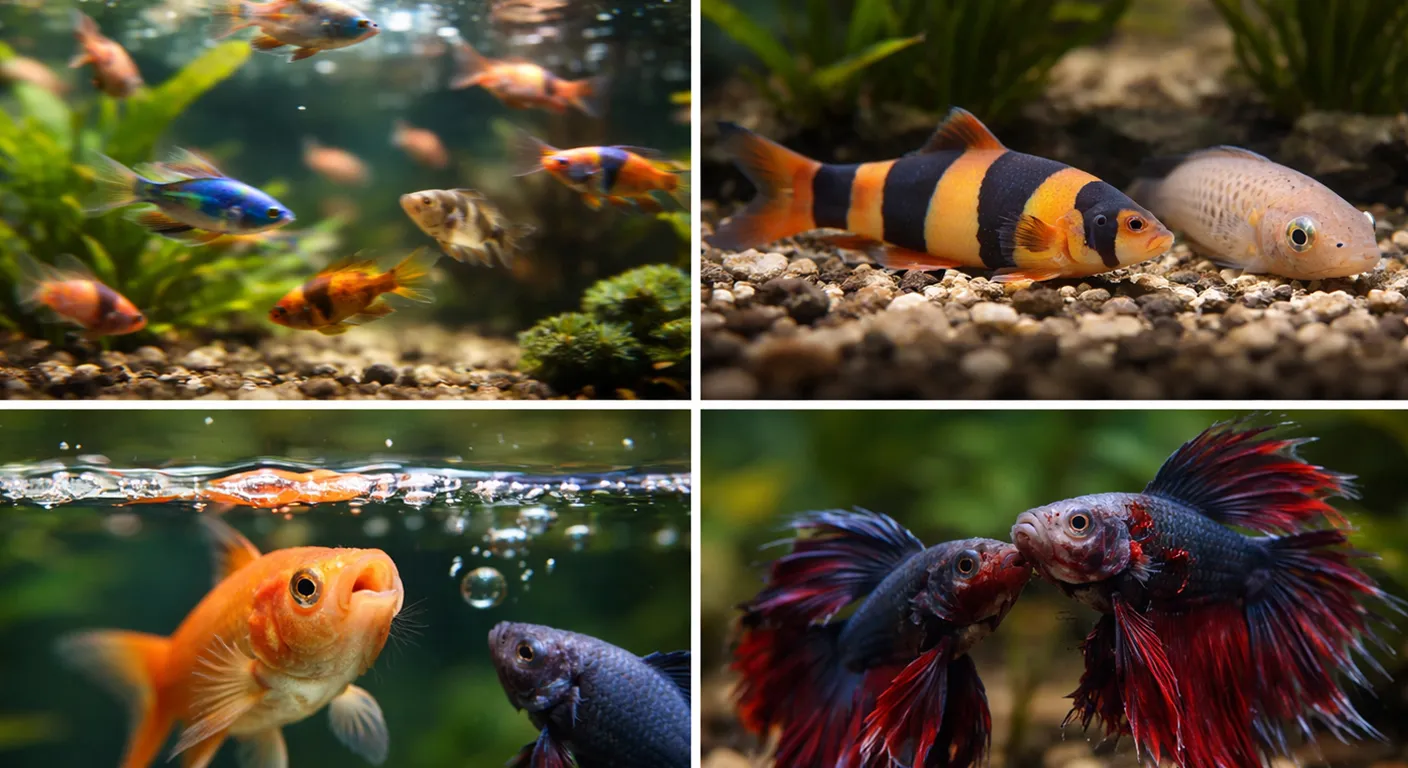
Here are some examples of normal stuff that beginners usually misread:
Loaches or certain catfish just lying on their sides or wedging themselves under decorations. Looks dead, totally fine.
Corydoras and plecos zoom up to the surface real quick to gulp air. They do this all the time.
Bettas flaring up, pacing along the glass, or just chilling on broad leaves. That’s what they do.
Cichlids digging huge pits in your substrate or guarding one spot like their life depends on it. Super normal.
Schooling fish suddenly scatter everywhere and then come back together. Happens all the time.
Red Flag Versions of the Same Behaviors
Now here’s when those same behaviors mean something’s actually wrong:
Fish swimming around frantically with no breaks, no pattern, just constant chaos.
Loaches or catfish stay completely still and do not respond when you get close.
Going to the surface over and over to gasp for air, plus they look sluggish and tired.
Aggression that’s actually ripping fins apart or causing bleeding. That’s not normal territory stuff anymore.
What Are The Common Courtship Patterns Of Fish
Fish courtship looks different depending on what kind you have, but once you know what to look for, the patterns are pretty easy to spot. Let’s break down the most common types of people keep and what’s normal for them versus when you actually need to step in.
1. Livebearers (Guppies, Mollies, Platies)
Normal courtship stuff:
Males chasing females around pretty much all day. That’s just what they do.
Shimmying and showing off their fins to get the females’ attention.
Short bursts of chasing instead of going after them nonstop.
Females get pregnant regularly, and you see fry pop up.
When you should worry:
Females are getting harassed so badly that they never get a break. Like constantly.
Females are hiding all the time and not coming out to eat.
Torn fins, stress lines showing up on their bodies, or they’re losing weight.
Your male-to-female ratio is off (too many males), or there’s nowhere for females to hide.
2. Tetras, Barbs, and Other Schooling Egg Scatterers
Normal courtship stuff:
The whole group is chasing each other instead of just two fish pairing up.
Sudden bursts where they all swim together in sync. Looks pretty cool, actually.
Colors are getting brighter for a bit during spawning times.
Eggs are scattered around in plants, moss, or in the gravel.
Way more active after you do water changes or early in the morning.
When you should worry:
Swimming around like crazy, and it doesn’t calm down.
Fish smashing into the glass or decorations over and over.
The school is breaking apart and not coming back together.
Seeing injuries after all that group activity.
3. Cichlids
Normal courtship stuff:
Digging pits in your substrate or cleaning off flat rocks. They’re super picky about their spawning spots.
Lip locking and pushing each other around. Looks aggressive, but it’s usually just how they do things.
Defending one area of the tank hard. They get really serious about their territory.
Colors are getting way more intense when they’re breeding. Some cichlids look completely different.
Actively guarding eggs or baby fish once they show up.
When you should worry:
Violence that just won’t stop and isn’t following any pattern.
One fish is getting cornered with no way to escape.
Injuries happening repeatedly, or one fish looking completely exhausted.
Your tank’s too small for them to have separate territories. Cichlids need space.
4. Labyrinth Fish (Bettas, Gouramis)
Normal courtship stuff:
Males building bubble nests at the surface. You’ll see clusters of bubbles, usually in a corner.
Flaring and showing off fins. It’s part of the whole display thing.
Circling each other and wrapping bodies together during actual spawning.
The male collects the eggs and puts them in the nest one by one.
When you should worry:
Fighting that goes on way longer than spawning should take.
Fins are getting shredded badly or are seeing actual bleeding.
Females can’t get away or recover between spawning attempts.
The male keeps attacking even after the eggs are safe in the nest.
5. Catfish and Algae Eaters
Normal courtship stuff:
Way more active at night than usual. A lot of catfish spawn when it’s dark.
Quick dashes up to the surface. Some species do this as part of spawning.
Group spawning in some types. You might see multiple fish involved.
Pressing up against surfaces or even other fish during spawning.
When you should worry:
Staying completely still outside of normal resting times.
Breathing looks hard or way too fast.
Hiding nonstop with zero activity even during their usual active periods.
Behavior is getting worse over time instead of following a short cycle and then stopping.
Acute Stress, Chronic Stress, and Breeding Cycles
Acute stress:
This is what happens when something sudden throws your fish off. Transport stress, a big water change, power goes out, temperature shoots up or drops fast. Your fish freak out immediately. They’ll dart around like crazy, breathe super fast, and slam into the glass. Looks terrifying, honestly, but most of the time it doesn’t last. Give them a day or two for things to settle, and they bounce back.
Chronic stress:
Now this is the tricky one. It creeps up slowly, so you don’t catch it until it’s been going on for a while. Your fish starts losing weight bit by bit. They get sick, recover, then get sick again. Colors fade out and look washed compared to when you first got them. They hide way more than they used to, and barely come out anymore. Just less active overall.
What makes chronic stress so bad is that it grinds them down over weeks and months. And it’s almost always from problems you haven’t fixed yet. Water quality stays bad, one fish keeps picking on another, and the tank’s too cramped. Things like that.
Breeding Cycles and Repeating Patterns
When fish breed, there’s usually a pattern to it. First, they do the courtship displays, then they spawn, then they guard the eggs or babies, then everything chills out for a bit. That whole sequence repeats itself pretty regularly. It’s not random.
So here’s how you tell the difference. If the behavior happens in cycles and your fish are still chowing down at feeding time, colors still look good, and they’re active like normal, that’s breeding. Stress doesn’t cycle. It just stays constant or gets worse. No breaks, no pattern, just ongoing weirdness.
A Simple Behavior‑First Diagnostic Routine
Before you grab your test kit or start messing with equipment, just watch your fish for a bit. Here’s what to pay attention to:
Watch:
Are they eating? Skipping meals or going after food like normal?
How fast are they breathing? Gills moving crazy fast or just regular?
Where are they hanging out in the tank? Top, middle, bottom, or all over?
How are they acting with other fish? Chasing, hiding, swimming together?
Any movements they keep repeating? Same path, same routine, over and over?
Scan for:
Any injuries you can see. Torn fins, missing scales, wounds.
Disease symptoms. White spots, fuzzy patches, weird growths.
Eggs stuck to plants or rocks, or baby fish swimming around.
Nests or bubble nests, especially up at the surface.
Spots where they’ve cleaned rocks or leaves, or pits they’ve dug in the gravel.
Testing and Action
Here’s the thing. Before you start testing water or checking if your filter’s working right, watch the behavior first. What your fish are actually doing tells you way more than you’d think. It gives you context, so when you do test or make changes, you’re targeting the actual problem instead of just guessing and hoping something works.
Conclusion
Figuring out if your fish is stressed or just trying to breed comes down to watching a few things. Are they eating? How are they moving around? What’s going on with the other fish? Did something change recently? Any physical stuff like injuries or nests? Once you get familiar with what’s normal for your species, you stop panicking over every little thing.
Learning your fish’s usual behavior makes all the difference. You won’t mess with them when they’re fine, and you won’t ignore actual problems because you thought it was breeding. The more you know about how your specific fish act during courtship, the better calls you’ll make.
Start keeping notes or take some videos of your tank. Sounds boring but trust me, it helps. When you look back over a week or two, patterns jump out that you’d miss otherwise. You’ll get to know their routines, their cycles, what’s typical for them. That’s when you stop second guessing yourself every time they do something weird.

AQQA Adjustable Aquarium Air Pump, 4-Outlet Oxygen Aerator...
Original price was: $36.89.$34.84Current price is: $34.84.







Add comment
You must be logged in to post a comment.