

Lighting is a very important aspect of a freshwater aquarium. It promotes the photosynthesis of water plants and aids fish in sustaining their natural biological cycles. Correct lighting also brings out the rich colors of the fish and the plants to make your tank beautiful. Nevertheless, selecting an appropriate aquarium light may be a problem for amateurs. It is a challenge to many beginning aquarists to strike a balance between brightness, spectrum, and intensity, and many of these beginners end up purchasing lights that are not what was needed in their tank.
Among the initial choices is whether you have a fish-only tank or a planted tank. Planted tanks demand higher intensity and the right spectrum of light to achieve healthy growth, whereas fish tanks only demand lower intensity light to be seen and look appealing to the eye. The problem is also that there are a lot of lighting options: fluorescent, LED, and metal halide, and it may seem very difficult to make the correct choice.
In this article, we are going to disassemble all that you should know about freshwater aquarium lighting. We will discuss the distinction between fish-only and planted tanks, the key types of lighting, and provide five key considerations before making your decision. At the end, you will understand how to make a lively and successful aquarium.
Your Needs: Fish Only Tank Vs Planted Tank

It is important to know the needs of your tank before you purchase an aquarium light. The lighting system needed will depend on the nature of the inhabitants: fish or plants.
For Fish-only Tanks
Tanks with fish only would need less-intensive light because plants would not need to be provided. The task of the lighting in such arrangements is to make the aquarium aesthetically pleasing and give the fish a stable day/night cycle. Proper lighting makes your fish look brighter in their natural color, which is appealing. Fish-only tanks generally do not require extremely bright LED or fluorescent light.
For Planted Tanks
Nevertheless, planted aquariums are highly illuminated. Light energy is required in plants to carry out photosynthesis, which is essential to the survival and growth of the plants. On average, 3-5 watts/gal with basic wattage calculations; however, it is currently common that many aquarists use PAR (Photosynthetically Active Radiation) as a more precise estimate.
The importance of red and blue wavelengths in particular is that these wavelengths promote the production of chlorophyll and activate the growth of plants. Plants can also become dry or unproductive without proper lighting in the spectrum.
Main Types of Aquarium Lighting
After knowing what your tank needs, the next thing that you need to know is what types of lighting there are. Both of these choices have their own pros and cons.
After knowing what your tank needs, the next thing that you need to know is what types of lighting there are. Both of these choices have their own pros and cons.
Type | Best For (Which Tank) | Pros | Cons |
Incandescent | Small fish-only tanks | Inexpensive, widely available | Produces heat, inefficient, short lifespan |
Fluorescent (Standard & Compact) | Fish-only or low-light planted tanks | Affordable, energy-efficient, cooler operation | Limited spectrum, less powerful for high-demand plants |
T-5 HO & VHO | Medium to high-light planted tanks | High intensity, good penetration, wide spectrum | Requires more fixtures, generates heat |
Metal Halide | Large or deep-planted tanks | Excellent penetration, mimics natural sunlight | Expensive, high heat output, and more energy consumption |
LED | All tank types | Long lifespan, customizable spectrum, energy-efficient, low heat | Higher upfront cost (but cost-effective long-term) |
5 Key Factors to Consider When Lighting
The choice of lighting has a number of considerations. These five aspects tend to put successful tanks and poor tanks on different levels.
1. Light Spectrum
To have a healthy aquarium, it is very important to select the proper spectrum. RGB spectrum lighting is used to make plants and fish appear colorful.
Red: This is essential to photosynthesis and plant growth, particularly root and stem development.
Green: This improves the color balance of the whole color scheme of aquariums to look natural and lively.
Blue: Stimulates good growth of leaves and deepening of color in fish, particularly those with iridescent scales.
Balanced spectrum lighting will provide your plants with an efficient photosynthetic process and will make the colors of fish visually attractive.

2. Color Temperature
Color temperature is calculated using Kelvin (K), and it influences the appearance of your tank as a whole. In a freshwater aquarium, the desired temperature is 5,500-8,000K.
Higher Kelvin (7,000–8,000K): Gives aquariums a clean, modern look and makes them look crisp and bluish white.
Lower Kelvin (5,500–6,500K): The tones are warmer and may be yellowish, and this can produce a natural sunlight-like effect.
Depending on the preference, the color temperature can be selected; however, it is important that it matches the kind of inhabitants in your tank.
3. Light Intensity
The level of light dictates the amount of useful light that gets to your plants or fish.
The watt-per-gallon rule was traditionally the standard among aquarists, with planted tanks consuming 3-5 watts per gallon.
Nowadays, a more precise procedure is the measurement of lumens and PAR. PAR is the measure of the quantity of usable light that is needed to take place in photosynthesis.
The light intensity decreases with distance; hence, tall aquariums require more powerful lighting to illuminate the bottom plants.
By making sure of the correct intensity, there will be no possibility of making plants leggy or unhealthy.
4. Tank Size, Shape, and Depth
The lighting must be according to the size of your aquarium.
Bigger tanks should have more powerful lights in order to give out uniform coverage.
More sophisticated aquariums will need lighting that has greater penetration, like metal halide or high-output LED.
Shadowed areas may be produced by the form of your tank. The correct positioning of the fixtures will make sure that the light is distributed evenly throughout the aquarium without creating dark spots or dark areas.
5. Energy Efficiency and Cost
Although it may not be the initial consideration, energy efficiency and long-term cost must be taken into consideration. LED lights are also more expensive to install, but take significantly longer and use much less energy than the traditional incandescent or metal halide systems. In the long run, they will save cash, and at the same time, there will be fewer replacements.
Additional Tips for Different Tanks
Different aquariums require different lighting strategies. Here are a few practical tips:
For fish-only tanks: Select moderate-energy, efficient, and consistent performance, LED or fluorescent lighting. Use adjustable-intensity lighting to recreate the effects of day and night, reduce heat output, and increase the color of fish without subjecting sensitive fish to stress.
For planted tanks: Full-spectrum LEDs or high-output fluorescent/metal halide systems designed with specific PAR output should be used. Make sure that they have balanced red and blue wavelengths to support photosynthesis. Moreover, they should be evenly distributed over the depth of the tank. Lastly, they have adjustable intensity to support advanced aquascaping or challenging plant growth.
For deep tanks: Lighting should be of high penetration (e.g., T-5 HO, metal halide, or high-powered arrays of LEDs). Choose models with high lumens output and PAR at depth. This will provide even light in the aquarium and eliminate darker areas with poor light penetration in the lower levels.
Conclusion
One of the foundations of a healthy freshwater aquarium is proper lighting. It promotes plant life, improves the coloration of the fish, and produces a visually appealing swimming atmosphere. It can be easy to be confused by the many choices offered in terms of lighting. But by knowing what your tank requires, checking out the available lighting type, and using the five main aspects (spectrum, color temperature, intensity, tank size, and price), you can choose the light that is suited.
The appropriate light can be the difference between a fish-only tank and a heavily planted aquascape. A lit aquarium is healthier as well as much more attractive to the eyes.
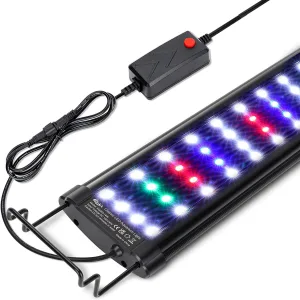
We would like to offer different kinds of aquarium lights for your reference, download the manual to learn more about AQQA Aquarium Lights.
FAQ
1. I heard that light can prevent algae. So what’s the best aquarium light to prevent algae?
Algae cannot be prevented only by light. Actually, too much light tends to promote the growth of algae. The most appropriate solution is moderate light and adequate management of nutrients and water quality. Use a full-spectrum LED or fluorescent light. However, you do not leave for more than 8-10 hours a day.
2. I have a small bowl tank, should I buy a light for it?
Little bowl tanks that contain fish alone often do not need special lighting. Nevertheless, when you need to emphasize the colors of the fish or you would like to grow tiny plants under the water, a small LED light can help you. Do not use too much lighting in small bowls, as it may cause stress to fish.
3. How much should I expect to spend on aquarium lighting?
The price is different depending on the capacity of the tank and lighting. A basic LED system in a small tank can be as cheap as $30-50. The high-end full-spectrum LED systems in the large planted aquarium can range between about 150-400 USD. LEDs are expensive initially. But they are efficient and long-lasting, thus cost-effective in the long run.
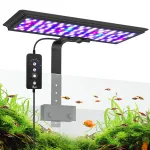
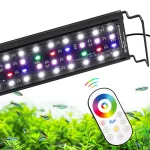
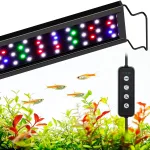
Full Spectrum Aquarium Plant Light (14W) with 3...
Original price was: $29.99.$21.99Current price is: $21.99.
Full Spectrum Aquarium LED Light (14W for 12″-18″)...
Original price was: $18.99.$13.99Current price is: $13.99.



Add comment
You must be logged in to post a comment.