
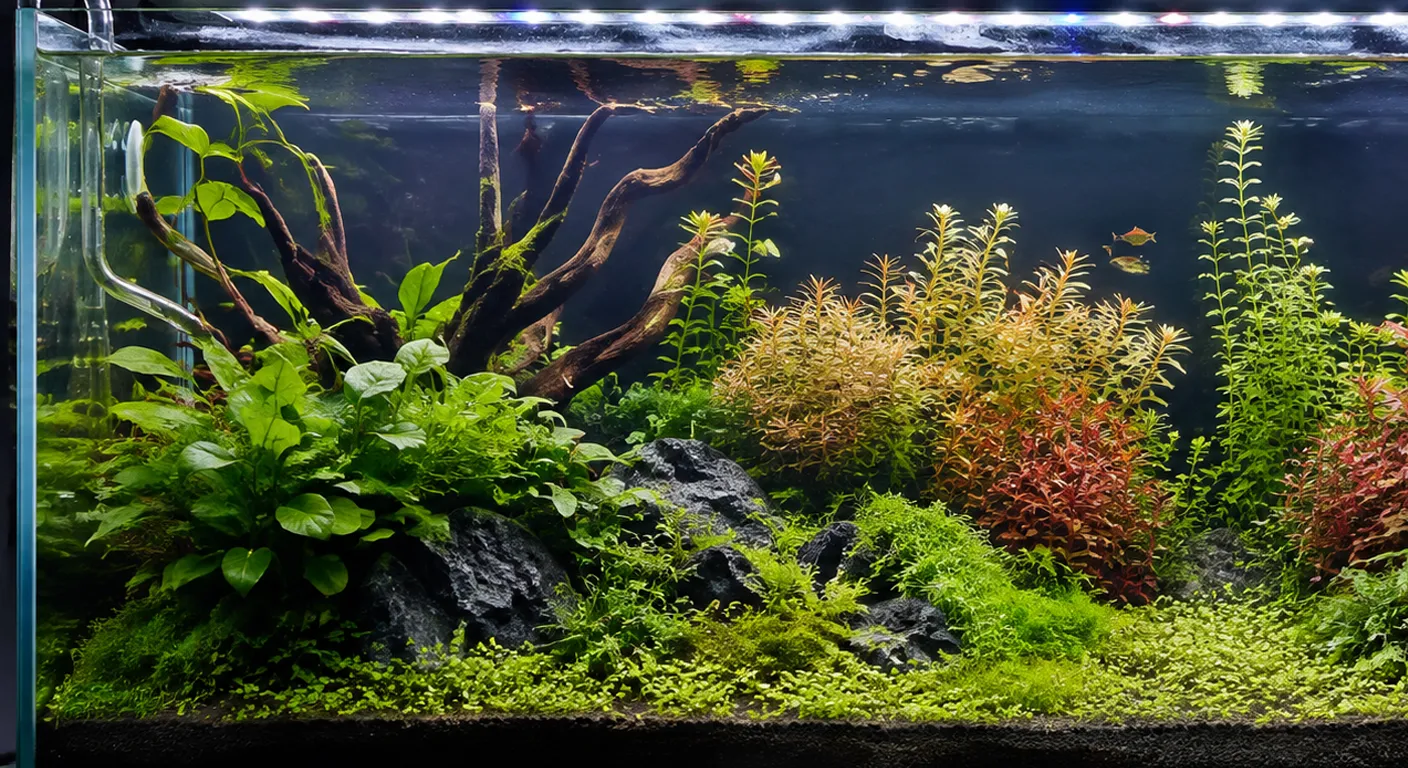
Choosing the best aquarium light for a 55-gallon planted tank depends on your plants, your tank depth, and your goals. It is not just brand names or price tags. A fixture that costs three hundred dollars can still fail a tall tank if the beam angle is wrong. A budget strip light can outperform it on a low-tech setup with easy plants.
A 55-gallon tank is deeper than most people expect. Standard dimensions run about 48 inches long, 13 inches wide, and nearly 21 inches tall. That extra height matters more than the footprint does because light intensity fades quickly as it travels through water. A fixture that looks bright on paper can leave the substrate dim and starved.
This guide uses a simple three-tier framework to match lights to different planted tank goals. We compare five popular options built for 55-gallon tanks, then walk through a quick decision process so you are not stuck guessing.
Why 55-Gallon Tanks Are a Lighting Sweet Spot
Fifty-five-gallon tanks sit in an awkward middle zone. They are common enough that manufacturers design fixtures specifically for the 48-inch length, yet deep enough that shallow tank rules of thumb stop applying.
The Depth Problem
Light loses strength as it passes through water and scatters off suspended particles, glass, and the water surface itself. Every inch of depth subtracts usable intensity. The drop is not linear; it compounds.
In a 12-inch-tall tank, a modest fixture can push enough Photosynthetically Active Radiation, or PAR, to the substrate without much effort. In a 55-gallon tank at nearly 21 inches of water depth, the same fixture might deliver strong light near the surface and almost nothing six inches down. Carpet plants and root feeders planted low in the substrate suffer first, even while floating plants near the top thrive.
As a rough guide, aim for 30 to 50 PAR at the substrate for low light plants, 50 to 80 PAR for medium demand species, and above 80 PAR for high light carpeting plants or red stem varieties.
Reaching those numbers at 20 inches of depth generally requires 40 to 60 watts of quality LED output, or a fixture explicitly rated for tanks in the 20 to 24 inch depth range. Wattage alone is a weak signal, though. LED efficiency and lens design matter more than raw power draw.
Matching Light to Plant Demand
Plants fall into rough categories based on how much light and carbon dioxide they need to thrive.
Low demand plants: Java fern, Anubias, Cryptocoryne, and most mosses. These tolerate weaker light and rarely need injected CO2.
Medium demand plants: Amazon sword, Vallisneria, and many stem plants like Rotala rotundifolia. These grow faster with moderate light and benefit from liquid carbon or light CO2 supplementation.
High-demand plants: Carpeting species like Monte Carlo and Dwarf Baby Tears, plus red stem plants such as Ludwigia and Alternanthera. These need strong, even light and pressurized CO2 to avoid melting or reverting to green.
Before buying anything, run a quick self-assessment. Ask what plants you actually want to grow, whether you are willing to run a pressurized CO2 system, and what you are comfortable spending. Someone who wants a low-maintenance jungle of Java fern. And Anubias needs a completely different fixture than someone chasing a competition-style carpet.
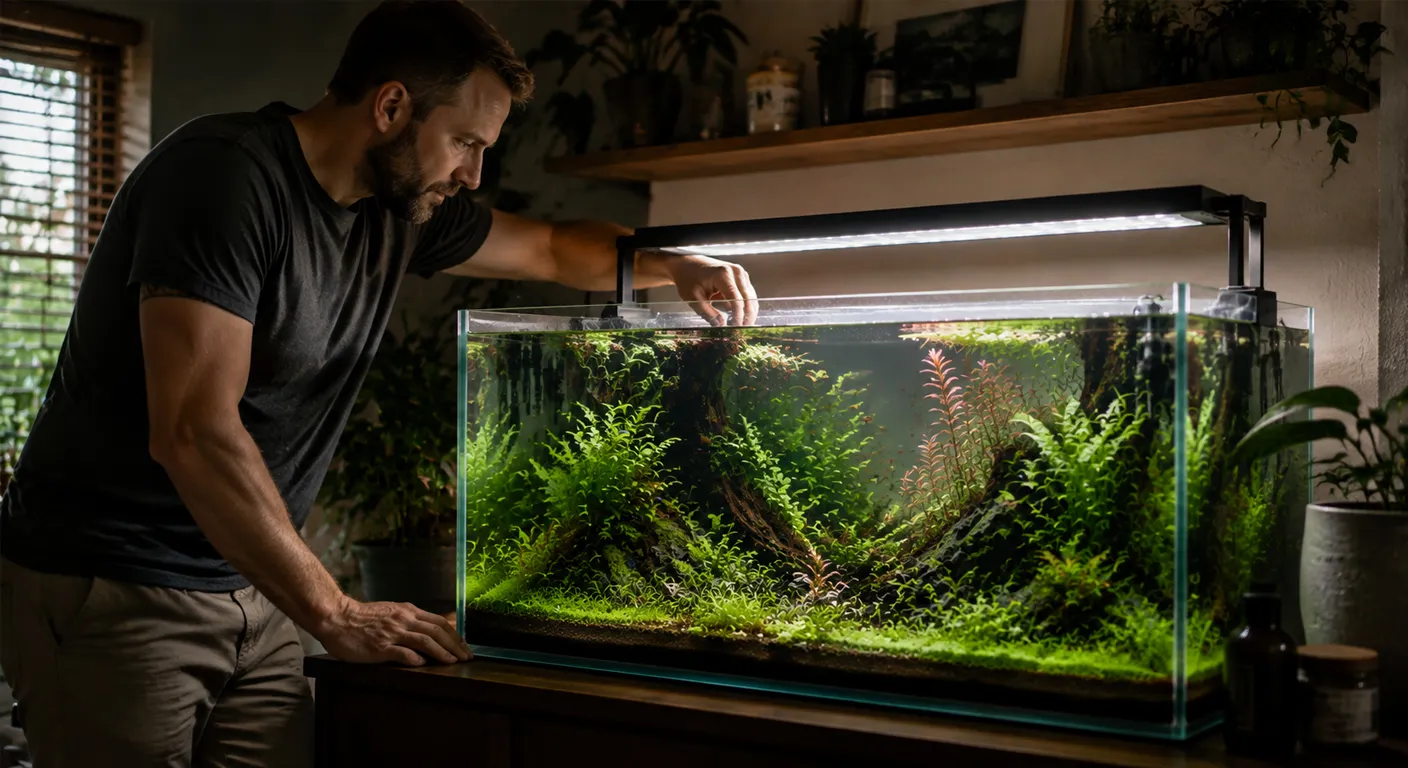
The Three Tier Framework: Match Your Light to Your Goals
Once you know your plant demand level and your appetite for maintenance, the fixture choice narrows quickly. Think of it as three tiers, not one scale.
Low-Tech and Medium-Tech Setups
The goal here is steady, forgiving growth without injected CO2 or heavy dosing. Java fern, Anubias, Cryptocoryne, and slower stem plants all do well.
Nicrew SkyLED Plus or similar entry fixtures: budget range, roughly forty to seventy dollars, adequate for shade-tolerant plants near the substrate.
Fluval Plant 3.0: mid range, generally one hundred fifty to two hundred dollars, with a built-in ramp timer and enough output for medium-demand stem plants without CO2.
Current USA Satellite Freshwater Plus: mid range, similar price bracket, known for wide coverage across the full 48-inch length.
A common mismatch at this tier is buying a fixture rated for a shallow tank and expecting it to reach the substrate of a 55-gallon. Check the manufacturer’s depth rating, not just the wattage listed on the box.
High-Tech Setup
This tier targets carpeting plants, red stem species, and dense planting that depends on strong, uniform PAR from front to back.
Chihiros WRGB II Slim 60: higher range, often two hundred to two hundred fifty dollars, with adjustable RGB channels for color tuning and enough intensity to support carpet growth with CO2.
Twinstar Light S or 600 EA: premium range, typically two hundred fifty to three hundred fifty dollars, prized for even spread and low glare despite high output.
A frequent problem at this level is coverage gaps. Many high-output fixtures are built narrower than 48 inches to concentrate intensity, which leaves the corners of a 55-gallon tank shaded. Confirm the fixture length matches your tank, or plan to run two units.
Head-to-Head: Top Five Lights for 55-Gallon Tanks
Pricing shifts often, so treat the ranges below as a starting point and check current listings on the retailer’s site before buying.
| Fixture | Best For | Approx. Price Range | Verdict |
| Nicrew SkyLED Plus | Low-tech, beginner tanks | $40 to $70 | Solid budget pick for shade plants, weak for carpets |
| Fluval Plant 3.0 | Low to medium-tech | $150 to $200 | Reliable all-rounder with a built-in ramp timer |
| Current USA Satellite Freshwater Plus | Medium-tech, wide tanks | $150 to $220 | Even spread across 48 inches, moderate CO2-friendly output |
| Chihiros WRGB II Slim 60 | High-tech, color tuning | $200 to $250 | Strong PAR at depth, app control adds a learning curve |
| Twinstar Light S / 600 EA | High-tech, dense planting | $250 to $350 | Best light quality and spread, priced above most hobbyists’ budget |
Decision Flowchart: Pick Your Light in Five Minutes
Work through this in order rather than jumping straight to a product name.
Start with your plant goal. Shade-tolerant plants only, medium demand stems, or a dense carpet with red stems.
Check your CO2 plans. No CO2 points toward the low-tech tier. Liquid carbon or pressurized CO2 opens up the medium and high-tech tiers.
Set your budget ceiling. Under one hundred dollars limits you to entry fixtures. Two hundred and above opens the high-tech tier described in Section 4.
Confirm coverage. Measure your tank length and compare it against the fixture’s rated coverage, not just its physical size.
If your plant goal and budget point to the medium-tech tier, the Fluval Plant 3.0 or Current USA Satellite Freshwater Plus from the table above are reasonable starting points. If you land in high-tech territory, weigh the Chihiros WRGB II Slim against the Twinstar Light S based on how much you value app-based color control versus raw spread quality.
Installation and Tuning: Avoid the Algae Trap
A well-chosen fixture can still cause algae outbreaks if it is installed or programmed poorly.
Mount the light close enough to the water surface to reach the substrate, typically within a few inches, unless the manufacturer specifies otherwise. Fixtures suspended too high lose a large share of their intensity before the light even touches the water.
Start new plants and new setups with a short photoperiod, around six hours daily, then increase gradually over two to three weeks toward a target of eight to nine hours. Ramping intensity slowly the same way, rather than running the fixture at full brightness from day one, gives plants time to establish before algae can exploit excess light.
A timer is not optional at this stage. Manual on and off switching invites inconsistency, and inconsistent light schedules are one of the most common triggers for algae blooms in new tanks.
Before moving on, run through this short checklist:
Fixture mounted at the correct height for its rated coverage
Timer set for a short initial photoperiod
Intensity ramp scheduled over two to three weeks
CO2 system, if used, matched to the light intensity rather than run independently
Common Mistakes and How to Fix Them
Even careful enthusiasts face several recurring problems.
Undersized light for tank depth. A fixture rated for a 12-inch tank will not push enough PAR through 20 inches of water. Fix this by checking the manufacturer’s depth rating against your actual water column, not just the tank’s gallon capacity.
Increasing intensity too soon. Jumping straight to eight or nine hours of full brightness on a new tank almost guarantees an algae bloom. Fix this by following the ramp protocol described above. Patience here saves weeks of cleanup later.
Confusing air PAR with substrate PAR. Many product listings advertise PAR measured just below the fixture, not at the depth where your plants actually sit. Fix this by looking for PAR figures specified at 20 or 24 inches, or by using a PAR meter yourself if the investment makes sense for your setup.
These mistakes trace back directly to the depth and demand mismatch covered in Section 2. Matching fixture output to your actual water depth and plant category solves most algae and growth problems before they start.
Conclusion
Choosing a light for a 55-gallon planted tank comes down to four factors working together: tank depth, plant requirements, budget, and how much maintenance you want to take on. Skipping any one of these leads to either wasted money or a tank full of leggy, struggling plants.
The best aquarium light is not always the most powerful or expensive option on the shelf. A well-matched budget fixture on a low-tech tank will outperform an oversized premium unit that never gets tuned correctly. Use the three-tier framework and the comparison table above to narrow your options, then confirm coverage and depth rating before you buy. That combination, rather than chasing the highest wattage number, is what actually keeps a 55-gallon planted tank thriving.
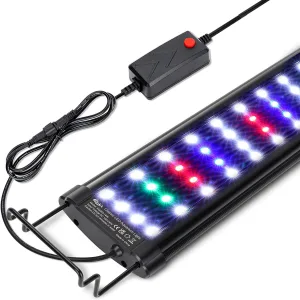
35W Aquarium Clip-On Stream Light For Freshwater Plants...
Original price was: $62.99.$59.49Current price is: $59.49.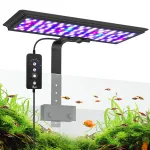
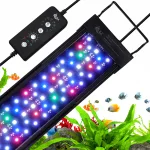
Aquarium LED Light, 24/7 Mode, IP68 Waterproof, for...
Original price was: $26.99.$24.59Current price is: $24.59.


Add comment
You must be logged in to post a comment.