
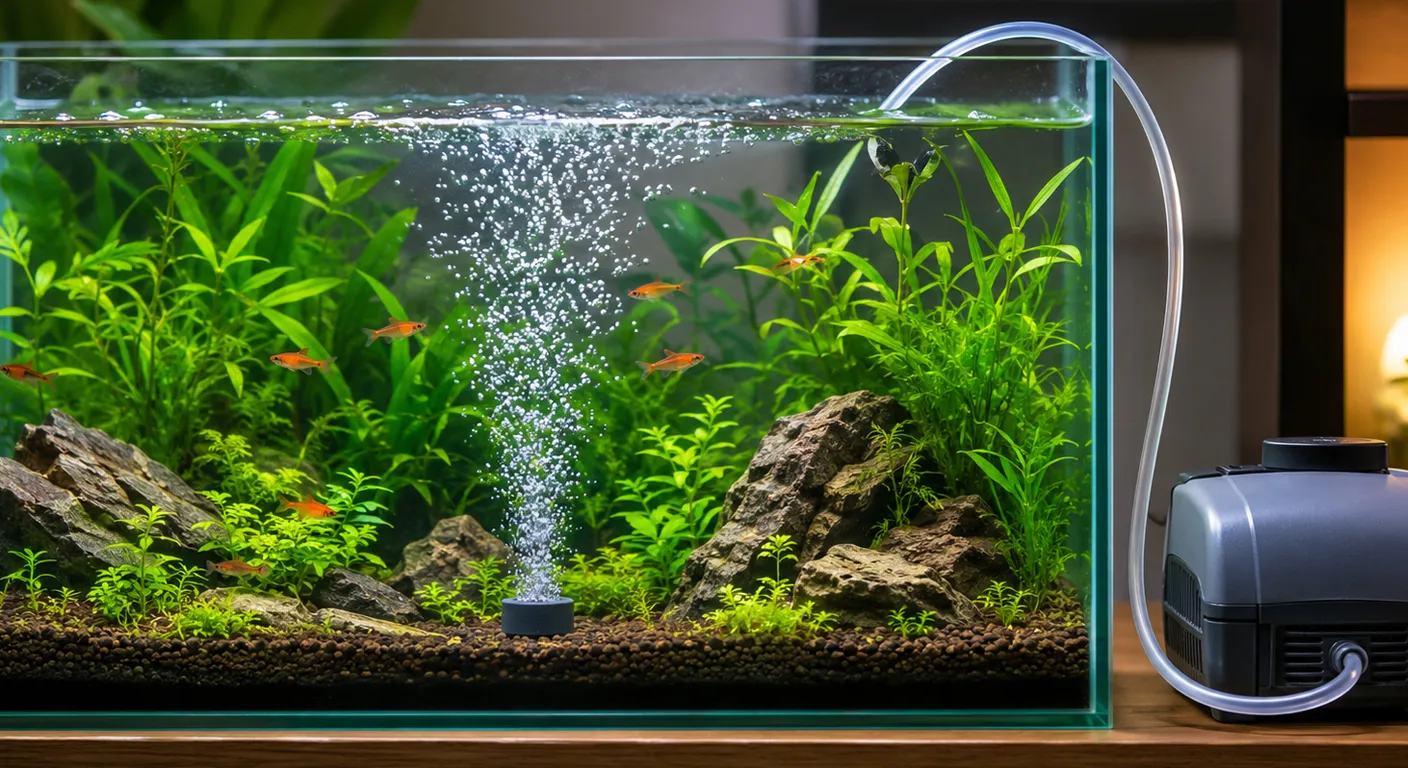
Choosing an air pump by the gallon rating on the box sounds simple. It rarely works out that way. You get home, hook everything up, and the bubbles barely reach the surface. Or the opposite happens. The pump roars, the airstone rattles against the glass, and your betta spends the day fighting a current it never asked for.
The right pump depends on more than tank volume. Depth, the accessories running off the pump, how heavily the tank is stocked, and even the type of setup all change the airflow you actually need. A planted tank injecting CO2 might need almost no air pump at all. A quarantine tank running a sponge filter around the clock needs far more than the box suggests.
This guide walks through what pump specs actually mean, why depth changes everything, and a simple three-stage method for calculating the airflow your tank requires. No guesswork. Just numbers you can check against your own setup.
Table of Content
ToggleWhat Air Pump Specs Actually Mean
Every air pump box lists three numbers, and most people only read one of them. That single habit causes more sizing mistakes than anything else in this guide.
GPH (gallons per hour) measures how much air the pump pushes when there is nothing on the other end to resist it. Think of it as a maximum, not a guarantee.
Pressure (measured in MPa) tells you how hard the pump can push against resistance, meaning water depth, tubing length, and any device attached to the line. A pump can have a high GPH rating and still struggle in a deep tank if its pressure rating is weak.
Outlet count simply tells you how many lines the pump can run at once. More outlets sound convenient, but each additional line splits the total output, which lowers the pressure and volume reaching any single device.
Most beginners check GPH, ignore pressure, and end up with a pump that underperforms the moment it faces a deep tank or a sponge filter. Pressure is the number that determines whether your pump will actually work for your setup, not just look good on paper.
What Determines How Much Airflow You Need
Four variables drive your actual requirement, and none of them is simply tank volume.
Tank depth: Deeper water creates more resistance, so the pump has to work harder to push bubbles to the surface.
Accessories connected: Every airstone, sponge filter, or bubble wall draws a share of your pump’s total output.
Stocking level: A heavily stocked tank consumes oxygen faster and needs more surface agitation to keep gas exchange stable.
Tank type: A planted tank with a CO2 system may need no air pump at all, since surface agitation actually strips CO2 that plants need. A densely stocked tank, on the other hand, often needs airflow well above what the box rating suggests.
Tank Type Changes Everything
Two tanks can hold the same volume of water and still need completely different airflow. A planted tank running pressurized CO2 wants minimal surface disturbance, so a small pump or none at all is often correct.
A community tank with moderate stocking needs steady, gentle aeration. A saltwater tank often runs a protein skimmer that already agitates the surface, reducing how much extra air the tank needs.
A hospital or quarantine tank, by contrast, usually runs a sponge filter as the sole filtration method. That alone demands a stronger pump than most people expect.
| Variable | Low Demand | High Demand |
| Tank depth | Under 12 inches | 20 inches or more |
| Accessories | One airstone only | Sponge filter, under gravel filter, and decoration combined |
| Stocking level | Lightly stocked or planted community | Heavily stocked, quarantine, or hospital tank |
| Tank type | Planted tank with CO2 injection | Saltwater sump or hospital tank |
Why Undersizing and Oversizing Both Cause Problems
It is tempting to think bigger is always safer. It is not.
An undersized pump produces weak, inconsistent bubbles. Sponge filters lose suction and stop pulling debris efficiently. Oxygen levels drop during warm weather, when water holds less dissolved oxygen to begin with, right when fish need it most.
An oversized pump causes its own set of headaches. Strong, constant current stresses fish that prefer calm water, including bettas, angelfish, and many shrimp species. In planted tanks, excess surface agitation strips dissolved CO2 out of the water before plants can absorb it. As a result, slowing growth and sometimes triggers algae outbreaks.
The right pump size is the calculated size for your specific tank. Not the largest pump on the shelf, and not the cheapest one that fits your budget.
Why Tank Depth Matters More Than Volume
Two 20-gallon tanks can need entirely different pumps. A tall 20 gallon holding water two feet deep needs far more pressure than a wide, shallow 20 gallon holding the same volume across a larger footprint.
Here is the plain explanation for MPa. Deeper water simply weighs more, and that weight pushes back against the air trying to rise through it.
A pump rated for a shallow ten-gallon tank often cannot push enough pressure to move bubbles efficiently through three feet of water. The GPH number stays the same on the label. The actual performance drops.
How to Measure Your Tank’s Effective Depth
Measure from the surface of your substrate to the waterline, not the total height of the tank glass. Effective depth is what your pump actually has to overcome.
Substrate, rockwork, and driftwood all reduce that distance somewhat, but the air gap above the waterline does not count toward pressure at all. Skip this step, and you will likely underestimate the pressure your pump needs, since most people measure the outside of the tank rather than the water column itself.
| Tank Depth | Min Pressure | Min GPH | Typical Setup |
| Under 12 in | 0.012 MPa | 35 GPH | Nano tank, 10 to 15 gallons, single airstone |
| 12 to 16 in | 0.016 MPa | 55 GPH | Standard 20 to 40 gallon community tank |
| 16 to 20 in | 0.020 MPa | 85 GPH | Tall 40 to 75 gallon tank, cichlid or deep-bodied setup |
| 20 in or more | 0.026 MPa | 130 GPH | Deep tank over 75 gallons, or a tall column style saltwater tank |
How to Calculate Your Total Airflow Requirement
The calculation happens in two steps. First, pull your base GPH from tank depth. Second, add the GPH draw from every accessory connected to the pump. Then apply a buffer, because manufacturers rate pumps at zero resistance, a condition your tank will never actually match.
Step 1: Base GPH From Tank Depth
Use the depth table above and pull the minimum GPH figure that matches your effective water depth. This is your starting number before anything else gets added.
Step 2: Add GPH for Each Accessory
Every device pulls air from the pump’s total output, and that draw adds directly to your base requirement.
| Accessory | GPH Per Unit |
| Nano airstone | 8 to 12 GPH |
| Standard airstone | 15 to 25 GPH |
| Sponge filter, 5 to 20 gallon size | 25 to 35 GPH |
| Sponge filter, 20 to 60 gallon size | 40 to 55 GPH |
| Bubble decoration | 12 to 20 GPH |
| Under gravel filter, per plate | 35 to 50 GPH |
Add each device’s draw to your base GPH from Step 1, then apply a buffer of fifteen to twenty percent. That buffer accounts for tubing length, check valves, and general wear, all of which quietly reduce output over time. Skip the buffer and your pump will likely fall short within a few months.
How to Match Your Number to the Right Pump
Once you have your total required GPH, including the buffer, you can shop by that number instead of by tank volume alone. Pump wattage is a rough guide, but rated GPH almost always overstates what the pump delivers once tubing and devices are attached. So, lean on the practical output column below rather than the rated number on the box.
| Wattage | Rated GPH | Practical GPH | Best For |
| 2.5W | 50 GPH | 35 GPH | Nano tanks up to 15 gallons |
| 5W | 65 GPH | 48 GPH | 20 to 40 gallon tanks, one accessory |
| 8W | 110 GPH | 80 GPH | 40 to 75 gallon tanks, dual outlet |
| 10W | 160 GPH | 115 GPH | 75 to 125 gallon tanks, multiple accessories |
| 15W | 240 GPH | 170 GPH | 125 gallons and up, or multi-tank setups |
If your calculated requirement sits close to the boundary between two wattages, choose the higher option. A single outlet pump running near its limit performs worse over time than a slightly larger pump running comfortably below its maximum.
If you need to split airflow across two or more devices, a multi-outlet pump with an adjustable valve gives you more control than trying to force one line to feed everything through a manifold.
Conclusion
Choosing the right aquarium air pump comes down to three stages. Understand what the specs actually mean, account for tank depth and every accessory attached to the line, then calculate the airflow your specific setup requires.
Do not rely on the gallon rating printed on the box. Check your effective water depth, add up your accessory requirements, and look at practical output rather than the rated maximum. Leave a small performance buffer for resistance. Since, no tank matches the zero-resistance conditions manufacturers test under.
Recalculate your airflow needs whenever you add equipment, change stocking levels, or modify your tank setup. A pump that was right for your tank a year ago may no longer meet the tank’s needs today.
Related Products For Your Reference
Multifunctional Rechargeable Aquarium Lithium Battery Air Pump (1.7W)
Multifunctional Aquarium Lithium Battery Air Pump (2.5W/5W) with...














Add comment
You must be logged in to post a comment.