
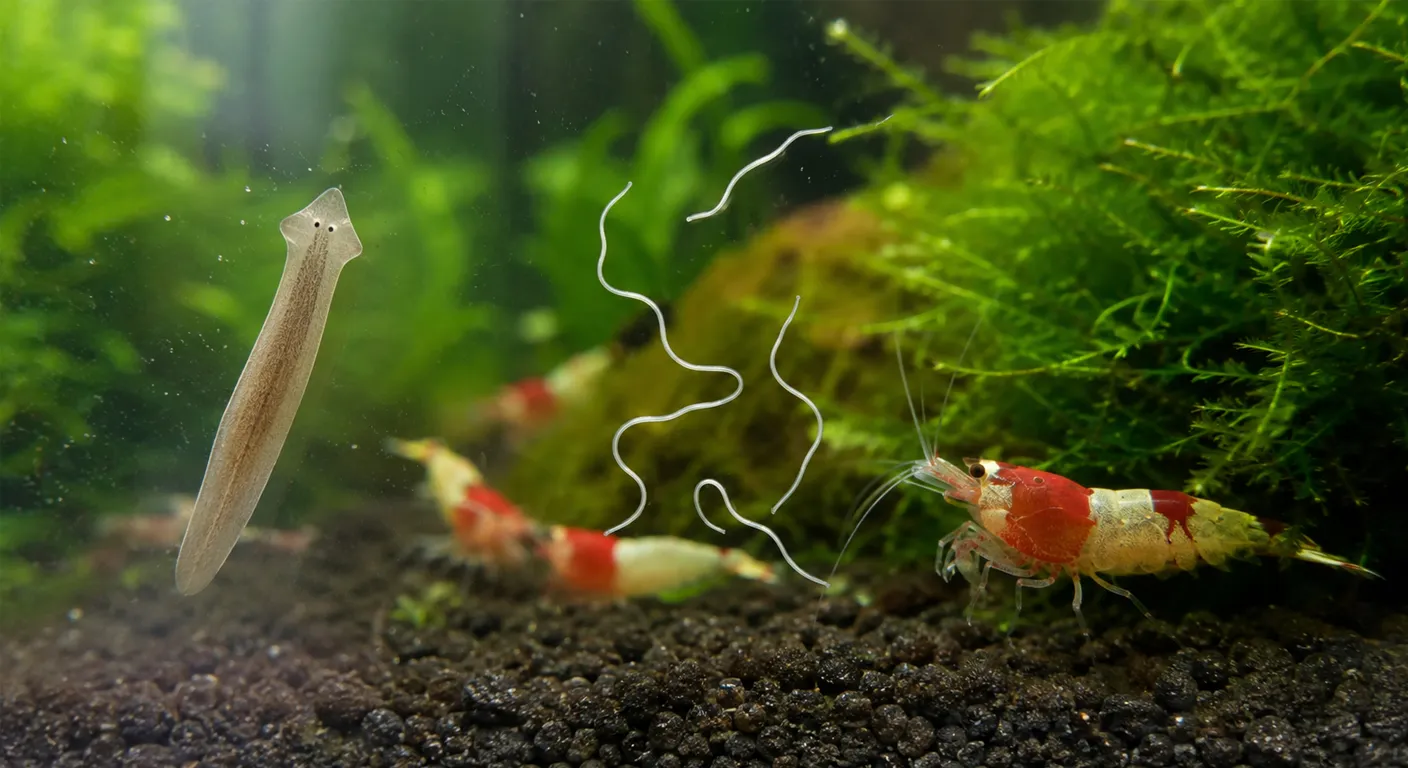
If you’ve spotted tiny white worms crawling on your aquarium glass, the two most likely culprits are planaria (predatory flatworms) or detritus worms (harmless scavengers) and telling them apart matters, because planaria hunt shrimp, shrimp eggs, and fish fry, while detritus worms just signal excess organic waste in your tank.
They look similar at a glance: both are small, pale, and wriggle along the glass. But planaria have a flatter, triangular head and glide in smooth, gliding motions, while detritus worms are thinner, rounder, and move in quick, erratic jerks, often clustering near uneaten food or substrate.
This guide walks through how to identify each worm type, what each one actually means for your tank’s health, the mistakes most aquarists make when identifying them, and the exact steps to take once you know which one you have.
Side-by-Side Comparison: Planaria vs. Detritus Worms
| Feature | Planaria | Detritus Worms |
| Head Shape | Triangular or arrowhead-shaped | No distinct head, thread-like at both ends |
| Eyespots | Two small dark eyespots near the head | None visible |
| Body Shape | Flat, ribbon-like | Round, thin, and wormlike |
| Movement | Smooth, gliding motion across surfaces | Thrashing, wriggling, or looping motion |
| Size | Roughly 3 to 15 millimeters | Roughly 5 to 10 millimeters, thinner |
| Color | Brown, tan, or pale white | Clear, white, or slightly pink |
| Activity Time | Visible day or night, often hiding in daylight | Most active at night |
| Location | Glass, substrate, filter intakes, plant leaves | Mostly in the substrate and along the glass |
| Shrimp Risk | High, especially to molting shrimp and eggs | None |
| Cause | Overfeeding, decaying matter, and new livestock introductions | Overfeeding, excess waste buildup |
| Treatment Needed | Yes, targeted removal or medication | No, maintenance adjustments only |
How to Identify Each Worm Type
Most misidentifications come down to rushing the look. Slow down, get a flashlight close to the glass, and check these three traits in order.
Head Shape: The #1 Giveaway
The head is the fastest way to separate these two worms, and it rarely fails.
Planaria: The head narrows into a triangle or arrowhead shape. Under magnification, this shape is unmistakable and does not change as the worm moves.
Detritus Worms: Both ends of the body look nearly identical. There is no widening or narrowing that marks a head versus a tail.
Movement Patterns
Watch how the worm moves for ten or fifteen seconds before deciding anything.
Planaria: Glides smoothly along glass or substrate, almost like it is sliding rather than crawling. The motion looks controlled and deliberate.
Detritus Worms: Thrashes, coils, or loops erratically. The movement looks frantic compared to the steady glide of a planarian.
Body Shape & Location
Planaria: Flat and ribbon-shaped, often found clinging to glass, filter intakes, or the underside of plant leaves.
Detritus Worms: Round and thread-thin, usually found wriggling in the substrate or drifting near the bottom of the tank.
Common Misidentification Mistakes
A few quick traps catch even experienced keepers off guard.
White planaria vs. detritus worms: Color alone tells you nothing, since both can appear pale white.
Rhabdocoela vs. planaria: Some flatworms are flat but harmless, and panicking over shape alone leads to unnecessary treatment.
Hydra confusion: Hydras do not glide or wriggle at all. They sit still and extend tentacles, which rules out both worm types.
What Each Worm Means for Your Tank
Identification only matters because the two pests carry completely different consequences. One is a predator. The other is a cleanup crew doing exactly what it should.
Planaria: The Real Threat
To Shrimp: Planaria attack shrimp during molting, when the shell is soft, and shrimp cannot defend themselves. They also consume unguarded eggs directly off the female’s abdomen.
To Snails: Snail eggs and newly hatched snails are vulnerable, though adult snails are generally safe.
To Fish: Fry and very small fish species face risk, while adult fish are rarely bothered.
Indicator of: A planaria outbreak almost always points to overfeeding or decaying organic matter left uncleaned in the tank.
Detritus Worms: The Harmless Scavengers
To Shrimp, Snails, Fish: Detritus worms pose no threat to any tank inhabitant. They do not bite, sting, or compete meaningfully for food.
Indicator of: A visible population usually means excess waste has built up in the substrate, often from overfeeding or infrequent vacuuming.
When to Worry: Population Thresholds
Planaria: Even a small number, five or ten visible worms, justifies action because their numbers double quickly, and shrimp losses can start immediately.
Detritus Worms: A moderate population is normal in any established tank. Concern only arises when numbers explode into the hundreds, which signals a maintenance gap rather than a health risk.
Common Misidentification Mistakes
These four mix-ups account for most of the panic messages posted in aquarium forums.
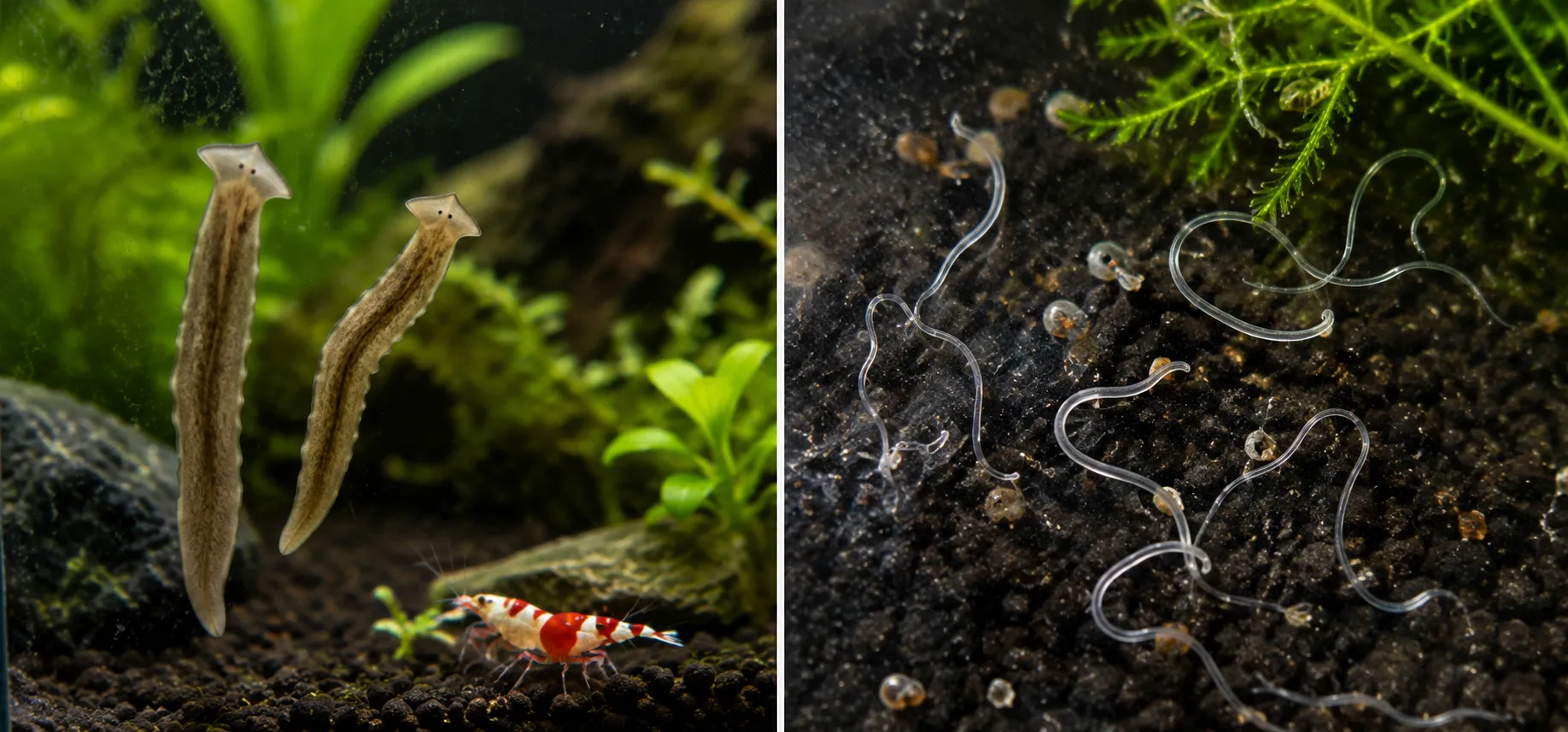
White Planaria vs. Detritus Worms
The assumption that every white worm is a harmless detritus worm leads people to skip treatment entirely.
Reality: Planaria can appear pale white, especially younger individuals, and color provides no reliable clue on its own.
Fix: Always check for the triangular head and eyespots before ruling planaria out, regardless of color.
Rhabdocoela (Harmless Flatworms) vs. Planaria
Any flat, worm-shaped creature tends to trigger alarm, even when it poses no danger.
Reality: Rhabdocoela are flat but lack the triangular head and eyespots that define true planaria, and they do not prey on shrimp.
Fix: Confirm both diagnostic features together. A triangular head paired with visible eyespots confirms planaria; either trait alone is not enough.
Hydra vs. Both
Hydra gets mistaken for worms constantly, despite being a completely different organism.
Reality: Hydras are tiny anemone-like polyps that attach themselves to a fixed surface and can sting and kill small shrimp.
Fix: Hydra does not travel. They stay anchored and simply extend or retract their tentacles to feed.
Nematodes vs. Detritus Worms
Some keepers treat every thin, wriggling worm as a pest that must be eliminated.
Reality: Most aquarium nematodes are harmless, and certain species even help break down waste alongside detritus worms.
Fix: Nematodes typically wriggle freely in open water rather than staying in the substrate, and rarely require any treatment.
Quick Action Guide and Prevention
If You Have Planaria
Confirm the identification first, then move through treatment in this order.
Confirm the triangular head and eyespots under a flashlight or magnifying glass before starting treatment.
Reduce feeding immediately, cutting portions by half for one to two weeks to starve the population.
Set physical traps using bait such as a small piece of shrimp pellet inside a container with a narrow entry point.
If manual removal is not enough, use a fenbendazole-based treatment at the dose labeled for invertebrate safe tanks, since standard doses are shrimp safe when used correctly.
Vacuum the substrate thoroughly during and after treatment to remove eggs and remaining worms.
Monitor the tank for two full weeks after the last worm sighting before resuming normal feeding levels.
If You Have Detritus Worms
No medication is needed here, and reaching for treatment products wastes money and stresses your livestock unnecessarily. Focus entirely on maintenance instead.
Reduce feeding to match what your fish and shrimp actually consume within two to three minutes.
Vacuum the substrate weekly to remove built-up waste before it accumulates further.
Increase water change frequency slightly for two to three weeks to lower the overall organic load.
Check filter media and clean it if the flow has noticeably slowed, since clogged filters let waste settle undisturbed.
Prevention Strategies (Both Types)
Both pests trace back to the same root cause in most tanks: too much uneaten food and organic waste sitting undisturbed. Feed only what your livestock can finish quickly, and remove any leftovers within a few minutes rather than letting them decay in the substrate.
Stick to a consistent gravel vacuuming schedule, since disturbed substrate prevents the buildup that both worm types depend on. Finally, quarantine any newly purchased plants or livestock for one to two weeks before adding them to your main tank, since planaria and their eggs often hitch a ride on plant leaves and roots.
Conclusion
Planaria and detritus worms look similar at first glance, but they behave and affect your tank in completely different ways. Planaria are predators that threaten shrimp, eggs, and fry, while detritus worms are harmless scavengers that simply indicate excess waste in the system.
Do not treat every white worm you see as an automatic pest. Check the head shape, look for eyespots, and watch how it moves before deciding on any treatment. That one habit alone prevents wasted medication, unnecessary stress on your livestock, and missed treatment windows when planaria really is the problem.
Build a routine of moderate feeding and regular substrate cleaning, and both worm populations tend to stay in check on their own. A tank kept clean rarely gives either species the conditions it needs to spread out of control.


Add comment
You must be logged in to post a comment.