
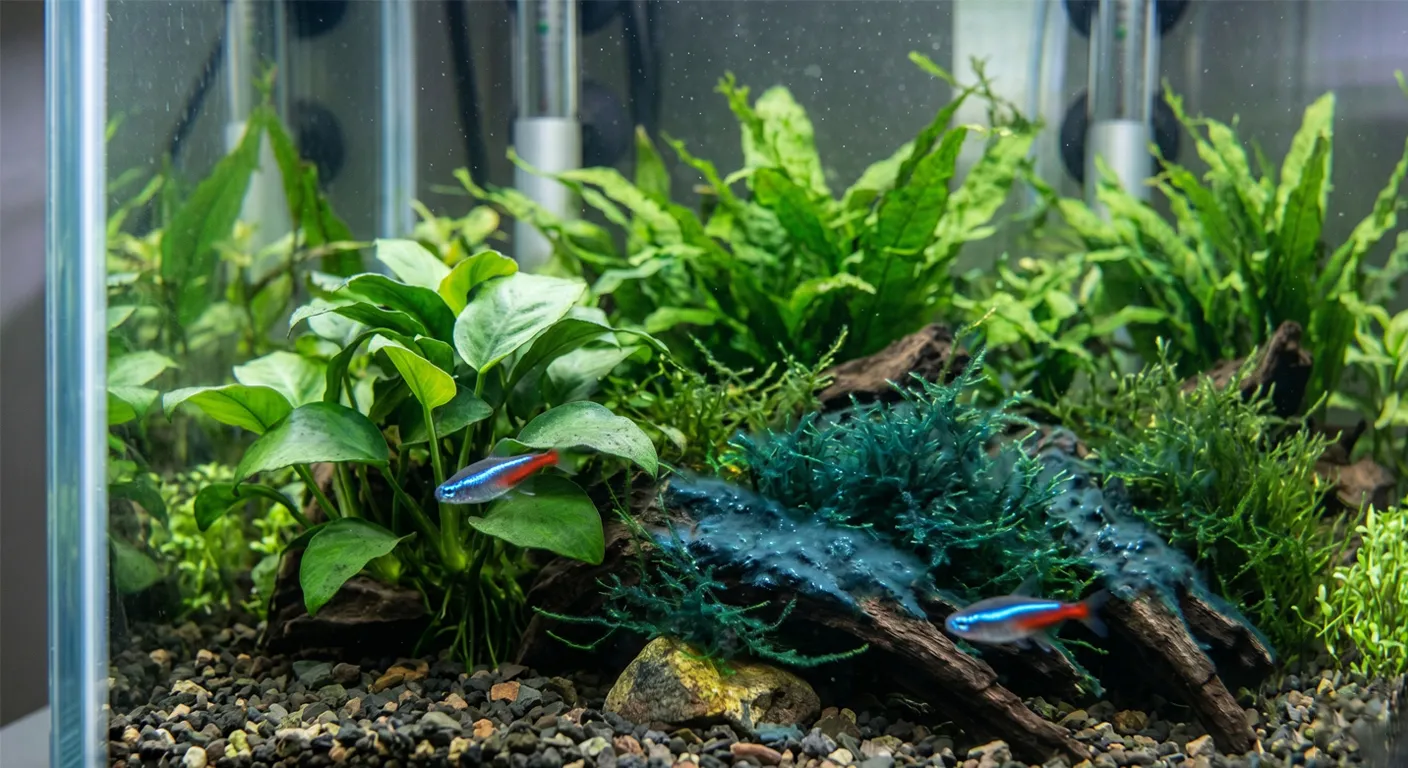
I came downstairs one morning and the whole bottom of my tank was covered in dark reddish slime. It had spread overnight across the substrate and was creeping up the plants. The tank had looked completely fine the day before.
That’s how cyanobacteria works. It doesn’t announce itself. It just shows up. And when it does, it moves fast. Most people reach for a chemical treatment first. That works short-term. But if the conditions that caused it are still there, it comes right back. The real fix isn’t the product. It’s understanding what the tank is doing wrong and correcting that.
In this guide, we’ll cover how to identify cyanobacteria correctly. Why does it keep coming back? How to remove it safely. And how to build a maintenance routine that actually prevents it long term.
Cyanobacteria vs. Other Algae: How to Tell the Difference
Correct identification matters because cyanobacteria get confused with diatoms, film algae, dinoflagellates, and general detritus buildup. Treating the wrong thing makes the actual problem worse.
| Visual Sign | Cyanobacteria | Common Lookalikes |
| Texture | Slimy and mat-like. Lifts off in sheets | Diatoms are powdery. Detritus is loose and cloudy |
| Color | Dark green, blue-green, red, or brownish | Diatoms are brown. Film algae is green. Dinos look similar but more golden |
| Behavior | Spreads in sheets. Traps bubbles underneath. Smells musty | Other algae don’t lift cleanly or trap gas the same way |
| Location | Low flow areas. Substrate surface. Behind rocks and decor | Diatoms appear on glass and hardscape. Film algae coats surfaces evenly |
Note: The easiest spot check is to try lifting a small piece. Cyanobacteria come off in a connected sheet and usually have a distinct musty smell. If it crumbles or disperses into the water, it’s probably something else. Getting this wrong matters because treatment that works on cyanobacteria can actually feed other types of algae.
Most common visual traits:
Spreads in flat mats across the substrate or low-flow surfaces
Traps small air bubbles underneath as it grows
Has a musty or earthy smell when disturbed
Comes off in connected sheets rather than breaking apart
Can appear dark green, blue-green, brownish, or reddish depending on tank conditions
Why Cyanobacteria Keep Coming Back
Repeated outbreaks usually mean the underlying conditions were never fixed. Removing the slime without addressing the cause is just buying time.
Dead flow zones: Any area where water movement is weak becomes a breeding ground. Behind rocks and under dense plant growth, and in corners where the filter output doesn’t reach are the most common spots. Cyanobacteria don’t compete well in strong flow. It thrives where nothing is moving the water.
Waste accumulation: Uneaten food and fish waste sitting on the substrate break down and feed the bacteria directly. If your substrate has visible debris between cleanings, the tank is already providing ideal conditions for an outbreak.
Nutrient imbalance: Low nitrate and low phosphate sounds like a good thing, but it’s actually a warning sign in a planted tank. Cyanobacteria can fix their own nitrogen from the water. That gives it a serious advantage when nutrient levels crash too low.
Excessive cleaning: Over-cleaning disrupts the beneficial bacteria colonies in your substrate and filter. When those colonies weaken, the biological balance shifts. Opportunistic organisms like cyanobacteria fill that gap fast.
Inconsistent lighting: Too many hours of light per day or light that’s too intense feed blooms of all kinds. Cyanobacteria are particularly efficient at using light, even when other organisms can’t keep up.
Equipment issues: A partially clogged filter reduces flow throughout the whole tank without being obvious about it. An undersized pump creates the same problem. Equipment that isn’t maintained regularly is one of the most common hidden causes of recurring outbreaks.
Overstocking and overfeeding: More fish means more waste. More waste means more nutrients. More nutrients mean more fuel for cyanobacteria. Each skipped water change compounds the last one.
Skipped maintenance: A tank with irregular water changes and inconsistent cleaning develops gradual imbalances. By the time a bloom appears, the conditions have usually been building for weeks.
How to Prevent Cyanobacteria from Recurring
Most guides tell you how to remove cyanobacteria. They rarely explain how to stop it from becoming a recurring problem. Here’s what those articles are missing.
| Common Content in Existing Articles | Missing Angle |
| Siphoning and water changes | How to siphon without disrupting beneficial bacteria colonies |
| Flow and light advice | How to audit dead zones and reposition equipment specifically |
| Chemical treatment | Why repeated treatment means the root cause is still there |
| Nutrient control tips | How to balance nutrients without crashing them too low |
| Basic prevention tips | A repeatable maintenance framework built around prevention not reaction |
The real shift is treating diagnosis as the first step. Before removing anything, figure out where the water flow is weak. Check whether nutrients are too high or too low. Look at your lighting schedule and feeding habits. Then remove the cyanobacteria and correct the conditions at the same time. The recovery habits after treatment matter just as much. Consistent maintenance in the weeks following a bloom is what stops it from coming straight back.
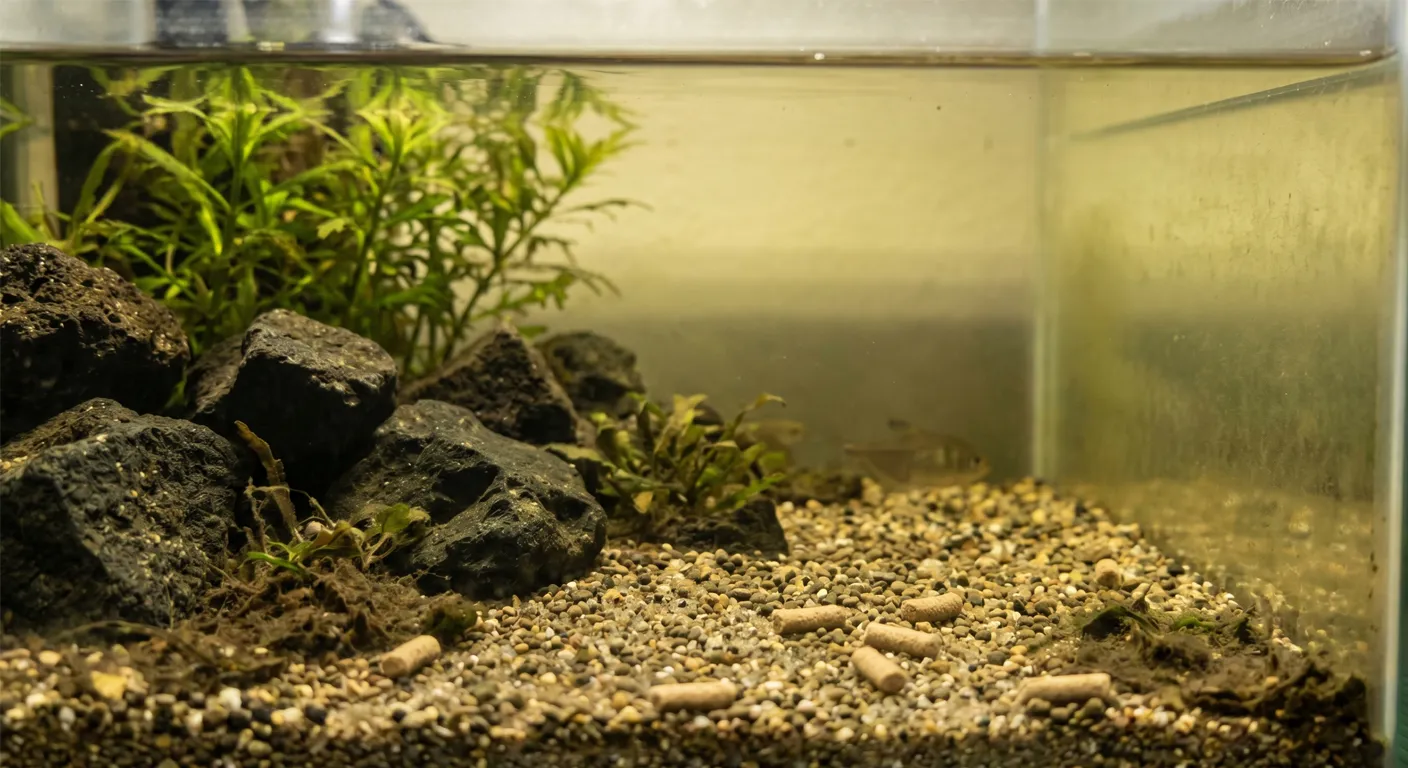
Early Warning Signs Before a Bloom
Cyanobacteria usually appear after the tank has already been showing subtle signs of stress. Catching these early gives you a chance to act before anything becomes visible.
Dead flow zones forming behind rocks and decor, and dense plant growth where debris collects and sits
Substrate that looks dirty between cleanings or debris building up visibly in corners
Nitrate and phosphate levels that are uneven or dropping lower than they should be
A still water surface with weak agitation and low oxygen exchange
Cleaning sessions are becoming inconsistent or getting skipped over for several weeks
Uneaten food sitting on the substrate after each feeding
Maintenance Routine
A consistent maintenance system is one of the best ways to prevent cyanobacteria from taking hold. The goal is to catch problems before they become visible.
Daily:
Remove visible waste or uneaten food before it breaks down
Check water movement in low-flow areas and behind hardscape
Look for small patches of anything unusual before they have a chance to spread
Weekly:
Clean the glass and siphon debris from the substrate
Test key parameters and look for anything that has shifted from the previous week
Rinse the mechanical filtration media if the flow has noticeably reduced
Monthly:
Deep clean equipment, including pumps, filter housings, and any skimmers
Review flow patterns across the whole tank and identify any new dead spots
Evaluate whether lighting duration, feeding amounts, and stocking levels need adjustment
How to Prevent Cyanobacteria Long Term
Prevention works best when the tank is treated as a complete system rather than a collection of isolated problems.
Keep nutrient levels stable. Chasing sudden swings in either direction causes more harm than holding a consistent middle ground
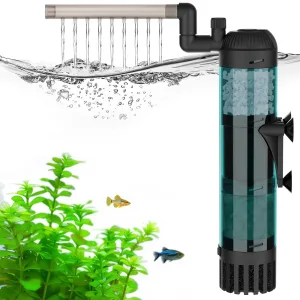
Improve circulation across the full tank. Point a powerhead at problem areas if the main filter isn’t reaching them
Feed only what fish consume within two to three minutes. Remove anything left over before it settles
Maintain filters and pumps on a regular schedule. A partially blocked filter is one of the most overlooked causes of outbreaks
Address waste buildup before it becomes visible. By the time you see a layer of debris, it’s already been feeding bacteria for days
Keep maintenance predictable. The tanks that avoid recurring outbreaks almost always have consistent weekly habits behind them
Safe Response When Cyanobacteria Appear
Once cyanobacteria show up, the goal is to remove the visible buildup without ignoring the reason it formed.
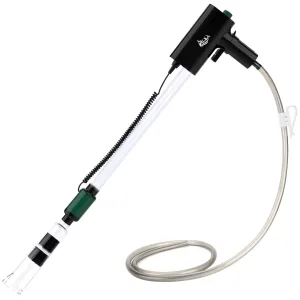
Manually remove as much as possible using a siphon or by hand. Getting the mass out first reduces the load immediately
Clean problem areas thoroughly, but avoid disrupting the substrate so deeply that you damage beneficial bacteria colonies
Identify and correct the cause at the same time as the removal. Flow, nutrients, lighting, and feeding all need to be looked at
Monitor the tank closely for the next week. Regrowth in the same spot within days means the underlying condition is still there
Use stronger treatment only when basic maintenance corrections haven’t been enough after a reasonable amount of time
When to Use Treatment Products
Chemical and commercial treatments can help, but they work best as part of a broader strategy. Not as a standalone fix.
Only use treatment after addressing the basic maintenance issues first. Treatment on top of unchanged conditions buys time, but doesn’t solve anything
Avoid relying on products as a permanent solution. If you’re treating the same tank repeatedly, the root cause is still there
Recurring use of chemical treatment is a sign that the flow, nutrients, or cleaning routine still needs work
Pair any treatment with improved circulation, better feeding habits, and consistent cleaning. The product handles the current bloom. The maintenance changes handle the next one
Conclusion
Cyanobacteria are a signal that something in the tank is out of balance. Flow, nutrients, waste, lighting, or maintenance consistency. Usually, it’s more than one thing at the same time. The fix starts with identifying it correctly.
Then, figure out what the tank is actually doing wrong. Then, removing the bloom and correcting the conditions that allowed it. In that order. Skipping straight to treatment without changing anything else is why so many tanks deal with the same outbreak month after month.
A tank that’s maintained consistently doesn’t give cyanobacteria the conditions it needs to establish themselves. That’s the actual goal. Not treating it faster. Preventing it from having a reason to show up at all.









Add comment
You must be logged in to post a comment.