
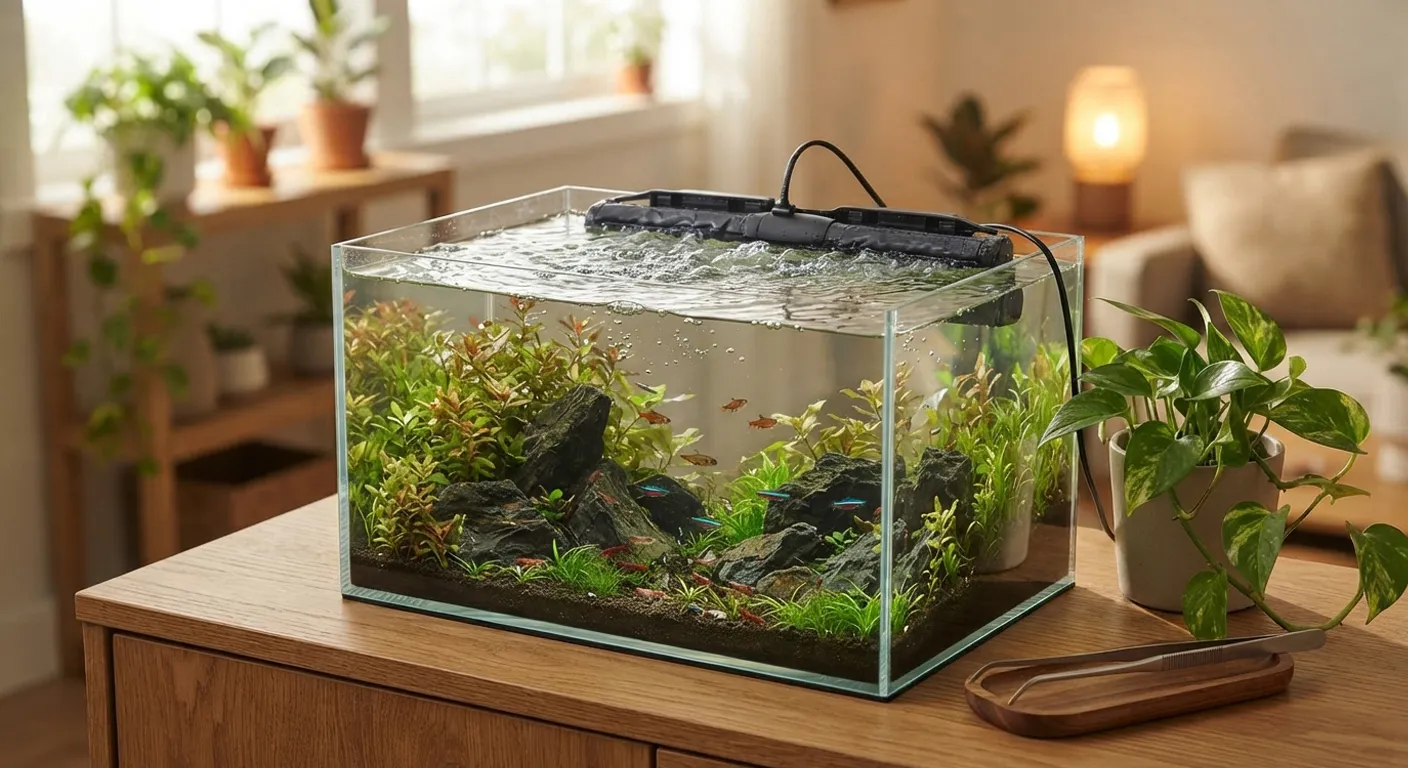
Short answer: no. A nano tank doesn’t automatically need a wave maker.
Your filter or return pump already moves a lot of water. The layout of the tank matters too. So do the animals and plants living in it? The real question is simple. Is there a problem your current water movement leaves behind?
I bought a small pump for my first nano tank on day one. I figured every tank needed one. Later I found out a rock was blocking my filter outlet. I moved the rock, and the pump went in a drawer.
In this guide, I’ll show you how to check the water movement in your tank. You’ll learn how to spot dead areas. We’ll look at what reef fish, corals, plants, and shrimp need. Then I’ll cover what to try before you spend money. If you still need a pump after that, I’ll tell you what to look for.
Start With What Already Moves the Water
What Is Creating the Current
Start with the gear you already have. Look at the filter outlet. Look at the return pump. Check for anything else that pushes water, like an air stone or a small powerhead.
Then watch where each one points. Drop in a tiny pinch of fine food and see where it goes. This takes two minutes and tells you a lot.
Where Does That Movement Reach
Strong flow at the outlet doesn’t mean strong flow everywhere. So look at the rest of the tank.
Plants and decorations: Do the leaves move at all or just the ones near the outlet?
Behind rocks or wood: This is where dead spots like to hide.
Near the substrate: Check the bottom corners. Debris settles there first.
The surface: A still surface can mean the water isn’t mixing well.
What Are You Trying to Fix
A wave maker should fix something you can name. “The tank looks too still” isn’t enough. The table below gives you starting points. It doesn’t prove you need a pump.
| What you notice | What to check first | Possible next step |
| Debris collects in one area | Decor blocking the flow. A dirty intake or outlet. | Move the decor or clean the filter. Then watch again. |
| The surface barely moves | Outlet position and water level. | Raise the outlet or angle it toward the surface. |
| Strong flow in one area and little in another | Outlet direction and what sits in its path. | Redirect the outlet or rearrange the hardscape. |
| Inhabitants need more circulation than the setup provides | Their needs against what you see after cleaning and adjusting. | Consider a small pump with adjustable output. |
| No clear circulation problem | Nothing needs fixing. | Leave the setup alone. |
Two tanks of the same size can need very different flow. Picture two 10-gallon tanks. One has bare sand and a strong filter. The other is packed with rock and tall stems. Same size but different needs.
Let the Inhabitants Guide the Decision
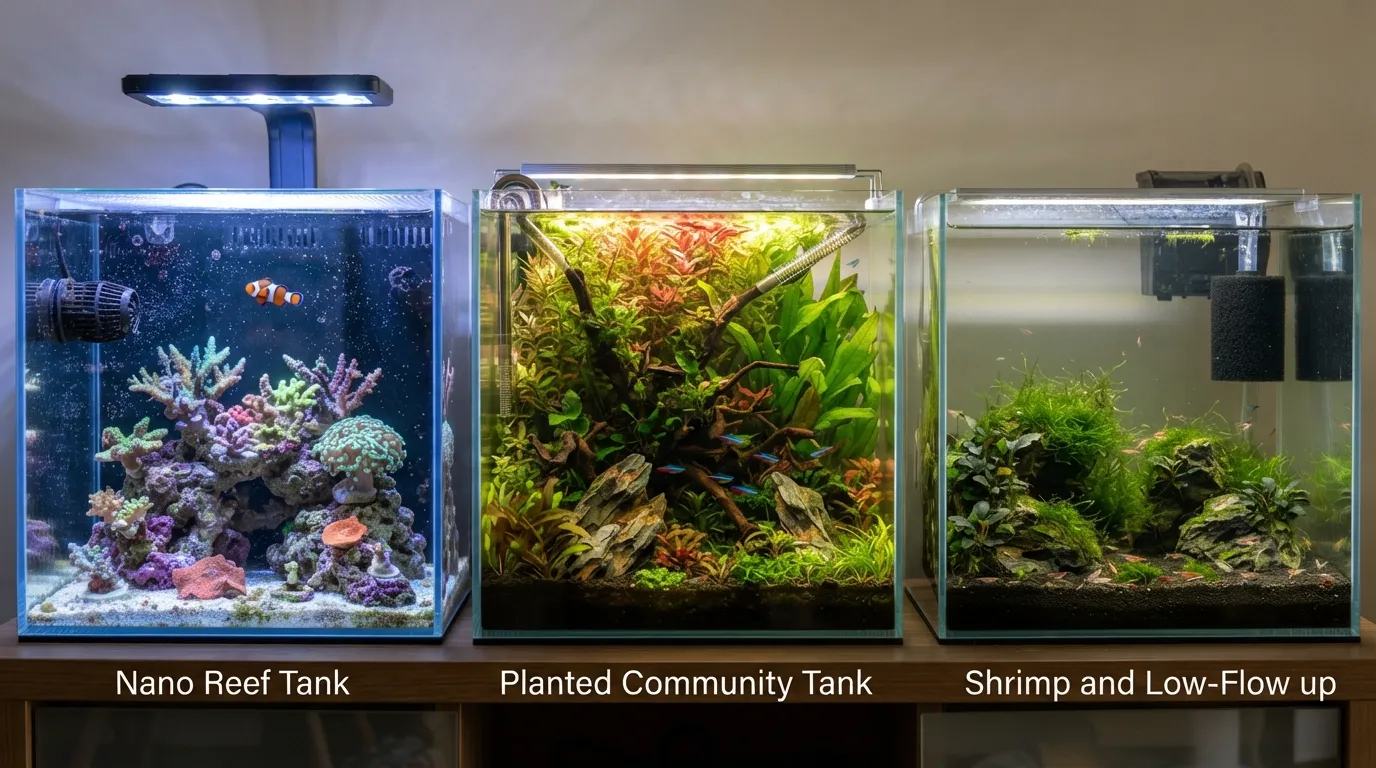
Nano Reef Tanks
Corals and fish don’t all want the same thing. Some corals like more movement. Others do fine with gentle flow. Look at the water around your rockwork because dead spots form behind it.
Don’t assume every nano reef is the same. Check what your specific corals and fish need. Then compare that to what you see in the tank.
Planted Community Tanks
Plants and hardscape can block flow. A thick patch of stems slows water down a lot. Filtration matters here too. A strong filter may already cover the tank.
Before you add a pump, check the outlet. A small change in angle can fix uneven flow. Don’t assume every planted tank needs another pump.
Shrimp and Low-Flow Setups
Think about the animals first. Many shrimp do best with gentle flow. Too much current wears them out. Keep some quiet areas in the tank where they can rest.
If you do run a pump, protect the intake with a sponge cover. Baby shrimp can get pulled in. Also make sure you can reach the pump easily. You’ll need to clean it.
Try These Changes Before Buying
Most of the time, this is where the problem gets solved. Here’s what I’d do:
Clean your equipment: A clogged filter or a gunked-up impeller can cut flow a lot.
Check the outlet direction: Aim it across the tank or toward the surface and see what changes.
Look for blockers: Decor and plants can stop the current cold.
Make one change at a time. Then watch for a day or two. Did the original problem get better? If it did, you just saved yourself some money. If not, you’ve learned the cause isn’t placement or upkeep.
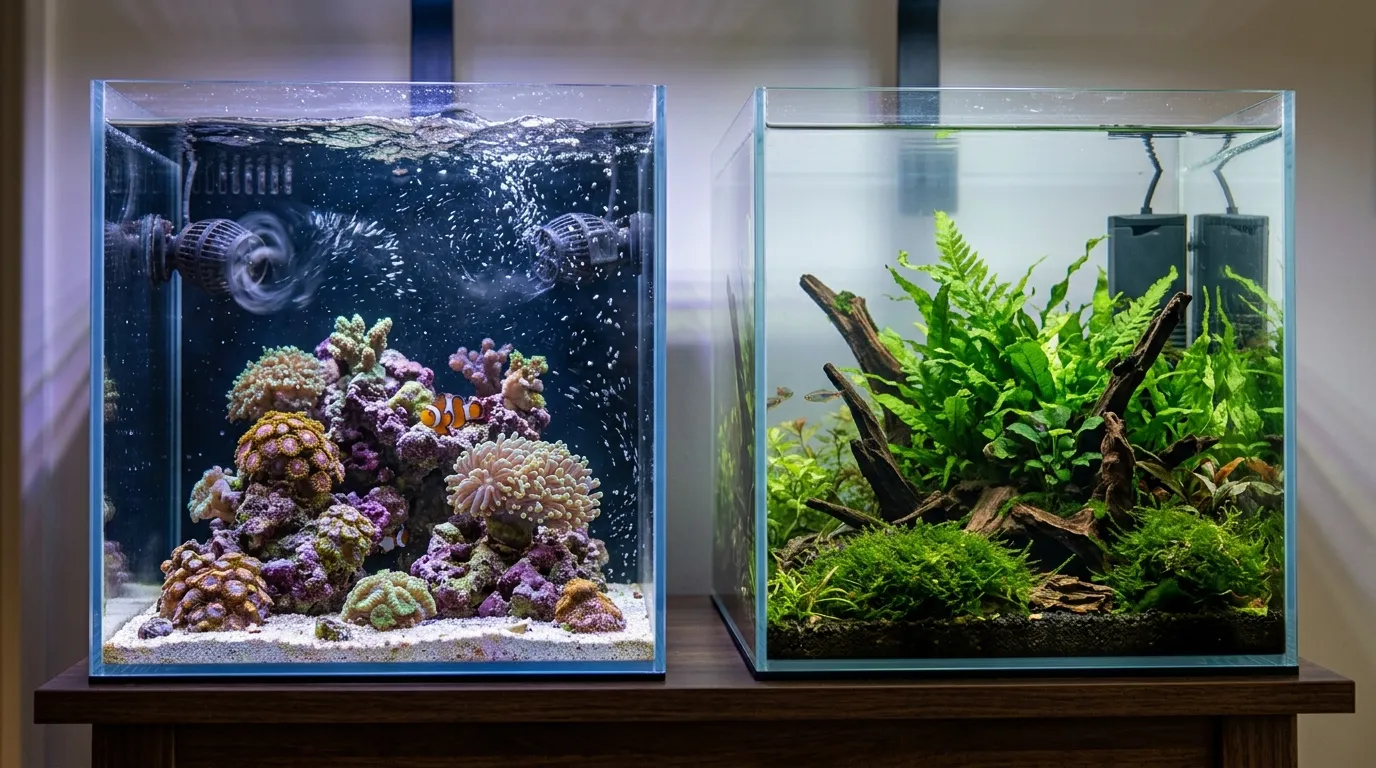
When a Wave Maker Is Worth Considering
Think about one only when a clear need is left. These three things should all be true:
The equipment you have can’t give the tank enough circulation.
Layout changes haven’t fixed the uneven movement.
The animals and plants in the tank actually need more flow.
The pump also has to fit. A nano tank has little room. If the pump takes up usable space, it may not be worth it.
What Would Make It a Poor Fit
Hold off if any of these sound like your tank:
You can’t name a clear problem.
There’s no safe spot for the pump.
Your inhabitants don’t handle current well.
The pump’s lowest setting may still be too strong.
If You Add One, Choose for Control, Then Check the Result
Prioritize Control Over Power
Don’t shop by maximum flow. A nano tank rarely needs it. Look at these instead:
Lowest output: Can you turn it down far enough for your tank?
Flow pattern: Is it a gentle spread or a narrow jet?
Size and mounting: Will it fit and stay put?
Cleaning access: Can you take it apart without draining the tank?
Intake protection: Does it come with a guard or can you add one?
Check Whether It Actually Helps
Once it’s running, go back to your original problem. Ask yourself a few things:
- Is circulation better where you wanted it, or did the debris just move somewhere else?
- Can your fish and shrimp still move around comfortably?
- Do they still have quiet areas?
If the answer to any of these is no, then reposition the pump or turn it down. Small changes make a big difference in a nano tank.
Conclusion
Not every nano tank needs a wave maker. Some already have enough circulation. Others just need better placement. A few really do benefit from an extra pump. It depends on the water movement in your tank and the layout. It also depends on how comfortable your animals are.
So start with what you have. Check the filter output. Look for places where debris collects. Think about whether plants or rock are blocking the flow. Adjust the current setup before you assume you need another pump.
Then decide. Keep the setup if it works. Improve it with simple changes if it doesn’t. Add a pump with good control only if a real need remains. The goal is better water movement without too much current. Keep some calm areas, too.
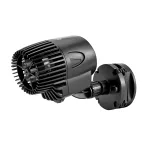
15W Wave Maker Pump (2100GPH) with 360 Degree...
Original price was: $18.69.$17.59Current price is: $17.59.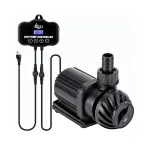
800-3200GPH Multifunction Controllable Water Pump for Salt/Freshwater
Original price was: $109.99.$104.49Current price is: $104.49.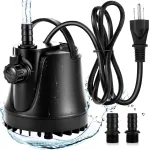
Ultra-quiet 265-800GPH Submersible Water Pump with High Lift,...
Original price was: $18.99.$16.14Current price is: $16.14.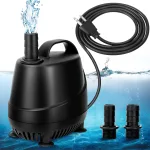
265-920GPH Aquarium Submersible Water Pump with 2 Nozzles...
Original price was: $18.99.$16.14Current price is: $16.14.


Add comment
You must be logged in to post a comment.