
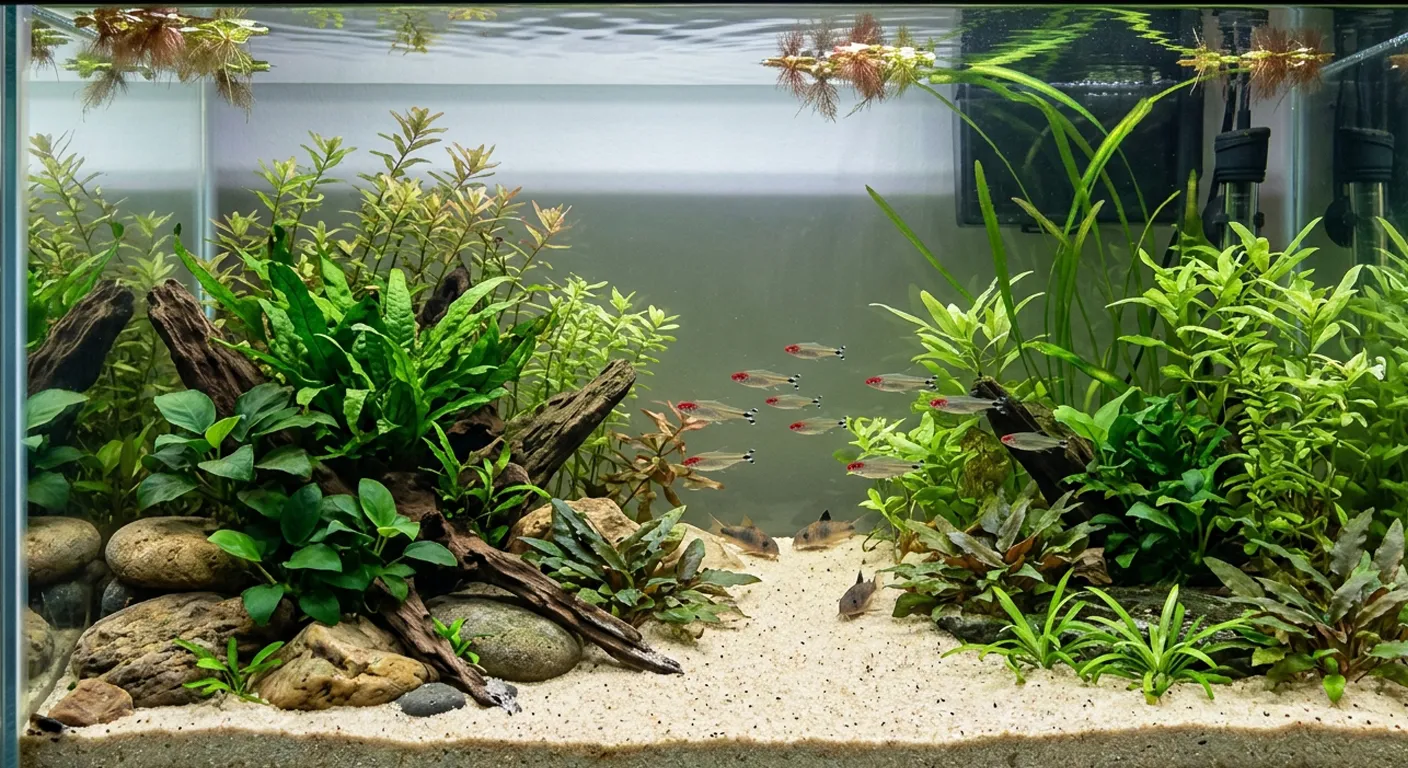
A planted aquarium does not need to be packed with greenery to look full and healthy. Too many plants shrink the swimming space, block water flow, and make feeding and cleaning harder. Fish also lose the open areas they need to move comfortably.
This guide shows how to plan planting around swimming zones and keep pathways open. It also covers choosing plants by mature size and keeping the balance as the tank grows.
Table of Content
ToggleWhat Overcrowded Means in a Planted Aquarium
Many plants are not automatically a problem. A heavily planted tank can work very well when plants, fish, filtration, lighting, and maintenance stay in balance. Trouble starts when growth outpaces your pruning, or when plants take over the space fish actually use.
Plant Density vs. Usable Fish Space
A tank can look lush from the front while the fish inside have no clear route through it. Visual fullness describes what you see. Usable space describes where fish can actually swim.
Different plants close space differently. Dense stems like Rotala or Ludwigia form walls that fish cannot pass through. Large rosette plants, such as Amazon sword, spread wide leaves across the floor. Hardscape takes up room as well, and floating plants shade the top layer. Open water is part of the layout, not wasted space.
Signs You Have Too Many Plants
Watch for these warning signs:
Fish have little open area to school or explore.
Plants block the filter outlet or reduce visible water movement.
Debris collects inside dense stems or under floating plants.
Lower leaves turn yellow or melt because they receive too little light.
Fast-growing plants need constant emergency trimming.
Surface plants cover so much water that feeding becomes difficult.
Fish hide all day because plant growth has closed their usual routes.
One or two signs need only a trim. Three or more mean the layout needs rethinking.
Start With Fish Needs, Not Plant Numbers
The advice of one plant per gallon sounds tidy but falls apart quickly. A single Amazon sword can outgrow a small tank, while ten stems of Rotala occupy very little room. Plant size and fish behavior vary too much for a universal count.
Consider Where Your Fish Spend Their Time
Most fish favor one of three zones, and each zone calls for different planting.
Surface zone: Hatchetfish live here, and bettas visit often to gulp air from above. Floating plants belong in this zone, but the fish still need clear access to the surface.
Midwater zone: Tetras, rasboras, danios, and many barbs swim here. This zone needs the most open space, so keep tall plants toward the edges.
Bottom zone: Corydoras and kuhli loaches forage across the substrate. They need bare patches of sand or smooth gravel to food search.
Match the Layout to Fish Behavior
Active schooling fish, such as danios and rummynose tetras, benefit from a broad, open central lane.
Bettas and other shy fish appreciate planted sides and sheltered resting spots. Broad floating leaves, like Amazon frogbit, give a better place to rest just under the surface.
Territorial fish, including many cichlids, need sight breaks, caves, and defined boundaries rather than an impenetrable plant wall.
Bottom dwellers need open substrate for foraging, not a fully carpeted floor or dense roots everywhere.
Suggested visual: a tank diagram with three zones, planted sides, and one open swimming route.
Plan the Layout Before Buying Plants
Overcrowding often begins in the shop. Keepers pick attractive plants one at a time, ignoring final size and overall fit. A rough sketch prevents most of that.
Map Out the Functional Areas
Sketch the tank from above and mark these points before you buy anything:
The filter intake and outlet positions.
Access to heaters, thermometers, and other equipment.
One open feeding area, ideally close to the filter outlet.
The main fish swimming lane.
Spots where tall plants can hide equipment without blocking circulation.
A clear route for gravel vacuuming and algae cleaning.
Use the Edges and Pathways Layout
The rule is simple. Plant the perimeter and keep the center open.
Plant the back: Place tall stems and Vallisneria along the rear glass to hide equipment and add height.
Plant the sides: Use the side edges and corners for medium plants and cover.
Keep a pathway: Leave a continuous lane through the middle. About a third of tank width is a reasonable starting point.
Leave a surface opening: Keep a clear patch of surface for feeding and gas exchange.
Choose Plants by How They Occupy Space
Growth habits tell you more than a plant count.
Background Plants: Build Height Without Blocking Flow
Ludwigia, Hygrophila, Rotala, and Vallisneria create height quickly. They also form dense walls, so they belong at the rear or in the corners.
Thin them by removing whole stems at the base, not just the tops.
Plant stems in loose groups about an inch (2.5 cm) apart, so light reaches lower leaves.
Keep them away from the filter outlet, where thick growth can redirect the current.
Midground Plants: Add Cover Without Closing the Center
Medium plants work best as grouped accents around hardscape, along the sides, and between foreground and background. Cryptocoryne wendtii, Java fern, and Anubias are common choices, and all stay fairly compact.
Avoid large clumps in the main swimming lane. Grouping one species in a single spot also looks cleaner than scattering single plants across the tank. A patch of five crypts reads as a design, while five different plants placed alone read as clutter.
Foreground Plants: Keep the Front Functional
Low plants soften the front edge without covering every inch of substrate. Dwarf sagittaria, Cryptocoryne parva, and dwarf hairgrass suit this job. Leave some bare substrate for feeding, cleaning, and bottom dwellers.
Carpeting plants deserve extra caution. Under strong light, Monte Carlo and dwarf sagittaria spread much farther than most people expect. They creep into areas you meant to keep open.
Floating Plants: Use Shade Carefully
Amazon frogbit, red root floater, and salvinia calm shy fish and absorb nutrients. In a bright, nutrient-rich tank, they can double in coverage within one to two weeks.
Use a floating ring to hold plants back and protect a feeding zone.
Thin them whenever they block light for plants below or cover the filter flow.
Keep part of the surface free, so fish can breathe air and gases can exchange.
A Practical Planting Guide by Coverage Level
Coverage is a flexible starting point, not an exact formula. The right amount depends on tank footprint, fish species, plant type, and how often you maintain the tank. Percentages below refer to floor coverage.
| Planting level | What it looks like | Best for | Main risk |
| Lightly planted | A few anchor plants, mostly bare floor, about 10 to 25 percent covered | Beginners and bottom dwellers | Algae, since few plants compete for nutrients |
| Moderately planted | Planted back and sides, open central lane, about 30 to 50 percent covered | Mixed community tanks, schooling fish, bettas | Slow creep in density if pruning is skipped |
| Heavily planted | Dense stems and carpet, over 60 percent covered | Experienced keepers and small species | Blocked flow, trapped debris, heavy upkeep |
A moderately planted design is often the easiest starting point for a mixed community tank. It gives fish cover, lets plants absorb nutrients, and leaves room to correct mistakes.
Start with fewer plants than you think you need, and favor a few large or fast-growing types. Plants grow. Empty-looking areas fill in within weeks, especially with stems like Hygrophila or Rotala. Pulling out extra plants later is far harder than waiting for gaps to close.
How to Plant Without Creating Future Problems
Good spacing and correct technique prevent most overcrowding issues later.
Leave Space for Mature Growth
Check the expected height and spread of each plant before placing it. Store-bought plants are often young, small, or sold as cuttings. An Amazon sword bought at 6 inches (15 cm) can reach around 20 inches (50 cm) over time.
Leave gaps between stem groups, rosette plants, and hardscape. Those gaps look sparse at first and disappear within a couple of months.
Avoid Blocking the Filter Current
Dense plants growing in front of the outlet or around the intake interfere with circulation. Poor flow leads to debris buildup and uneven nutrient distribution, which invites algae in stagnant corners.
After planting, watch the leaves move. Gentle swaying throughout the tank is a good sign. If leaves at the back stay still, move a plant group or thin the plants near the outlet.
Plant Each Type Correctly
Rooted plants: Plant roots in the substrate, but avoid burying the crown, which can rot.
Rhizome plants: Attach Anubias and Java fern to rock or wood with thread or gel superglue. A buried rhizome will decay.
Stem plants: Plant in small groups with enough spacing for light to reach the lower leaves.
Floating plants: Thin regularly and keep an open surface area.
Carpeting plants: Plant in small sections and allow them to spread gradually.
How to Tell When It Is Time to Prune or Remove Plants
Pruning is normal maintenance in a planted tank. It does not mean the setup failed.
Routine Pruning
Prune when plants block light or airflow. Fast stems like Rotala may need a trim every one to two weeks. Anubias needs attention only a few times per year. Removing about one third of a plant at a time is a common limit. Take all trimmings out of the water, because decaying leaves foul the tank.
Thinning vs. Trimming
Trimming shortens plants by cutting the tops, which encourages side shoots and often makes growth denser. Thinning removes whole stems, runners, or old leaves at the base, which opens space and light. Trimming alone can turn a thicket into a thicker thicket. If the tank feels crowded, thinning usually solves the problem better.
Common Planting Mistakes
Buying plants for looks without checking their mature size.
Filling the tank at maximum density on day one.
Planting in front of the filter outlet or around the intake.
Burying rhizomes or covering crowns.
Carpeting the whole floor when bottom-dwelling fish live in the tank.
Adding floating plants freely, then ignoring them for weeks.
Conclusion
Overcrowding is rarely about owning too many plants. It usually comes from planting without a plan for fish movement, water flow, and mature size. Map the tank first, plant the edges, and keep a clear lane through the center.
Begin with a moderate layout, then adjust as growth shows where space runs tight. Do not fill every gap on day one. Thin on a schedule and watch how leaves move in the current.
Related Products For Your Reference
AQQA Adjustable Aquarium Air Pump, 4-Outlet Oxygen Aerator...
AQQA Planted Fish Tank Light With IP68 Waterproof...
AQQA 14W 24/7 Mode LED Fish Tank Light...
AQQA 200ML Auto Fish Feeder, Quiet Smart Timer...


Add comment
You must be logged in to post a comment.