
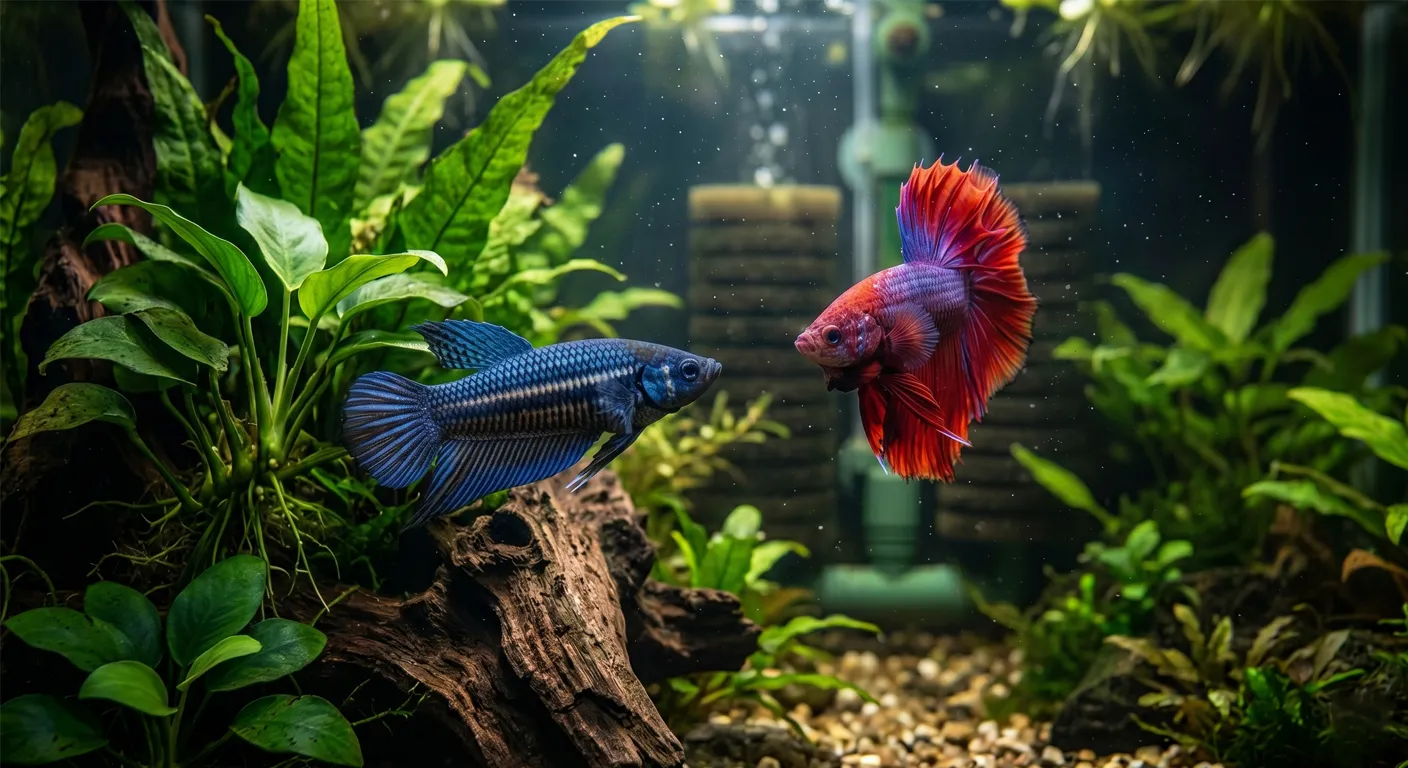
I thought keeping a male and female betta together would be fine as long as the tank was big enough. For the first few days it actually seemed okay. The male would flare occasionally but nothing serious. Then one morning I came downstairs and the female was hiding behind the filter with chunks missing from her fins. The male was patrolling the whole tank like it belonged to him. I felt terrible because I had no idea it could escalate that fast.
Here’s the straight answer. Male and female bettas are not safe long-term tank mates. Opposite-sex aggression can be just as bad as male-to-male fighting. It leads to torn fins and chronic stress and in some cases death. The only situation where keeping them together makes sense is controlled breeding and even then you need to know exactly what you’re doing.
In this guide we’ll go through the behavioral science behind betta aggression. Warning signs to watch for before things escalate. And practical strategies to prevent fights and handle the aftermath if one happens.
Why Male and Female Bettas Fight
Male-female fighting usually comes from territory, stress, or breeding-related confusion. It doesn’t always look the same but the triggers are consistent.
Territory defense: Bettas are hardwired to defend space. A male will treat the entire tank as his territory and any other fish moving through it as a threat. A female is no exception to that. She gets the same response as a rival male would.
Stress response: A stressed betta becomes unpredictable. Overcrowding and poor water quality and sudden changes in the environment all push a fish toward aggression faster than it would otherwise get there.
Reproductive tension: When a male is ready to breed and the female isn’t the situation gets dangerous fast. He’ll chase and nip trying to push her toward spawning. She’ll resist. That back and forth can cause serious injury in a short amount of time.
Mismatch in temperament: Not all bettas have the same aggression level. Some males are relatively calm. Others are relentless. Putting an aggressive male with a timid female almost always ends badly regardless of tank size or setup.
Lack of hiding places: When a fish can’t get away from another fish the aggression has nowhere to go. Without breaks in line of sight and places to retreat a smaller or more submissive fish takes constant damage with no relief.
The Science Behind Betta Aggression
Let’s first understand the Betta aggression according to science.
The Evolution of Fighting Behavior
Betta splendens were originally found in shallow rice paddies and slow moving streams in Southeast Asia. Those environments had limited resources and limited space. Fighting wasn’t just instinct. It was a survival strategy. The fish that defended territory successfully got access to food and mates. That behavior got selected for over thousands of generations and it’s still fully intact in the fish sitting in your tank today. Domestication softened a lot of things in a lot of species. In bettas it didn’t change much at all.
Gender-Specific Aggression Patterns
Males are more consistently aggressive but females are not passive. Male aggression tends to be immediate and visible. Flaring, chasing, attacking. Female aggression is often more calculated. She may ignore a tank mate for days and then attack suddenly when conditions shift. Hormonal cycles play a role in this. A female carrying eggs behaves differently than one that isn’t. A male detecting those hormonal signals can shift from calm to aggressive within hours. Both fish are capable of serious harm. The difference is mostly in timing and trigger.
The Difference Between Flaring, Chasing, and Fighting
Not every aggressive display is a true fight but early warning signs often look similar. Knowing what you’re actually seeing buys you time to act before something gets hurt.
| Behavior | What It Usually Means | How Serious It Is |
| Flaring | Asserting dominance or responding to a perceived threat | Low on its own. Normal betta behavior but watch for escalation |
| Chasing | One fish actively pursuing another through the tank | Moderate. Needs monitoring. Separation may be needed if it doesn’t stop |
| Nipping | Biting at fins or body | High. Physical contact has started. Injury is likely if it continues |
| Cornering | Trapping the other fish with no escape route | Very high. This usually leads directly to a serious attack |
| Torn Fins or Visible Injury | A fight has already happened | Immediate separation required. Begin treatment |
Warning Signs a Male and Female Betta Are About to Fight
The sooner you recognize the warning signs the easier it is to prevent injury.
One fish constantly following the other without rest even across the whole length of the tank
The female hiding behind equipment or in corners and refusing to come out to eat
Rapid gill movement in either fish while they’re stationary. That’s a stress response
The male building a bubble nest aggressively and then immediately becoming hostile when the female approaches
Either fish clamping their fins tight against their body. Relaxed fins are a good sign. Clamped fins are not
Color draining from the female or stress bars appearing along her body. Those horizontal stripes are a clear distress signal
Sudden freezing behavior where one fish goes completely still while being approached
The Female Aggression Factor
Female betta aggression gets ignored in most guides and that’s a problem because she’s not always the victim. Sometimes she’s the one starting it.
When Females Attack Males:
Egg-eating aggression. A female carrying eggs can become intensely aggressive. She may attack the male to prevent him from getting near her eggs or simply because her hormones are running high and he’s the closest target.
Rejection aggression. When a female doesn’t want to breed she makes that clear physically. She’ll nip and chase the male away. In a small tank with nowhere to go that can turn into a sustained attack.
Territorial females. Some females are just naturally territorial. They claim a section of the tank and attack anything that enters it. Males included.
Size advantage. If the female is significantly larger than the male the dynamic flips. She can do real damage to a smaller male and he may not be able to defend himself effectively.
Post-injury vulnerability. If the male has existing fin damage or is already stressed the female may sense that weakness and become the aggressor even if she was submissive before.
Female Stress Responses That Trigger Male Aggression:
Erratic swimming patterns that the male reads as a challenge or threat display
Color changes in the female that signal distress but look like dominance signals to the male
Defensive nipping during unwanted courtship that escalates into a back and forth exchange
Failure to show submissive breeding postures which keeps the male in a state of agitation
When the Risk of Fighting Is Highest
Some situations make conflict much more likely even if the fish seemed fine at first.
The first 48 hours after introduction. This is when most serious fights happen
Feeding time when both fish are active and competing for the same space
When the male starts building a bubble nest. He becomes highly territorial during this phase
When the female is visibly gravid and carrying eggs. Hormonal tension runs high on both sides
After a water change. The shift in parameters and disturbance to the tank can reset territorial behavior
In tanks under 20 gallons where there simply isn’t enough space to create real separation
When either fish is already stressed from illness or poor water quality
When there are no plants or decorations breaking up line of sight across the tank
Tank Setup Strategies to Prevent Male-Female Fights
The right tank design doesn’t eliminate betta aggression but it gives you real control over it. Here’s how to build a setup that reduces risk.
Physical Barriers:
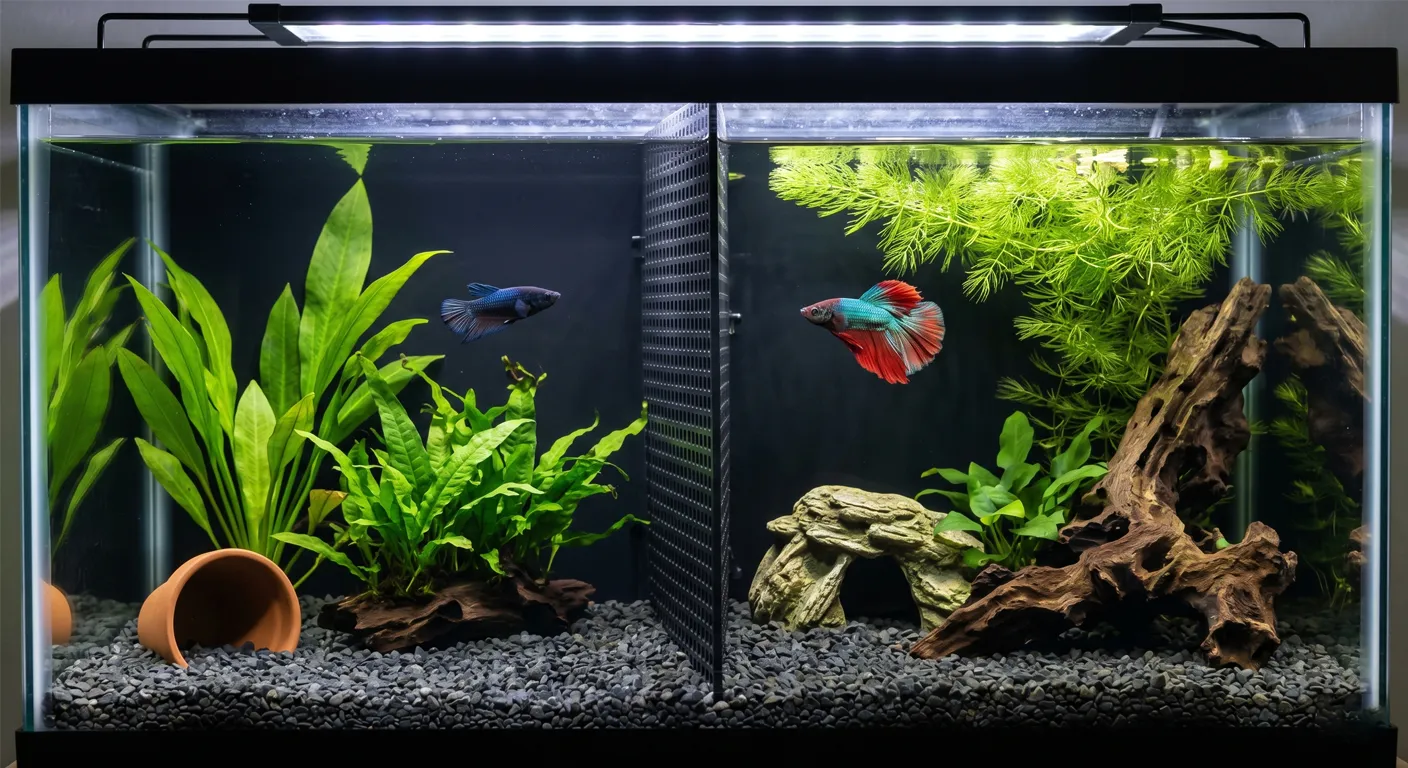
Tank dividers. A solid divider down the middle of the tank keeps both fish completely separated while sharing the same water column. This is the safest option outside of separate tanks entirely.
Breeding boxes. A mesh or clear breeding box lets you introduce the female in a controlled way during breeding attempts. She stays protected while the male gets used to her presence before any direct contact happens.
Minimum divider requirements. The divider needs to go from the bottom of the tank to above the waterline. Bettas jump. A divider that stops at the water surface is not enough.
DIY divider materials. Plastic canvas mesh from craft stores works well. It allows water flow while blocking direct access. Cut it to fit the tank and use suction cups to hold it in place.
Strategic plant placement. Dense planting breaks up line of sight across the tank. Java fern and amazon sword and hornwort all work well. The goal is to create visual breaks so neither fish has a clear view of the entire tank at once.
Decoration positioning. Place taller decorations along the middle section of the tank. This creates a natural visual barrier without needing a physical divider.
Multiple hiding spots. Both fish need their own retreats. Caves and dense plant clusters and driftwood all work. Each fish should be able to disappear from view when they need to.
Substrate considerations. Dark substrate tends to reduce stress in bettas. It mimics their natural environment and slightly lowers their visual aggression response.
Tank background. Covering three sides of the tank with a dark background reduces external reflections. A betta seeing its own reflection will flare and stress just like it would at a real rival.
Critical Tank Size Requirements
| Scenario | Minimum Tank Size | Recommended Size | Reason |
| Single male OR female | 5 gallons | 10 gallons | Enough space for territory and enrichment |
| Divided tank (male + female) | 20 gallons | 30 gallons | Each side needs adequate individual space |
| Breeding tank | 10 gallons | 20 gallons | Needs space for bubble nest and female retreat |
| Female sorority (4-6 fish) | 20 gallons | 30+ gallons | Aggression spreads out with more fish and space |
| Male + female (breeding only) | 10 gallons | 20 gallons | Temporary setup with close supervision required |
Water Parameters That Reduce Stress-Induced Aggression
Poor water quality raises stress levels and stressed bettas fight more. Keeping parameters dialed in is part of aggression management.
Temperature stability. Keep it between 76 and 82 degrees Fahrenheit. Fluctuations trigger stress faster than most people realize. A reliable heater with a thermostat is not optional.
pH levels. Aim for 6.5 to 7.5. Bettas come from slightly acidic water. Keeping pH stable within that range reduces background stress significantly.
Ammonia and nitrite. Both should always be at zero. Any detectable ammonia or nitrite in a betta tank is a problem that needs to be fixed immediately.
Keep it under 20 ppm. Regular water changes are the main way to manage this. High nitrate builds up slowly and stresses fish in ways that aren’t always obvious until behavior changes.
Water changes. 25 to 30 percent weekly. Consistent water changes keep parameters stable and remove waste before it builds up.
Use a low flow filter. Bettas don’t do well in strong current. High flow stresses them out and a stressed betta is a more aggressive betta.
After the Fight: Injury Assessment and Recovery Protocol
If a fight happens the next steps matter a lot. Here’s how to assess the damage and give the injured fish the best chance of recovery.
Immediate Injury Assessment Checklist
Fins: Look for tears, missing sections or ragged edges. Minor fin damage heals well. Large tears or completely shredded fins need treatment to prevent infection.
Scales: Check for missing scales or raised areas on the body. Raised scales can indicate dropsy which is a serious secondary condition.
Eyes: Look for cloudiness, swelling or bulging. Popeye can develop after injury and needs immediate treatment if caught early.
Gills: Rapid gill movement while the fish is resting indicates stress or possible gill damage. Watch for asymmetrical breathing.
Body: Look for open wounds, red streaking or lesions. Red streaking along the body often means infection has already started.
Behavior: A fish that won’t eat, stays at the bottom or hides constantly after a fight is under serious stress. That behavior needs to resolve within a few days or something else is wrong.
Treatment Steps (First 24 Hours)
Immediate separation: Get the injured fish into a separate tank or hospital tank right away. Do not leave them together hoping it will settle down.
Water parameters: Check everything immediately. Clean stable water is the foundation of recovery. Do a partial water change if anything is off.
Add aquarium salt: One tablespoon per five gallons helps prevent infection and supports the healing of fin tissue. Use non-iodized aquarium salt only.
Indian almond leaves: Add one or two leaves to the recovery tank. They release tannins that have mild antibacterial properties and help reduce stress naturally.
Dim lighting: Bright light stresses an already injured fish. Cover part of the tank or switch to a low light setting for the first few days of recovery.
Remove sharp decorations: A fish with torn fins can catch on rough edges and make the damage worse. Keep the recovery tank simple and smooth.
Conclusion
Male and female bettas can coexist briefly under controlled conditions but they are not long-term tank mates. This guide covered why they fight and what the science behind that aggression actually looks like. How to tell the difference between a display and a real attack. How to read warning signs before injury happens. And what to do in the hours after a fight when fast action makes a real difference.
Prevention is the main job here. Keep them separated outside of supervised breeding attempts. Watch for early warning signs like chasing and nipping and stress bars. Build the tank in a way that limits direct contact and line of sight. And if a fight does happen separate the fish immediately and start treatment the same day.
The more time you spend observing your fish the better you get at reading them. Small behavioral shifts that seem minor are often the first sign something is about to go wrong. Get into betta keeping communities and learn from people who have been through the same situations. Apply what works and keep refining your setup. A low stress environment with proper separation is the only reliable way to keep both fish safe long term.











Add comment
You must be logged in to post a comment.