

A moon jellyfish was brought home in a standard 10-gallon glass tank, placed carefully near the filter intake. By morning, it is gone. Not escaped. Pulled directly into the power filter, tissue torn apart by suction designed for fish. That is not a rare horror story. It happens regularly to first-time jellyfish keepers who did not know what standard aquarium gear actually does to an animal with no skeleton, no rigid body, and no ability to swim away from danger. Jellyfish are not fish. The equipment built for fish can kill them within hours.
In this guide, we will list 7 mistakes that beginners need to avoid to help them to build a healthy jellyfish tank.
What a Home Jellyfish Tank Actually Is
A proper jellyfish tank is called a Kreisel, which translates loosely to “carousel” in German. The design is cylindrical or rounded, with no sharp corners, hidden filtration behind baffles or fine mesh screens, and a gentle circular water flow that keeps jellyfish suspended in the middle of the water column rather than pushed against walls or sucked toward intakes. That circular flow mimics open ocean currents and keeps the bell pulsing naturally without physical trauma.
Why Standard Tanks Fail for Jellyfish
Standard rectangular aquariums have two problems that are immediately dangerous for jellyfish. First, the 90-degree corners. Water flow in a rectangular tank creates dead zones at every corner where the current cannot reach. A jellyfish drifting with the flow eventually ends up pinned in one of those corners, unable to move away, slowly stressed or physically damaged by the pressure.
Second, the filtration intakes. Standard hang-on-back and canister filters pull water through an intake tube with enough suction to grab a jellyfish bell and hold it there. The tissue tears. There is no recovering from that. The entire filtration and flow design of a standard fish tank is built around animals that can actively swim away from danger. Jellyfish cannot.
Confirming Tank Readiness Before Adding Jellyfish
Many jellyfish deaths get blamed on disease or poor stock when the actual cause is an unready tank. Water quality problems are responsible for a significant percentage of early losses, and misidentifying the cause leads to treatments that do nothing because the real issue was never addressed.
Before any jellyfish enters the water, three parameters need to be stable and within range:
Salinity: Maintain specific gravity between 1.022 and 1.025. Moon jellyfish (Aurelia aurita) are particularly sensitive to salinity swings. Even a 0.002 shift over 24 hours can cause bell curling and tissue stress. Use a refractometer, not a swing-arm hydrometer.
Water Temperature: The target range for moon jellyfish is 15°C to 19°C (59°F to 66°F). Temperatures above 22°C accelerate tissue degradation and suppress the pulsing rhythm. A dedicated aquarium chiller is not optional in warmer climates or heated homes.
Water Flow: The flow rate should be gentle enough that a jellyfish can hold its position mid-column without being pressed against the screen. Aim for a turnover rate of 3 to 4 times tank volume per hour in a Kreisel setup.
Rule out these situations before proceeding:
Ammonia above 0 ppm
Nitrite above 0 ppm
Nitrate above 20 ppm
pH outside the 7.9 to 8.3 range
Salinity outside the 1.022 to 1.025 range
Adjust when any parameter sits outside the range. Wait at least 24 hours after correction and retest before introducing jellyfish. Observe for 48 hours after correction to confirm stability, not just a single favorable reading.
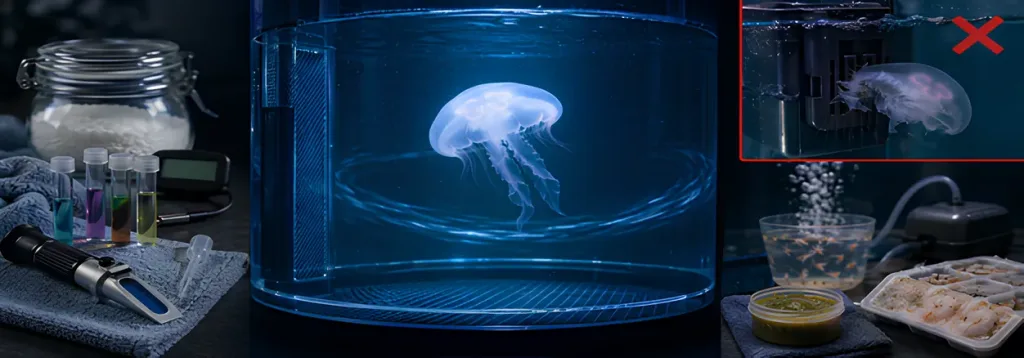
7 Mistakes May Kill Home Jellyfish Tanks
Now that the proper setup requirements are clear, here are the seven most common mistakes that catch new jellyfish keepers off guard.
Mistake 1: Using the Wrong Tank Shape
Rectangular tanks create corner dead zones where jellyfish get trapped and cannot escape. The linear flow in a standard aquarium pushes water straight across rather than in the circular current that jellyfish need to stay suspended.
Jellyfish-specific fixes:
Buy a dedicated Kreisel or pseudo-Kreisel acrylic tank from a reputable supplier. Cylinder sizes starting at 10 gallons are widely available online in the US.
Ensure all water intakes are shielded by fine mesh rated at 300 to 500 microns. Standard filter sponges are too coarse and too easily bypassed.
Avoid any tank with exposed powerhead intakes or hang-on-back filters without full mesh coverage.
Mistake 2: No Power Outage Emergency Plan
Flow stops during a power outage, and jellyfish sink to the bottom within minutes. At the bottom of a tank with no circular current, bell tissue contacts the substrate and begins degrading almost immediately. A 30-minute outage in a warm room is enough to cause irreversible bell damage.
Jellyfish-specific fixes:
Invest in a battery-powered air pump with a sponge output that can maintain minimal circulation during outages.
Keep a small, clean holding container with pre-mixed saltwater available specifically for emergency transfers.
In areas with frequent outages, a UPS (uninterruptible power supply) rated for the pump wattage provides 2 to 4 hours of backup operation.
Mistake 3: Adding the Wrong Cleanup Crew
Hermit crabs, snails, and many common reef cleanup organisms will physically attack jellyfish bells, particularly when the jellyfish is resting or weakened. A snail that climbs onto a bell and begins rasping causes tissue damage that does not heal. Peppermint shrimp and emerald crabs are equally dangerous.
Jellyfish-specific fixes:
Keep jellyfish tanks species-only. No cleanup crew.
Manual removal of detritus with a turkey baster is the appropriate method for waste management in a Kreisel.
If algae growth is a concern, address it through lighting schedule reduction rather than adding grazing animals.
Mistake 4: Relying Only on Store-Bought Live Food
Many jellyfish retailers sell live Artemia (brine shrimp) nauplii as the primary food source. Live food is excellent but not sufficient on its own. Store-bought brine shrimp nauplii are often newly hatched and nutritionally incomplete unless gut-loaded. A jellyfish fed exclusively on unfortified nauplii will gradually starve despite appearing to feed actively.
Jellyfish-specific fixes:
Gut-load nauplii for 12 to 24 hours with a phytoplankton concentrate before feeding to jellyfish.
Supplement twice weekly with commercially produced jellyfish food paste (Reef Nutrition’s Coral Frenzy or similar products formulated for cnidarians).
Feed small amounts twice daily rather than one large feeding. Overfeeding fouls water chemistry faster than almost any other single factor.
Mistake 5: No Vacation Feeding Plan
Three days without feeding stresses moon jellyfish noticeably. Five days cause visible bell shrinkage as the animal metabolizes its own tissue for energy. Two weeks without food is often fatal.
Jellyfish-specific fixes:
Arrange for someone familiar with the tank to feed every 48 hours at a minimum during absences.
Pre-portion frozen mysid shrimp into labeled daily feeding bags that require only thawing and rinsing before use. This reduces the skill level required for a substitute feeder.
Automatic jellyfish feeders exist, but are not reliable for live food delivery. A trained person is always the better option.
Mistake 6: Creating Lethal Microbubbles
Microbubbles, tiny air bubbles introduced through faulty plumbing or aggressive surface agitation, are far more dangerous for jellyfish than for fish. Bubbles enter the gastrovascular cavity of the bell, accumulate, and cause the jellyfish to float inverted at the surface. An inverted jellyfish cannot feed, cannot pulse properly, and deteriorates rapidly.
Jellyfish-specific fixes:
Check all plumbing connections for air leaks. A small air draw at a union fitting or bulkhead produces continuous microbubbles.
Keep surface agitation minimal. Skimmers should be external to the main tank or absent entirely in jellyfish-only setups.
If bubbles appear, trace the source immediately rather than waiting to see if the problem resolves.
Mistake 7: Skipping the Saltwater Nitrogen Cycle
A new saltwater tank that has not completed the nitrogen cycle has no established bacterial colony to process ammonia. Jellyfish produce ammonia as a metabolic waste product. Without nitrifying bacteria converting ammonia to nitrite and then nitrite to nitrate, ammonia accumulates to lethal levels within days.
Jellyfish-specific fixes:
Cycle the tank for a minimum of 4 to 6 weeks using an ammonia source before adding any jellyfish. Bottled bacterial cultures (Fritz Turbo Start 900 or similar) accelerate this process.
Do not add jellyfish until ammonia and nitrite both read 0 ppm on a liquid test kit for at least five consecutive days.
Test water parameters twice weekly for the first month after adding jellyfish, not monthly.
Mistake Comparison Table
| Mistake | Primary Risk | Quick Fix | Estimated Cost (USD) | Effort (1 to 5) |
| Wrong Tank Shape | Tissue damage, death | Replace with Kreisel tank | $150 to $400 | 3 |
| No Power Outage Plan | Bell degradation | Battery pump, holding container | $20 to $60 | 2 |
| Wrong Cleanup Crew | Physical attack on the bell | Remove immediately | $0 | 1 |
| Relying on Store Food | Gradual starvation | Gut-load and supplement | $15 to $30/month | 2 |
| No Vacation Feeding Plan | Bell shrinkage, death | Train a substitute feeder | $0 to $20 | 2 |
| Lethal Microbubbles | Inversion, starvation | Inspect and seal plumbing | $0 to $30 | 3 |
| Skipping the Nitrogen Cycle | Ammonia poisoning | Restart the cycle before adding fish | $20 to $50 | 4 |
Risk Assessment: Watch or Treat
Not every unusual behavior signals a crisis, but knowing which signs require immediate action does save lives.
Watch list (monitor for 24 hours before intervening):
Occasional resting at the bottom during low flow periods
Slightly reduced pulsing rate during the first 48 hours after introduction to a new tank
Minor color changes in the bell that resolve within a day
Treat triggers (act within the hour):
Bell inverted and floating at the surface for more than 20 minutes
Visible tears or holes in bell tissue
Ammonia reading above 0.25 ppm
Jellyfish are pinned against the intake mesh and are unable to pull free
Escalation path: Start with water parameter testing before any other intervention. Correct water quality first. If parameters are stable and the jellyfish is still visibly distressed, transfer to a pre-prepared quarantine container with clean, temperature-matched saltwater and reassess from there.
Conclusion
Jellyfish are anatomically unlike anything else commonly kept in home aquariums. No skeleton, no protective scales, no ability to swim away from danger. Standard fish tank equipment, from sharp-cornered rectangular tanks to powerful filter intakes, was simply not designed with that reality in mind. The seven mistakes covered here are all preventable with the right setup and consistent monitoring.
A properly cycled Kreisel tank, stable salinity and temperature, appropriate nutrition, and a clear emergency plan cover the vast majority of what jellyfish need. Observe daily, test parameters twice weekly, and learn saltwater chemistry as the hobby grows.
FAQ
1. How big do moon jellyfish get in a home tank?
Moon jellyfish (Aurelia aurita) typically reach 5 to 10 cm (2 to 4 inches) in bell diameter under home tank conditions. Growth rate depends heavily on feeding frequency and water temperature. Cooler water at the lower end of the acceptable range tends to produce slower growth and longer lifespans.
2. Can I use standard tap water and aquarium salt for a jellyfish tank?
Standard aquarium salt formulated for freshwater fish is not appropriate for jellyfish. It lacks the magnesium, calcium, and trace elements that marine invertebrates require. Use a synthetic reef salt mix such as Instant Ocean Reef Crystals or Red Sea Coral Pro, mixed with dechlorinated or reverse osmosis water to a specific gravity of 1.023 to 1.025.
3. What should I do if my jellyfish gets a hole in its bell?
Small holes in bell tissue can sometimes heal in stable, clean water conditions, but recovery is not guaranteed. Move the affected jellyfish to a clean quarantine container with pristine water parameters immediately.
You need to remove any potential sources of physical damage, including other tank inhabitants and any exposed hardware. Do not add medications. Jellyfish are invertebrates and extremely sensitive to copper-based and most common aquarium treatments. Clean water and reduced stress give the best chance of recovery.
15W Wave Maker Pump (2100GPH) with 360 Degree...
Original price was: $18.69.$17.59Current price is: $17.59.
800-3200GPH Multifunction Controllable Water Pump for Salt/Freshwater
Original price was: $109.99.$104.49Current price is: $104.49.
Ultra-quiet 265-800GPH Submersible Water Pump with High Lift,...
Original price was: $18.99.$16.14Current price is: $16.14.


Add comment
You must be logged in to post a comment.